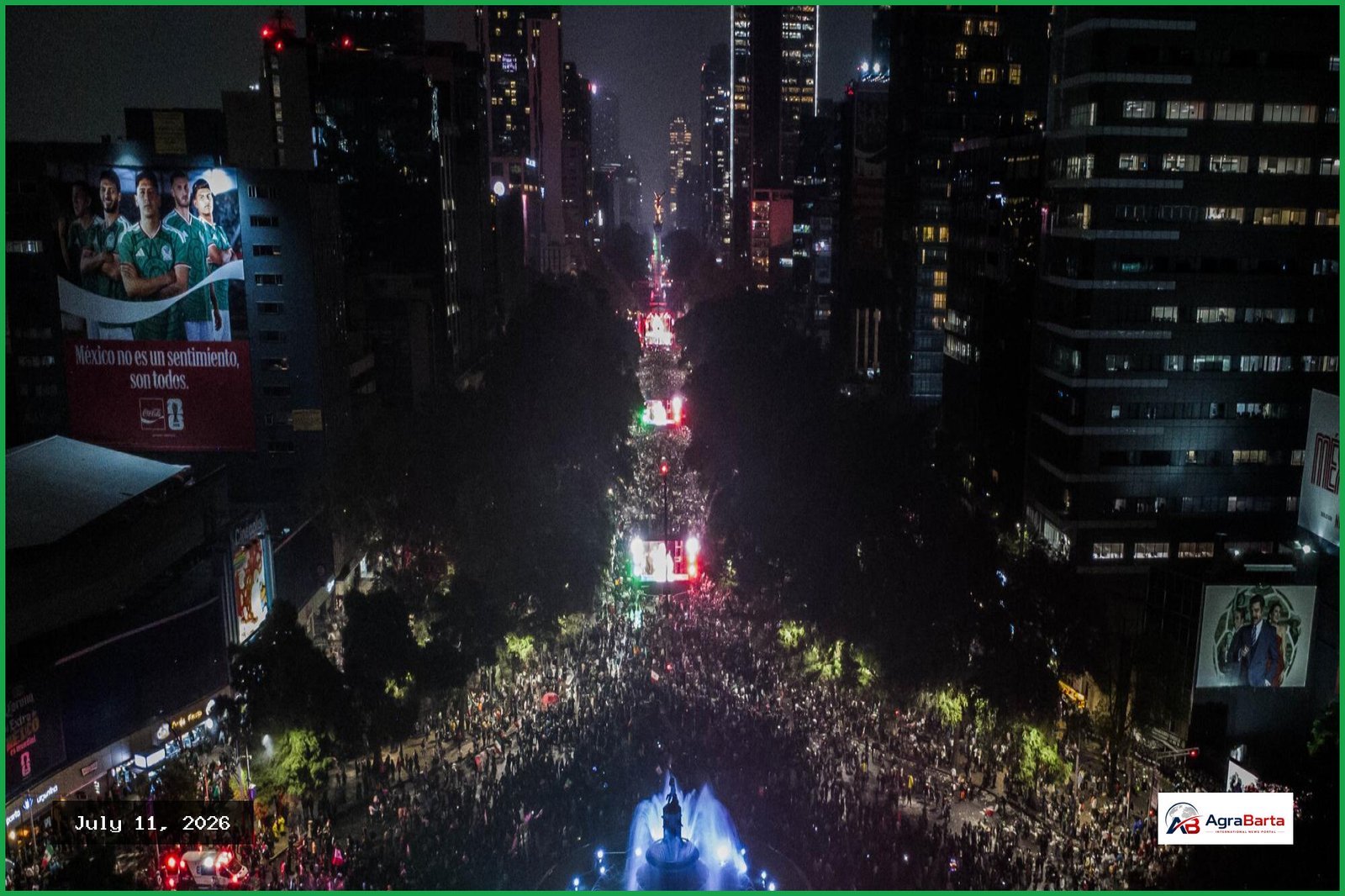
A high-stakes Sunday knockout match against England has Mexico City preparing for what could be one of the largest sports celebrations in national history, even as authorities implement strict security measures following a recent tragedy. As the national soccer team, El Tri, prepares to take the field at Azteca Stadium at 7 p.m. local time, the country is united under a new, viral rallying cry: “¿Y si sí?”—which translates to “What if we do?”
The upcoming match represents a historic opportunity. If Mexico defeats England, they will advance to the quarterfinals, matching the achievements of the 1970 and 1986 World Cups when Mexico also hosted the tournament. However, safety concerns are paramount. During the massive celebrations following Mexico’s recent 2-0 victory over Ecuador, which drew over 1 million fans, four people tragically died near the El Ángel de la Independencia statue. The breathtaking celebrations are on in Mexico City after El Tri’s historic win, as shared on Twitter by FOX Sports (@FOXSports) on July 1, 2026 (pic.twitter.com/k6nJRTInxX). In response, Mexican officials have capped gatherings at the statue to 25,000 people, directing overflow crowds to 49 other locations with screens along Paseo de la Reforma and throughout the city. FIFA briefly considered moving the kickoff to the daytime to enhance safety, but both the Mexican and English teams opposed the shift, and local authorities assured they could secure Azteca Stadium and the city’s streets.
This security crackdown is unlikely to dampen the explosive enthusiasm surrounding the team, which has won four consecutive World Cup matches without conceding a single goal. The traditional chant of “Sí se puede” (“Yes, you can”) has been entirely supplanted by “¿Y si sí?” The phrase echoed from more than 80,000 fans inside Azteca Stadium during the Ecuador victory, and veteran goalkeeper Guillermo Ochoa even posted a photo wearing a cowboy hat with the question inscribed on it. The phrase originated before the tournament during a Liga MX playoff press conference when Efraín Juárez, the former World Cup player and then-coach of Pumas, was asked about his team’s title drought and responded, “What if they do? What if the Pumas do become champions?”
The current euphoria stands in stark contrast to the mood in Mexico City just a month ago. The streets were then filled with protests from outraged members of a teachers’ union and relatives of kidnapping victims, alongside widespread skepticism toward a team coming off its worst World Cup showing since 1978 in Qatar. César Aquino, a fan who attended the 2010, 2014, and 2022 World Cups, recalled how the national morale was initially somber. Now, Aquino and his wife, Angélica Arias, are among the hundreds of thousands wearing identical “¿Y si sí?” caps. Víctor Velásquez, an Estrella TV reporter from Los Angeles, noted how forced and lackluster the tournament felt to fans initially, compared to the unprecedented devotion seen today.
For many, the phrase represents something far deeper than sports. Jesús Roberto Ramírez, a 36-year-old poet and content creator, produced a viral video thanking the team for bringing joy to a nation accustomed to bad news—a video that was later shared by FIFA President Gianni Infantino. Ramírez explained that the phrase challenges a cultural education that often holds Mexicans back. Adriana Valasis, an N+ reporter in Mexico City, observed that the team’s success has temporarily bridged deep-seated societal inequalities, providing a much-needed outlet for a country fractured by political polarization. “Right now, as Mexicans, we’re in such a polarized moment that you can’t even question what your government is doing without being labeled as part of the opposition, nor can you applaud what it does well without being labeled as being on one side or the other,” Ramírez said. “I desperately needed a breather. I missed being able to chat with my neighbor for 15 minutes without our political preferences coming up.”
As the tournament progresses, fans have also adopted a new postgame tradition of tossing people into the air, mimicking the team’s celebration of Ochoa after his likely final World Cup game at Azteca Stadium. While Ramírez acknowledges that a soccer tournament cannot permanently resolve generational social struggles, he hopes a fraction of this unity remains. Reflecting on the profound joy sweeping the nation, he repeated a line from his viral video: “How beautiful you are, happy Mexico.”
This article was written by Eduard Cauich, a native of Yucatán, Mexico, who holds a journalism degree and a master’s in mass communications from Cal State Northridge. He specializes in sports and coverage of Latino communities. His professional career includes roles at Univision New Mexico, Major League Soccer, HOY Los Ángeles, Azteca América, and La Opinión.
This is read by an automated voice. Please report any issues or inconsistencies here.
See more from the L.A. Times in Google Search. Set us as preferred