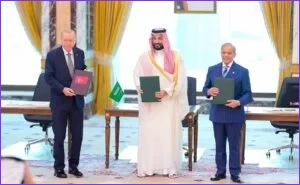
The recently signed Mecca Joint Defense Agreement (MJDA) between Pakistan, Saudi Arabia, and Turkiye has sparked intense debate among geopolitical analysts. While some observers compare the early August collective security pact to Russia's Collective Security Treaty Organization (CSTO) or herald it as the dawn of a new regional order that threatens the North Atlantic Treaty Organization (NATO), historical precedents suggest a far less transformative outcome. Instead, the MJDA closely resembles the failed and largely forgotten Central Treaty Organization (CENTO) of the Cold War, pointing to a future of grand promises but minimal practical security integration.
Originally established in 1955 as the Baghdad Pact, CENTO was a defensive alliance comprising Iran, Iraq, Pakistan, Turkiye, and the United Kingdom, with the United States participating as an observer. Formed in response to the collapse of the World War II global alliance system and the rise of the capitalist-communist divide, the pact sought to contain potential Soviet expansion. Secular Middle Eastern nations feared that a reemergent Soviet Union would seek warm-water ports and oil concessions, threatening the Mediterranean Sea, the Persian Gulf, and the Indian Ocean. Encouraging this alliance allowed Washington to implement its "Long Telegram" strategy of containment well beyond NATO's traditional borders.
Beyond military containment, CENTO aimed to foster economic cooperation, trade, and transportation links. It established a London-supported joint nuclear research center in Tehran and utilized U.S. funding to build communication lines connecting Ankara, Tehran, and Karachi. Iran's Chabahar port was envisioned as a central hub for regional commerce. However, these ambitious initiatives faltered as member states prioritized their individual defense agendas. The Soviet Union bypassed the alliance entirely in the 1960s and 1970s by forging ties with Ba'athist regimes in CENTO's "rear" and exploiting anti-colonial sentiment in places like Ethiopia and North Yemen.
Internal fractures further crippled the Cold War alliance. The United States imposed sanctions on its own CENTO ally, Turkiye, following the 1974 invasion of Cyprus. Meanwhile, Turkiye and Iran remained on the sidelines during Pakistan's military conflicts with India. Furthermore, the perceived Soviet threat was fundamentally misaligned with reality; Soviet leaders Nikita Khrushchev and Leonid Brezhnev had no plans to push to the southern seas. Soviet forces withdrew from Iran shortly after World War II, losing their oil concessions, and the December 1979 invasion of Afghanistan was not intended as a stepping stone to the Indian Ocean.
Like its Cold War predecessor, the newly formed MJDA is a treaty without teeth, uniting countries with vastly different security priorities and little motivation to cooperate. Pakistan remains focused on its long-standing, low-grade conflict with India, which it views as its primary threat and the reason it seeks strategic depth in Afghanistan. Meanwhile, Pakistan and Turkiye are highly unlikely to support Saudi Arabia's regional military actions. Riyadh's reliance on expensive military hardware has failed to turn the tide of its conflict with Houthi rebels in Yemen. Just as pan-Arabism failed to hold CENTO together, pan-Islamism is expected to be an unreliable foundation for the MJDA.
Nuclear dynamics also highlight the divergence among the signatories. Pakistan's security is secured by its domestic arsenal of approximately two hundred nuclear warheads, while Turkiye is protected by NATO's nuclear umbrella. Saudi Arabia lacks its own nuclear capabilities, though the current U.S. administration has promised assistance in developing a domestic program. Ultimately, the MJDA is currently defined by vague diplomatic statements, declaring an attack on one as an attack on all and encouraging defense cooperation. With the ongoing Iran-U.S. War likely to test this commitment soon, the alliance is expected to yield little more than stern statements, arms sales, and occasional joint training exercises.
You have reached the limit of 2 free articles this month.
Finally, what does the treaty itself commit the partners to? The MJDA, at this point, is a series of statements. Those statements claim that the treaty will consider an armed attack against one an attack against all signatories, and further defense cooperation between the signatories will be encouraged. The latter is so much diplomatese and nothing in previous bilateral agreements impeded such cooperation.