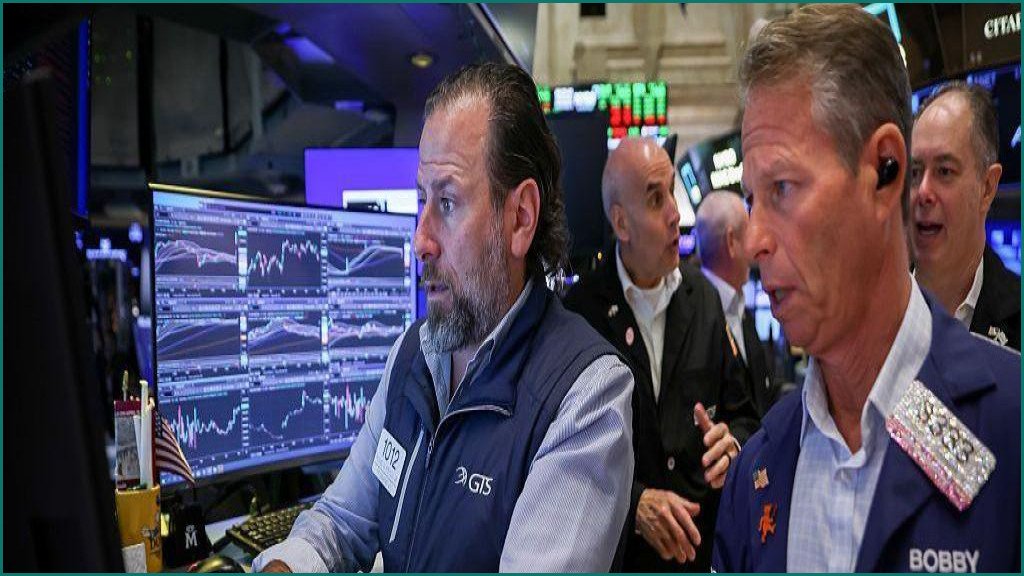
Hundreds of billions of dollars in market value has been wiped from major tech firms in the US and Asia in a massive stock market rout after the US midterm elections sparked concerns of a slowdown in artificial intelligence development. Shares in firms across the tech and AI sectors plummeted following Democratic wins after election campaigns run on slowing AI.
During Thursday's session, the tech-heavy Nasdaq composite index closed down by more than 5.5%, losing an estimated $2.5tn (£1.9tn) in market value, according to Dow Jones data. The fall was so severe that the Nasdaq Composite is now in correction territory, defined by market watchers when an index or company value falls at least 10% below its recent high. Other key US stock indexes also saw big losses in their worst days since 2025. The S&P 500 index fell by 4.4% by the end of trading, while the Dow Jones Industrial Average erased gains made on Wednesday to close down more than 3.4%.
The sell-off comes on top of broader concerns about whether the huge amounts being spent on AI will pay off, with some investors becoming concerned alongside the immediate midterm impact that AI shares could be in a bubble due for a correction. MarketWatch chips analyst Britney Nguyen noted that the downturn marks a "continuation of worries" over the level of spending on AI infrastructure.
Across the US, Democrats campaigned to slow the growth of data centres and AI, with dozens of measures placed on local ballots aimed at restricting the development of the hubs crucial for powering the technology. Tuesday's election victories handed Democrats control of both the US Senate and House of Representatives for the remainder of President Donald Trump's presidency. Regional races underscored this policy pivot, including in Texas, where Democratic governor-elect Gina Hinojosa campaigned heavily against data centres and pledged a moratorium on new construction in the sector.
Some Democrats have argued that AI has grown too big without any safeguards or oversight and have promised, with their new power in Congress, to change that. Democrat Senator Bernie Sanders expressed this position in a Thursday post on X: "Americans don't want Big Tech oligarchs wrecking the environment, gutting jobs and threatening humanity's future. NATIONAL DATA CENTER MORATORIUM NOW."
In a social media post, President Trump blamed the stock decline on his political opponents, writing: "The Stock Market suffered one of the Worst Days in History based on the results of the Election. Remember, it wasn't Republicans, it was Dumocrats. Do not fear, however, we will soon, one way or the other, be BIGGER AND STRONGER THAN EVER BEFORE. MAKE AMERICA GREAT AGAIN!"
Shares in companies heavily exposed to AI data centres, including crucial chipmakers and semiconductor manufacturers, fell sharply on Thursday, highlighting investor concerns that had already been growing. Nvidia shares slid more than 9%, knocking over $400bn off the firm's market value. Rival chipmakers also suffered heavy hits, with AMD and Micron both dropping by more than 17%, Intel shares dropping 10.3%, and memory card maker SanDisk plunging more than 22%. The Philadelphia Semiconductor Index, which tracks 30 of the largest semiconductor production companies, fell by more than 12%.
In total, the so-called magnificent seven tech companies, including Apple, Nvidia, and Tesla, shed a trillion dollars in value in a single trading day. Shares in Elon Musk's companies SpaceX and Tesla plunged, falling 8% and nearly 11% respectively, shaving more than $300bn off their market value on Thursday. Musk had spent nearly $450m backing Republican campaigns, including at least $45m supporting Ken Paxton for the Texas senate seat, but Texas was turned blue in Tuesday night's Democratic tsunami.
The market panic extended to Asia on Friday morning, where tech-heavy indexes fell sharply as companies manufacturing computer chips and AI powering equipment saw their shares slide. Japan's Nikkei 225 was 6% lower in early trading as memory chip maker Kioxia lost over 12.6% and Tokyo Electron slipped by 9.5%. In South Korea, SK Hynix fell by more than 11.5% and Samsung was down by nearly 10%. The sell-off in Seoul sent the Kospi index plunging more than 8.5%, triggering a circuit breaker mechanism that temporarily halts trading to curb panic selling. In Taiwan, the Taiex dropped by more than 8.3%, with chipmaking giant TSMC falling by nearly 8.5%.
Susannah Streeter, chief investment strategist at Wealth Club, stated that the steep sell-off on Wall Street was sending shockwaves into other global markets. "Fresh panic over the AI trade has hit Wall Street hard," Streeter said. "Fears that the vast sums poured into AI infrastructure may not deliver the returns investors have been banking on are now colliding with the prospect of a sharp slowdown in data centre construction."
Charu Chanana, Chief Investment Strategist at Saxo, warned that greater scrutiny of data centre approvals, environmental impacts, and electricity bills could delay projects and raise costs across the industry. While both political parties are keen to ensure US dominance in technology, Chanana noted that "there is a difference between supporting AI development and allowing infrastructure to expand at any cost or pace."
Some tech leaders have said they were caught off guard by the backlash against data centres in the midterms. Speaking at the WSJ Tech conference in Napa, California on Wednesday evening, OpenAI president and co-founder Greg Brockman admitted that everyone had been surprised by the community reaction. "A lot of our shift over the course of this year has really been to realise that from San Francisco trying to build infrastructure in Texas, Georgia, and other places, you can't just tweet and say: 'This is going to be good.' You need to be in those communities," Brockman said.
Meta's president Dina Powell McCormick told the same conference that the technology industry must work harder to communicate its benefits, stating, "I think we need to double and triple down on telling the story."
Food, fuel and taxes – can the Democrats actually make life cheaper?
With additional reporting from Lily Jamali