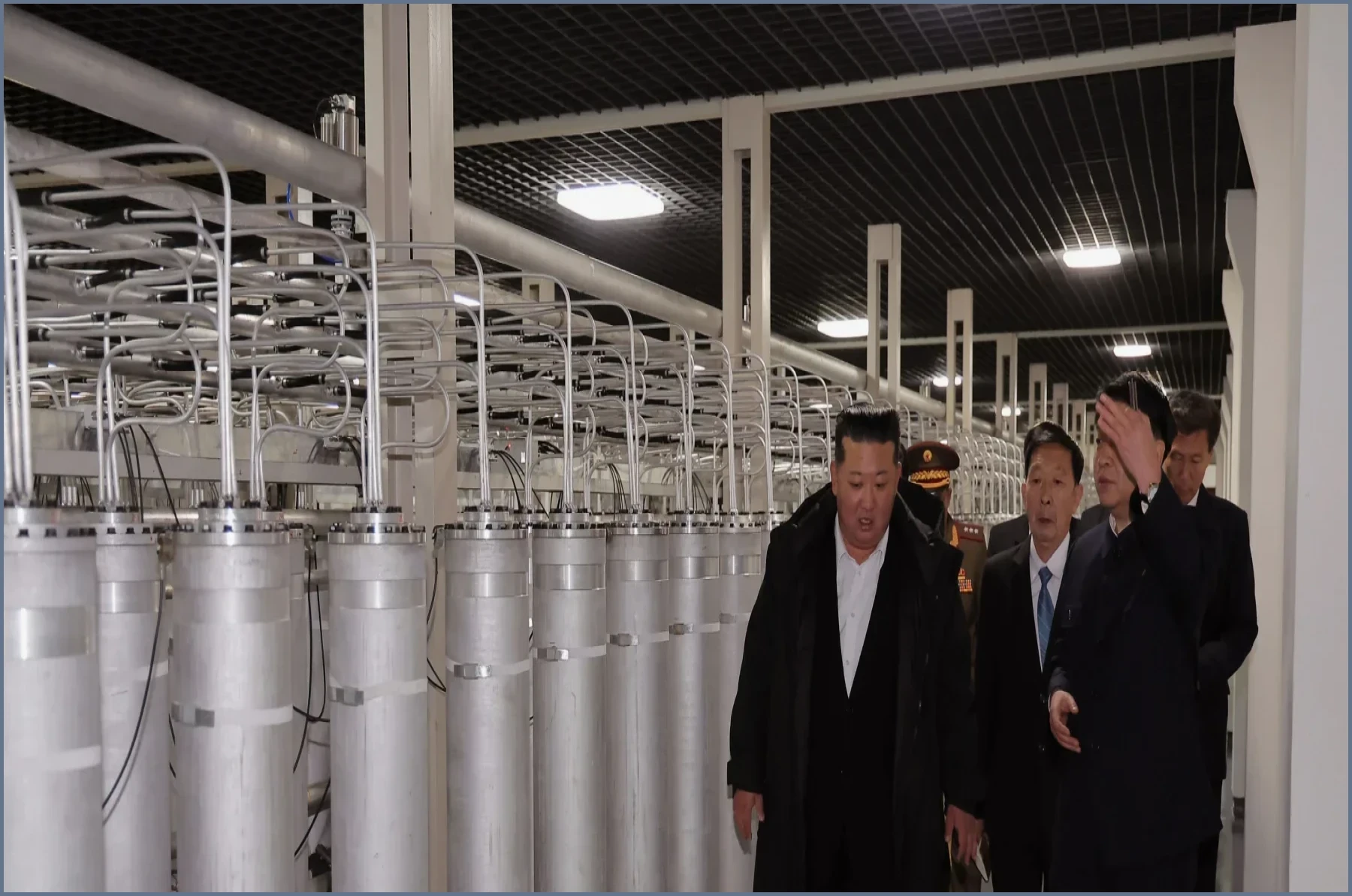
North Korean leader Kim Jong Un has explicitly reaffirmed his commitment to expanding his nation's nuclear arsenal, a development that underscores his rejection of future negotiations regarding the dismantling of the country's nuclear program. State media reported on Thursday that Kim recently inspected two nuclear materials production factories, one of which was newly inaugurated, while the other is currently undergoing expansion. Photographs released by the official Korean Central News Agency (KCNA) depicted Kim and senior military officials walking through rows of what appeared to be centrifuges utilized for the production of weapons-grade uranium, as well as touring facilities that displayed what were reported to be nuclear warheads. Some of these images were blurred.
In addition to these sites, Kim visited a nuclear-powered equipment production base and a nuclear research institute on Wednesday. Although the exact locations of these facilities remain undisclosed, the disclosures follow a pattern of transparency regarding uranium enrichment capabilities that began in 2010. Outside analysts suggest these visits are intended to demonstrate the evolution of the North's nuclear deterrent, which serves as the backbone of Kim's authoritarian rule, and to verify progress on state objectives ahead of the upcoming year-end Workers' Party conference.
Addressing the state's strategic direction, Kim stated that the possession of nuclear weapons and the ongoing trend of bolstering their quality and quantity constitute an "irreversible reality." He further emphasized the urgent necessity of deploying low-yield battlefield nuclear weapons across various domains to address the "inevitable reality facing the border with the most dangerous enemy state," a direct reference to South Korea. This focus on tactical nuclear weapons has intensified in recent years, coinciding with heightened regional animosity.
The display of nuclear capability appears to be a calculated response to recent diplomatic outreach from U.S. President Donald Trump. While Trump expressed a desire to restore diplomacy with Kim during his visit to the Asia-Pacific Economic Cooperation summit in China last week, no meeting materialized. Trump later dismissed claims that he had been rebuffed, telling the New York Post this week that he had not been ignored but that the timing had simply not been appropriate during a busy two-day period. Trump suggested that the exchange of letters, which characterized their previous diplomatic engagement, could be restarted at any time, despite acknowledging that the two leaders have not corresponded "recently."
Moon Seong Mook, an analyst at the Seoul-based Korea Research Institute for National Strategy, noted that Kim’s actions serve as a signal to Washington. "Kim Jong Un wants to say 'Look at how powerful we are. Don't talk about denuclearization if you want to meet us,'" Moon stated, highlighting the persistent gap between the U.S. demand for denuclearization and North Korea's desire for recognition as a nuclear state to facilitate the lifting of international sanctions. Previously, Kim has conditioned his return to talks on the U.S. dropping its "hostile policy" and respecting the North's status as a nuclear power.
International concern remains elevated, with International Atomic Energy Agency Director General Rafael Grossi recently warning that the expansion of the uranium enrichment facility at Yongbyon is a "cause for serious concern." Nuclear weapons can be built using either highly enriched uranium or weapons-grade plutonium, and North Korea has facilities to produce both at Yongbyon. Last year, South Korea's Unification Minister Chung Dong-young stated that North Korea was operating four uranium enrichment facilities and that they were running every day.
In this photo provided by the North Korean government, leader Kim Jong Un inspects a facility the government says is for producing weapons-grade nuclear material at an undisclosed location in North Korea, Monday, Nov. 25, 2026. Korean Central News Agency/Korea News Service via AP hide caption