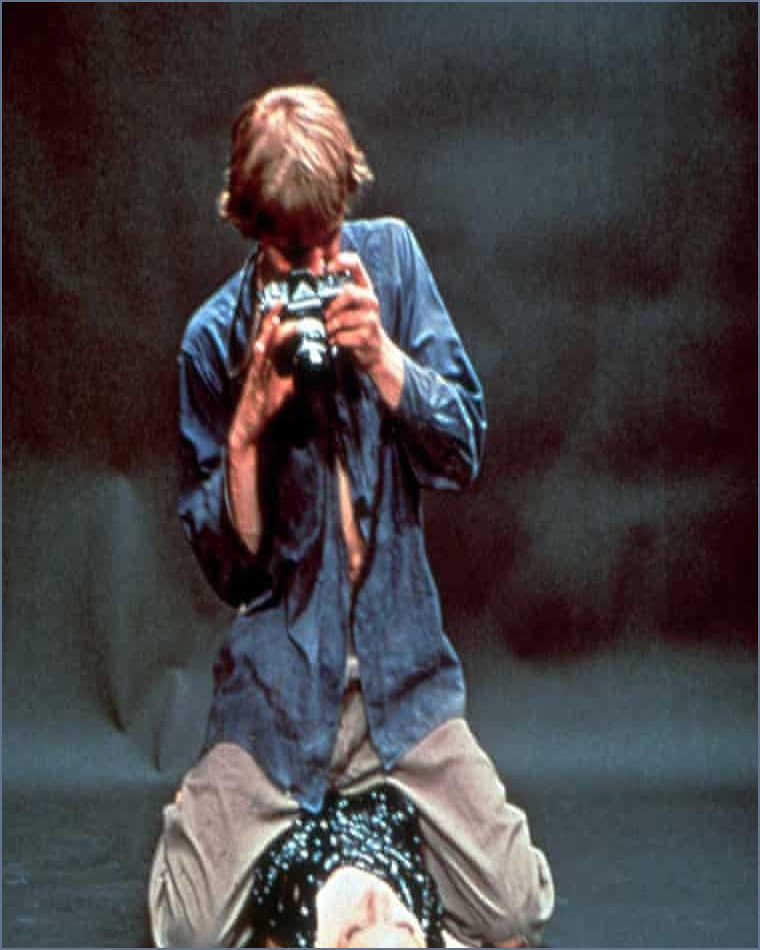
Veruschka, the German model and artist whose bold and dynamic shoots made her one of the biggest stars of 1960s fashion, has died at the age of 87.
Born Vera von Lehndorff, she created the persona of “Veruschka” — meaning “little Vera” — as a memorable alternative identity that she considered performance art. Her striking physical attributes, including a 6ft-plus tall body that could fill an entire glossy magazine spread, a face with magnificent bone architecture and feline eyes, and a long mane amenable to dramatic cuts and coiffures, were animated by her instinct for making shapes in the air. These were not mere poses but a dancer’s movements, famously captured in Michelangelo Antonioni’s 1966 film Blow Up, where she is seen seducing the camera of a photographer played by David Hemmings.
These unique gifts propelled Veruschka to become one of fashion’s greatest stars for 15 years, gracing hundreds of magazine covers, many for Vogue. Diana Vreeland, the new empress editor of American Vogue, sought Veruschka to embody the exotic aspects of 1960s culture. Upon their first introduction, Vreeland pinned Veruschka’s photo to her wall and declared: “You’re going to hear from me.”
Veruschka proved to be a character deep and compelling enough to sustain Vreeland’s most extravagant fantasies. This included a legendary 1966 sequence shot by Richard Avedon in Hokkaido, Japan’s “snow country,” an epic cinematic spread featuring Veruschka wrapped in a zoo’s-worth of furs and an 8ft-long Dynel wig, which Vreeland had originally wanted to be 20 feet. Veruschka also made a memorable appearance at Woodstock in 1969, wearing multiple necklaces and a minimal bra, drawing every camera to her. Vreeland even allowed Veruschka and her then-lover, photographer Franco Rubartelli, to conceive their own unconventional ideas, such as a moonlit shoot on Christmas Day on the island of Eleuthera in the Bahamas. Rubartelli also photographed her adventuring in an Yves Saint Laurent safari jacket in 1968, an image that cemented the designer’s bold-woman credentials.
Beyond Avedon, who considered her the most beautiful woman in the world, other prominent Vogue photographers, including Horst P Horst, Irving Penn, Bert Stern, and David Bailey, enjoyed collaborating with Veruschka. She was open to nearly any experiment, except smiling, though Steven Meisel eventually managed to capture her surprisingly goofy grin.
It was Italian photographer Johnny Moncada who helped Vera create the Veruschka persona. Photographer Ugo Mulas had first noticed her beauty while she was studying art in Florence in 1959. However, her early career attempts faced setbacks, with Paris rejecting her for being too tall, and New York agency chief Eileen Ford advising her to starve on hard-boiled eggs before ultimately rejecting her. Back in Italy, she and Moncada worked sporadically over a year. When these pictures were published in 2014 as the book From Vera to Veruschka, she recalled how Moncada fostered her on-camera persona by encouraging her to reveal her true feelings: “Having a look of sadness in my eyes is my biggest problem … he allowed me to be myself, even if that meant looking melancholy.”
Indeed, her life had been marked by much sadness. Born the daughter of Count Heinrich von Lehndorff-Steinort, whose family owned a castle on their estate in Steinort, East Prussia, her father was executed in 1944 for his involvement in the July plot to assassinate Hitler. The Gestapo imprisoned her pregnant mother, Gottliebe von Kalnein, and sent young Vera and her sisters, Gabriele and Marie, to an SS-run children’s home in Bad Sachsa. After the war, they were reunited with their mother and new sister, Catharina, but found themselves homeless and ostracized in Germany. They lived wherever relatives would take them in, leading to attendance at 13 different schools, where the “spidery, long and thin” Vera consistently felt like an outsider.
None of this personal history was known to the fashion world, which readily accepted the vaguely eastern European identity suggested by her pseudonym and capitalized on her talent for metamorphosis. The 1960s were the era of the international “Beautiful People,” and Veruschka was considered the fairest among them. Yet, even during her peak years, when she commanded an unprecedented $10,000 a day, she often sought to blend into the background, camouflaging herself with shoe polish to disappear into a Kenyan landscape or using body paint to match herself to a floor during shoots.
She ultimately left the fashion industry in 1975 after Grace Mirabella, who had replaced Vreeland as Vogue editor and was tasked with democratizing the magazine, told her she needed to be more ordinary, or “relatable.” Veruschka interpreted this as a call to be more bourgeois and “stalked away in her usual flat shoes.”
Thereafter, she lived under her birth name, Vera von Lehndorff, embracing her intended path as both an artist’s model and an artist, using her body as a canvas. She had begun working with photographer Holger Trülzsch in 1970. He painted her to blend into surrounding natural surfaces for fine art photographs, and later, in 1978, for performances where she absorbed herself into old buildings. They also experimented with painting clothes directly onto her body, an exploration that served as a form of revenge for her years of exposure to fashion. Trülzsch and Veruschka published a monograph of their collaborative work, Trans-figurations, in 1986, featuring a foreword by Susan Sontag.
As an artist, she led a simple life, first in Brooklyn and, from 2005, in suburban Berlin, where she wrote her autobiography, Veruschka: Mein Leben, published in 2011. Fashion occasionally called her back, offering good pay for her to walk on show catwalks, something she had not done during her glory years. She remained indifferent to designers, whether unknowns or Karl Lagerfeld at Chanel, as she had never truly liked couture. Her personal style remained haute hippy, with almost any length of cloth or exaggerated makeup looking elegant on her frame and face. In a late appearance, at nearly 80 years old, modeling denim and worn leather for Acne Studios, she was as cool and effortlessly beyond it all as ever.
Veruschka is survived by her sisters, Gabriele and Catharina.