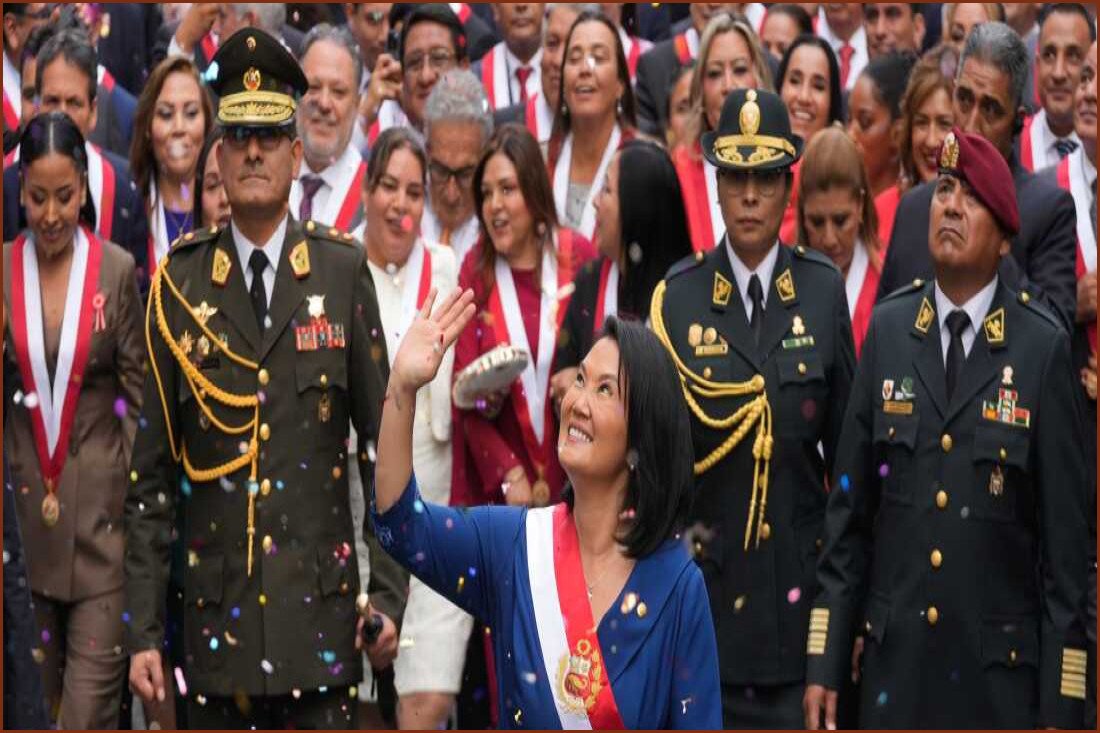
Conservative leader Keiko Fujimori officially assumed the presidency of Peru on Tuesday, following a tight runoff election in June that saw her secure victory by a margin of fewer than 50,000 votes. Her inauguration marks a notable regional trend in South America, signaling a shift toward conservative governance. At 51 years old, Fujimori now becomes the ninth individual to hold the presidency in the last ten years, a period defined by significant political volatility.
As the leader of Peru's largest political party and a four-time presidential candidate, Fujimori has outlined an agenda focused on stabilizing the nation's political landscape, boosting economic growth, and addressing crime. A central pillar of her campaign involved a commitment to combatting extortion rackets and improving national security. She has pledged to fight crime with an "iron fist," drawing inspiration from policies championed by Salvadoran President Nayib Bukele, including the potential construction of a megaprison modeled after El Salvador’s Cecot penitentiary. Additionally, she plans to implement reforms that allow judges to conceal their identities during criminal trials to ensure their personal safety.
Economic development is also a priority for the new administration. Fujimori has promised to facilitate public infrastructure projects by streamlining partnerships between government agencies and private investors. On Tuesday, she further announced a 15% increase in the national minimum wage and a reorganization of social services aimed at tackling malnutrition in rural areas. "My goal is not only to administer the state," Fujimori stated. "My main objective is to narrow the enormous social deficit that affects millions of Peruvians."
The political climate remains tense. Opposition leaders are pressuring the new government to overturn several laws passed by the previous legislature that critics argue hinder the fight against organized crime. These disputed measures include the elimination of preventive arrests, restrictions on prosecuting political parties for corruption, and increased difficulty for police to seize the assets of criminal groups. Furthermore, opposition groups are calling for an official commission to investigate the deaths of 50 civilians during anti-government protests that occurred between late 2022 and early 2023, following the removal of former President Pedro Castillo. During the swearing-in ceremony, some lawmakers staged protests outside the parliament, displaying photographs of those killed during the unrest.
Fujimori’s electoral support was strongest in Lima and along the Pacific coast, whereas left-wing candidate Roberto Sanchez, an ally of Castillo, dominated the Andean highlands. Although Sanchez challenged the results due to alleged irregularities in overseas vote counting, electoral authorities ultimately rejected his complaints. Despite this friction, Peru maintains a reputation for economic stability, characterized by a conservative approach to public spending and a central bank that keeps benchmark interest rates below 5%. However, the divide in living standards between the coastal region and the highlands remains a point of contention.
Fujimori is the daughter of former President Alberto Fujimori, who governed in the 1990s. His tenure was marked by economic stabilization and the defeat of terror groups, but he was later imprisoned for human rights abuses and authoritarian actions committed by the military under his leadership. He received a pardon in December 2023 and passed away in September 2024. Her victory, alongside recent conservative wins in Colombia and Chile, reflects a broader political movement across South America that contrasts with the left-wing surge seen in previous decades.