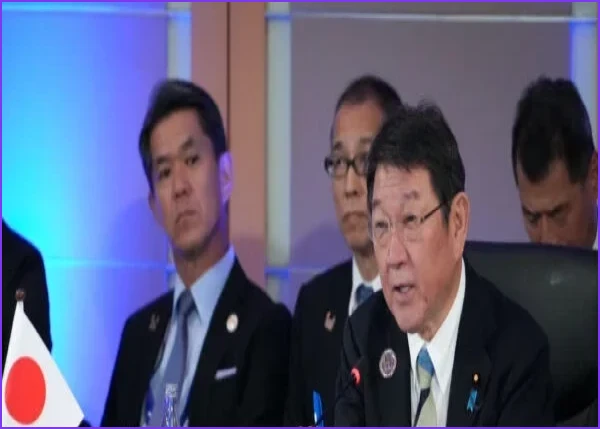
Japanese Foreign Minister Motegi Toshimitsu’s recent visit to Manila served as a significant public demonstration of Prime Minister Takaichi Sanae’s updated Free and Open Indo-Pacific (FOIP) strategy. This initiative marks a distinct shift in Japan’s approach to Southeast Asia, moving beyond traditional development assistance to prioritize practical security cooperation. The framework, which Takaichi initially detailed in a May 2, 2026, address at Vietnam National University in Hanoi, emphasizes the need for Indo-Pacific nations to enhance their autonomy and resilience in the face of rising geopolitical competition and rapid technological change.
The updated FOIP strategy is built upon three primary pillars: developing resilient economic infrastructure for the data and AI age, including critical mineral and energy supply chains; fostering growth through public-private partnerships; and expanding security cooperation to ensure regional stability. During the ASEAN-Japan Foreign Ministers’ Meeting in Manila on July 22, 2026, Motegi reaffirmed that ASEAN remains at the center of this vision. He pledged increased cooperation in maritime security, artificial intelligence, disaster response, and economic security, while also stressing that Japan’s FOIP is intended to complement, not compete with, the ASEAN Outlook on the Indo-Pacific (AOIP).
Motegi signaled firm opposition to any unilateral attempts to alter the status quo by force or coercion in the East and South China Seas. He further advocated that any future South China Sea Code of Conduct between ASEAN and China must align with the United Nations Convention on the Law of the Sea. Japan’s practical efforts include providing equipment to various nations, such as patrol boats for Indonesia and Cambodia, surveillance gear for the Philippines, search-and-rescue equipment for Thailand, and a diving support vessel for Malaysia. Notably, Tokyo and Hanoi have begun discussions regarding the potential joint development of fast landing craft.
The Philippines continues to be Japan’s closest security partner in the region. During the Manila meetings, both nations brought their Acquisition and Cross-Servicing Agreement into force as of August 22, alongside ongoing radar transfers and expanded joint military exercises. Tokyo is also working to bridge Southeast Asia with broader regional security architectures, exemplified by ASEAN’s participation as observers at the Japan-Pacific Islands Defense Dialogue in February.
While Japan seeks to act as a "dot connector" for like-minded partners, the strategy has faced criticism from Beijing. Chinese officials have warned against a perceived "revival of militarism" and criticized Japan’s increased defense spending and closer ties with the United States. Despite varying levels of receptivity among ASEAN members—with the Philippines and Vietnam showing the most openness while others remain cautious—Japan continues to institutionalize security ties, aiming to create a cohesive network that stretches from Southeast Asia to the Pacific Islands.