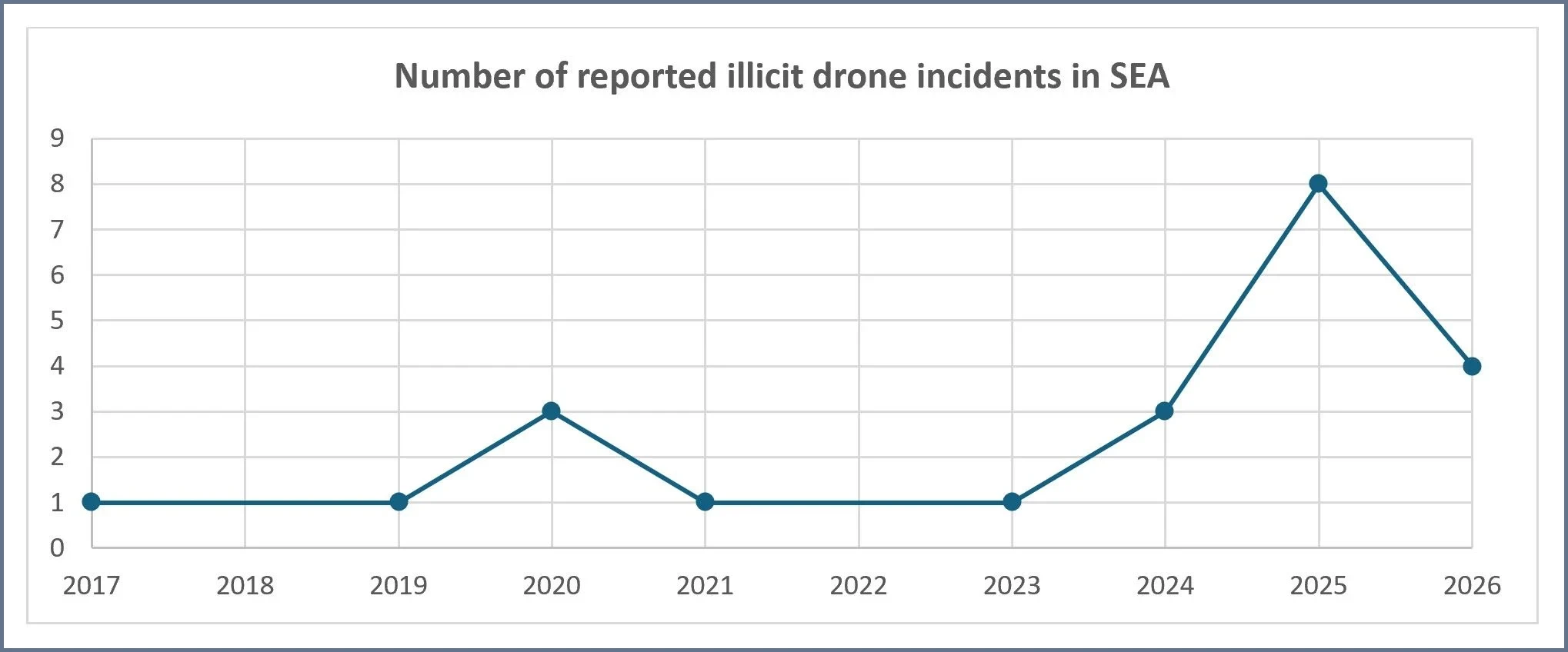
Southeast Asia is experiencing a significant rise in the illicit use of drones, primarily commercial-off-the-shelf (COTS) consumer models, by both criminal and terrorist organizations. This trend, observed across 22 reported incidents up to August 2026, excludes drone use in active conflict zones, which has become widespread in regions like Russia-Ukraine, Myanmar, Sudan, and the Middle East.
The adoption of drones by illicit networks is attributed to media attention, the accessibility of COTS systems, and the relatively low barriers to their operation. An analysis of these incidents indicates that approximately 86 percent are linked to criminal activities, with narcotics-related operations, including prison incursions and cross-border smuggling, being the most prevalent.
In Malaysia, the first recorded illicit drone incident occurred in August 2024, when a commercial quadcopter smuggled narcotics into Tapah prison. The Malaysian Home Ministry reported 55 cases of drones being used for prison narcotics smuggling that year. More recently, in July 2026, two individuals were apprehended for attempting to smuggle tobacco into Sungai Udang Prison in Malacca using a DJI Air 2S drone, following a similar case at Machang prison in Kelantan in 2025.
Indonesia has also seen similar incidents, such as in June 2025, when a drone delivered drugs to a Class IIA Narcotics Prison in Bandung, West Java, with transactions facilitated via social media. Earlier cases were noted in Sragen Prison in 2023 and Nusa Kambangan in 2019, with similar occurrences reported in prisons in the Philippines.
Beyond prison incursions, drones are increasingly employed for cross-border narcotics smuggling. The United Nations Office on Drugs and Crime highlights their use along the Malaysia-Thailand, Thailand-Myanmar, and Thailand-Laos borders. In June 2020, Singaporean and Malaysian authorities dismantled a syndicate using a COTS drone to smuggle drugs from Malaysia into Singapore. Larger drones are also implicated; in June 2025, two large hexacopter drones were discovered buried in Sadao district, Songkhla, Thailand, linked to three Chinese nationals allegedly involved in a narcotics syndicate. In Vietnam, a couple was arrested for using a DJI quadcopter to deliver drugs and collect payments. Additionally, these networks utilize drones for reconnaissance to evade law enforcement.
Drone trafficking and smuggling networks, potentially linked to conflict actors, are also exploiting mainstream businesses. Thailand has reported at least three major seizures of drones and components over the past two years. A December 2025 raid on a warehouse in the 2nd Army Area led to the seizure of 2,500 suspected smuggled drones. In March 2026, raids on two warehouses in Lat Krabang, outside Bangkok, uncovered 2,083 smuggled drones being illicitly resold online. An August 2025 raid in Samut Prakan, linked to a Singaporean company, found numerous drones, signal jamming devices, and a van with signal-disrupting equipment.
Some of these networks are suspected of cross-border drone trafficking. The December 2025 raid was followed by the arrest of four Myanmar nationals near Suvarnabhumi airport in Bangkok, suspected of trafficking 10 large industrial multi-rotor Chinese drones to Myanmar’s military junta, to be dismantled and transported via commercial flights. In July 2026, another Myanmar national was arrested in Mae Sot, Tak province, near the Thailand-Myanmar border, attempting to smuggle four advanced first-person view (FPV) drones and components, originating from Chiang Mai, into Myanmar for an unidentified end-user. A year prior, a one-way attack drone with an explosive warhead, believed to belong to the Myanmar military, was found in the same province.
The use of drones by non-state armed groups (NSAGs) in Myanmar is well-documented, with the Armed Conflict Location and Event Data Centre recording over 2,100 drone strikes across more than 600 locations by 2024, significantly reshaping battlefield strategy. The junta has also increased its reliance on airstrikes since late 2023. Illicit trafficking networks through neighboring countries may be assisting both NSAGs and the military in circumventing export controls on dual-use materials from China. A U.K.-based Conflict Armament Research study found that high-precision European satellite navigation systems, which harden drones against jamming, were diverted through commercial resale to Myanmar for junta use.
Drones have also been linked to suspected espionage. In August 2025, two Chinese nationals were arrested in Kuala Lumpur for trespassing the Malaysian Ministry of Defense headquarters with a DJI Mavic 3 drone, allegedly attempting to capture footage. Following last year’s Thailand-Cambodia border conflict, numerous drone reconnaissance flights were detected over military installations and government agencies in Thailand, with government officials hinting at possible espionage.
Terrorist groups have also adopted drones. During the 2017 Marawi siege in the Philippines, the Islamic State (IS)-linked Maute group used inexpensive COTS drones primarily for intelligence, surveillance, and reconnaissance, a tactic also employed by the Armed Forces of the Philippines. While IS heavily weaponized drones in Iraq and Syria during the same period, no weaponized drones were documented in Southeast Asia.
Malaysian and Indonesian terrorist cells have also possessed or planned to use drones. In 2016, Malaysian authorities uncovered an IS-linked plot to attack the federal police headquarters in Kuala Lumpur with a drone, though no evidence of procurement or actual use beyond online discussions was found. Recent arrests in Malaysia revealed drone-related information, simulation games, and operational instructions on suspects' electronic devices, but no operationalization in plots or attacks.
In Indonesia, an October 2020 discovery found a Jemaah Islamiyah cell in Bekasi, West Java, in possession of a drone allegedly intended for an attack. In September 2024, counter-terrorism operations led to the arrest of seven individuals from West Sumatra and the Bangka Belitung Islands who were planning to attack Pope Francis during his visit, possessing a DJI mini drone for potential surveillance or attack.
Indonesian nationals have also been involved in attempting to smuggle drones to militants in the Middle East. Court documents revealed a syndicate attempting to transport drones and components from Indonesia to Hayat Tahrir al-Sham (HTS) militants in Syria via Türkiye. The group procured various drones, including a Chinese-made Sonicmodell Sea Rescue, a Heewing RC F-01, an Indonesian-made Rajawali, a Diatone Manba MK4 F722 flight controller stack, and FPV goggles, often through open websites, social media, and e-commerce sites like AliExpress. These components were packed with foodstuff and sent via commercial post to Türkiye for onward transport to HTS. Indonesian authorities also uncovered the use of cryptocurrency in the financial trails.
The proliferation of cheap, easily available COTS drones with few purchasing restrictions remains a key concern due to their dual-use nature. Narcotics will likely continue to feature prominently in illicit drone use, with drones serving both for smuggling and reconnaissance. There is also a future possibility of drones being used to traffic firearms, a tactic observed along the India-Pakistan border. While sophisticated systems like fiber optic or FPV drones, used by Latin American cartels, are not currently prevalent among illicit actors in Southeast Asia, this possibility cannot be discounted.
Drone trafficking networks, potentially linked to conflict actors, continue to exploit mainstream businesses, using front companies, commercial transport, and human mules to move drone parts through countries like Thailand and Indonesia. The modular design of some drones and the commercial availability of their components facilitate this illicit trade.
To counter these trends, measures should focus on interdicting illicit supply chain networks, logistical pipelines, and the human nodes connecting them. Government agencies must invest in enhancing counter-drone capabilities, including hardware and trained personnel, and fortifying critical infrastructure against drone attacks. Countries such as Thailand, the Philippines, Malaysia, Indonesia, and Singapore have already integrated drones into law enforcement operations and established specialized units, which is a positive step. This must be complemented by robust legal frameworks and comprehensive drone forensics capabilities, ensuring regional governments are as innovative in countering drones as their adversaries are in using them.
Beyond their use in conflict, the region has seen a steady increase in the illicit use of drones primarily involving commercial-off-the-shelf (COTS) consumer drones (Figure 1).
Figure 2: Breakdown of recent illicit drone incidents in Southeast Asia by type of illicit activity. (Chart by Rueben Dass)