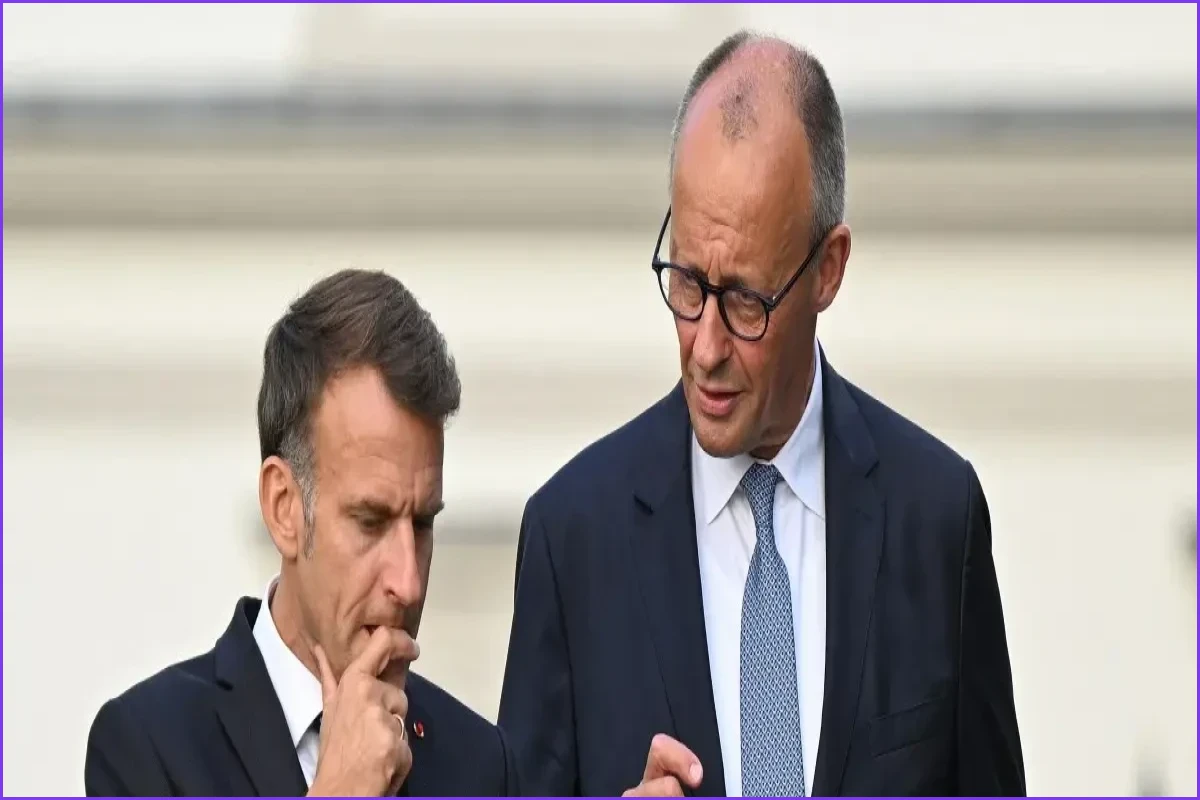
French President Emmanuel Macron and German Chancellor Friedrich Merz are convening near Cologne on Friday to breathe a 'new dynamic' into bilateral defense cooperation. The high-level government meeting follows the high-profile collapse of their joint fighter jet project last month, prompting both nations to seek alternative pathways for security integration, including discussions on nuclear deterrence.
The annual summit is taking place at Augustusburg Castle in Bruehl, a site steeped in historical significance for bilateral relations. It was at this very castle in 1962 that French President Charles de Gaulle and German Chancellor Konrad Adenauer laid the groundwork for the landmark friendship treaty between their nations. Chancellor Merz highlighted the venue's importance on Thursday evening during one-on-one discussions with President Macron at Bensberg Castle in Bergisch Gladbach. Ahead of the formal sessions, the two leaders projected unity, with Macron thanking 'my friend the chancellor' for attending Bastille Day celebrations in Paris earlier in the week. Macron noted a 'genuine Franco-German convergence' in recent months across investments, innovation, and trade protection, emphasizing that the meetings aim to build a 'powerful Europe which unites our strengths.'
To symbolically reinforce their commitment to European rearmament amid a perceived threat from Russia and shifting U.S. security commitments, the leaders will also hold a Franco-German Defence and Security Council meeting at the Noervenich Luftwaffe air base. The military cooperation was on display Thursday as two nuclear-capable French Rafale jets deployed to the base, and a French aircraft conducted a mid-air refueling of a German Eurofighter, according to a Luftwaffe spokesperson who spoke to AFP.
Despite the show of solidarity, the talks are shadowed by recent industrial setbacks. The French presidency has expressed a desire to 'bounce back' with concrete initiatives following the collapse of the joint Future Combat Air System (FCAS) fighter jet project, which dissolved due to deep-seated disagreements between Airbus and France's Dassault. Tensions also linger over the Main Ground Combat System (MGCS), a joint initiative to replace battle tanks that has faced internal friction since the entry of German defense firm Rheinmetall.
Air defense remains another point of contention between the neighbors. Germany continues to champion its European Sky Shield Initiative (ESSI), which relies heavily on the American Patriot and Israeli-American Arrow-3 defense systems. France has declined to participate, arguing that the initiative deepens Europe's reliance on non-European military technology and that the continent should focus on strengthening its own domestic defense industries. Furthermore, Merz's stated goal of establishing the 'strongest conventional army in Europe' has raised concerns in France—the world's second-largest arms exporter—about intense competition from a German defense sector bolstered by a massive borrowing program.
With Macron scheduled to leave office before the next annual summit, the pressure is on to secure progress on other fronts, particularly a French-led nuclear deterrence initiative. Macron previously indicated that Germany is among eight nations that have agreed to participate in discussions surrounding the project. However, he has maintained that France, which alongside the United Kingdom represents Western Europe's only nuclear powers, will keep exclusive control over its nuclear decision-making. A German government source noted that Berlin views any such French-led initiative as something that must remain 'complementary' to NATO, warning against the creation of 'different security zones' within Europe.
In addition to defense and security, the steering group expected to be launched on Friday will focus on deepening cooperation on radar systems, deep-strike capabilities, and missile defense. The two leaders are also slated to discuss European economic competitiveness, the European Union budget, digital regulation, and joint strategies to counter disinformation.