George Major, the iconic Pearly King of Peckham who spent decades championing East London's working-class traditions, raising money for charity, and mastering the intricate art of Cockney rhyming slang, has died at the age of 88. Major passed away on August 1, leaving behind a rich cultural legacy that spanned generations. On September 14, he was laid to rest in a cemetery located near the Cockney Museum, an institution he founded to preserve the unique history of his community. His final send-off was a raucous, emotional affair, featuring a horse-drawn cart that carried his casket into a small chapel where the walls literally shook with the sounds of mourners singing traditional pub songs, much to the bewilderment of a gardener working outside.
At the gravesite, four generations of Major's family stood united, all dressed in matching, intricately decorated pearly suits. The gathering of pearly kings, queens, princes, and princesses offered a striking visual tribute to the man who had been the best-known pearly king of his generation. When a visiting reporter approached the family to offer condolences and share a memory of a confusing but delightful interview with Major years earlier, the family members looked up through their tears and burst into laughter. "A real Cockney cheeky chappy!" exclaimed his daughter, Janet Major, as she embraced the visitor.
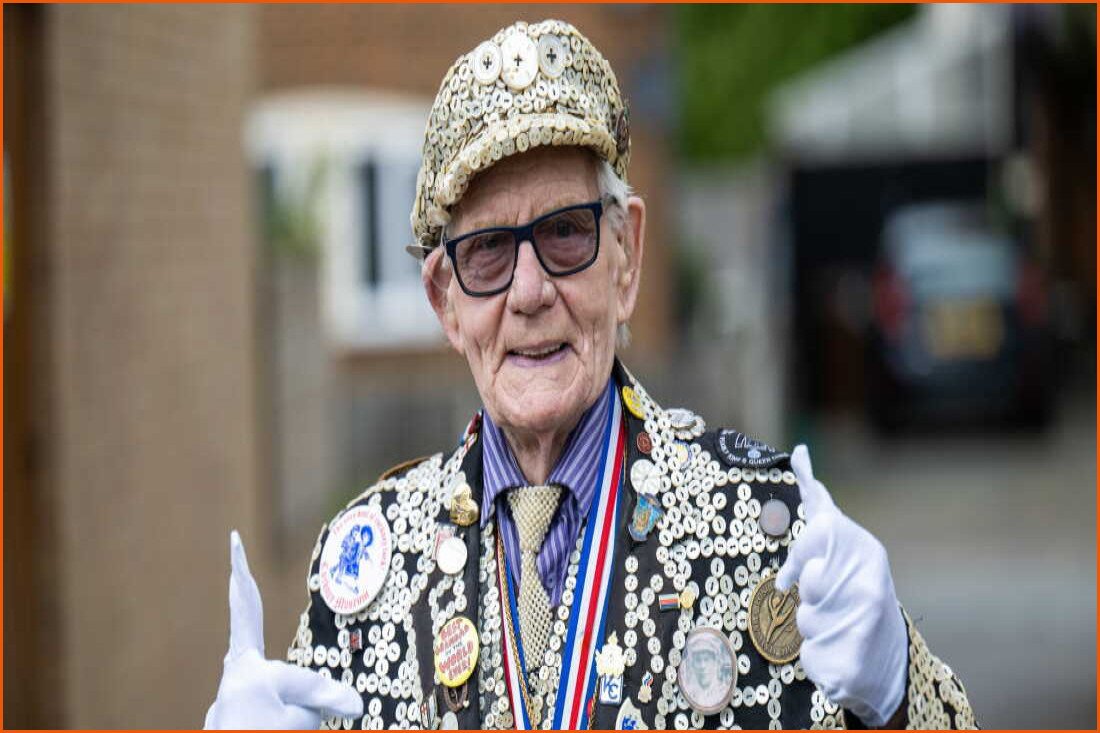
That memorable encounter occurred back in 2016 during a reporting trip to London, when Major was 78 years old. Already a beloved local celebrity, Major walked through the streets of the East End, where the historic factories and docklands of his World War II childhood had long been replaced by towering glass skyscrapers. As they walked, a street vendor rushed out to give Major a high-five, and tourists eagerly snapped photographs of his spectacular attire. Major had arrived in full regalia: a black suit and a flat cap, both heavily festooned with sequins, sparkles, and hundreds of mother-of-pearl buttons. Across the back of his jacket, his official title—Pearly King of Peckham—was spelled out in shimmering buttons.
Despite both speaking English, the reporter found Major's rapid-fire speech nearly impossible to decipher at the time. "The costermongers, wheeze used to fly-pitch, on this frog and toad," Major had said during the interview. The language was a dizzying mix of what Major called "backspeak" and traditional Cockney rhyming slang, prompting the flustered reporter to look at the camera and joke, "We might need a translator here!" Years later, the meaning of those words became clear. Major was explaining that he was a "costermonger" (a street hawker) who used to "fly-pitch" (sell goods without a license) on the very "frog and toad" (road) where they were standing.
Cockney rhyming slang is a complex linguistic tradition where words are replaced by rhyming phrases. For instance, "porky pies" means lies, "apples and pears" means stairs, "whistle and flute" means suit, and "Ruby Murray" means curry. To make matters even more complicated, Major also utilized "backspeak" or "backslang," a system where words are simply spelled backward, such as the word "yob" for boy. According to Andy Green, the co-founder of the Modern Cockney Festival, this slang likely originated as a secret code used by street vendors to confuse the police or to secretly rig prices among themselves.
The tradition of the Pearly Kings and Queens dates back to the 1870s, when an orphaned street sweeper named Henry Croft began decorating his suit with mother-of-pearl buttons he scavenged from the streets outside East London's textile factories. Croft's ornate clothing was a way to bring a sense of dignity and a "royal air" to menial labor. This act of creative expression quickly blossomed into a celebrated working-class institution. "These pearly suits are now cultural artifacts with fantastic designs, telling a profound story about London and Cockneys, what we call the non-posh Londoners," Green explained. The annual Modern Cockney Festival continues to celebrate these diverse, working-class communities.
Historically, many of the pearlies were street hackers, market vendors, or unlicensed traders. The community was highly diverse, with many immigrants joining the ranks and peppering the local slang with words from Yiddish or Bengali. "You had what are called costermongers, which is a posh word for street hawkers, street sellers," Green noted. "Imagine you're a newly arrived immigrant in the country. One of the first jobs you could possibly do might be to hustle, sell goods on the street."
George Major's own life story was a testament to this working-class hustle. Born in 1938 inside a military barracks in Peckham, southeast London, he was abandoned as a child and grew up in a local workhouse. As a teenager, he found odd jobs in the local market. "Dad eventually became one of the costermonger kings that used to run market stalls," his daughter Janet explained. "It was not an easy childhood, but he followed the ideals of Henry Croft. That was before the welfare state, when you had to help your friends, your neighbors, your community." Janet recalled her childhood weekends, when her father would lead all seven of his children, dressed in matching pearly suits, door-to-door to raise money for various charities.
Today, a dwindling number of pearlies continue this tradition, canvassing for causes such as children's hospitals, women's shelters, and veterans groups, while also appearing at summer street festivals and marching in parades. Major himself eventually trained as a plumber and ran a plumbing supply shop, but he never lost his connection to his pearly roots. His larger-than-life persona left a mark on British popular culture. The pearly kings famously inspired the character of Bert, the streetwise chimney sweep played by American actor Dick Van Dyke in Walt Disney's Mary Poppins—an actor who later admitted to delivering "the most atrocious Cockney accent in the history of cinema."
Furthermore, Major's family and peers believe he was the real-life inspiration for Del Boy, the happy-go-lucky East London huckster from the long-running British sitcom Only Fools and Horses, known for his constant get-rich-quick schemes and the catchphrase, "This time next year, we'll be millionaires!" Fittingly, Major's funeral eulogy was filled with references and quotes from the beloved show. However, like his fictional counterpart, Major also had run-ins with the law. In 2012, he was sentenced to six months in prison after pleading guilty to benefits fraud, though he was released early. Despite this setback, his fame remained undiminished, and he was chosen as one of the pearly royals to march in the opening ceremony of the 2012 London Olympics. Today, a massive portrait of Major covers an entire wall at Heathrow Airport, greeting travelers from around the world.
The intricate designs on the pearly suits carry deep symbolic meanings that are passed down through generations. At the funeral, Major's 19-year-old great-granddaughter, Aleisha Gordon, pointed out the patterns on her own pearly outfit, which matched the design Major had proudly shown off in 2016. "There's a straight line, which is your life line," she explained, pointing to the shimmering buttons. "The triangles are the ups and downs in life, and the flowers are the friends and family that help you along the way."
As the funeral service concluded, children threw handfuls of earth onto George Major's coffin as it was lowered into the ground. The undertaker brought out four caged doves, which were released into the sky by Major's descendants. The birds circled twice overhead before flying away. Mourners gathered to share fond memories of a man they described as a "real rascal" and "the most hilarious person," who was nevertheless "very particular" about who made his tea. Soon, a boombox was turned on, and the crowd began kicking their legs in a lively can-can, singing along to 1950s songs. The mourners then paraded out of the cemetery, heading toward a nearby "nuclear sub"—the Cockney rhyming slang for a pub—to raise a cool pint of "pig's ear" or "King Lear" in honor of the legendary Pearly King of Peckham.
Pearly kings and queens, wearing clothes decorated with mother-of-pearl buttons, are committed to raising money for charities. Laura Chiesa/LightRocket viz Getty Images hide caption
People shared anecdotes about a "real rascal" and "the most hilarious person" who was nevertheless "very particular" about who made his tea. Someone turned on a boombox, and mourners began kicking their legs like the can-can, singing along to 1950s songs.