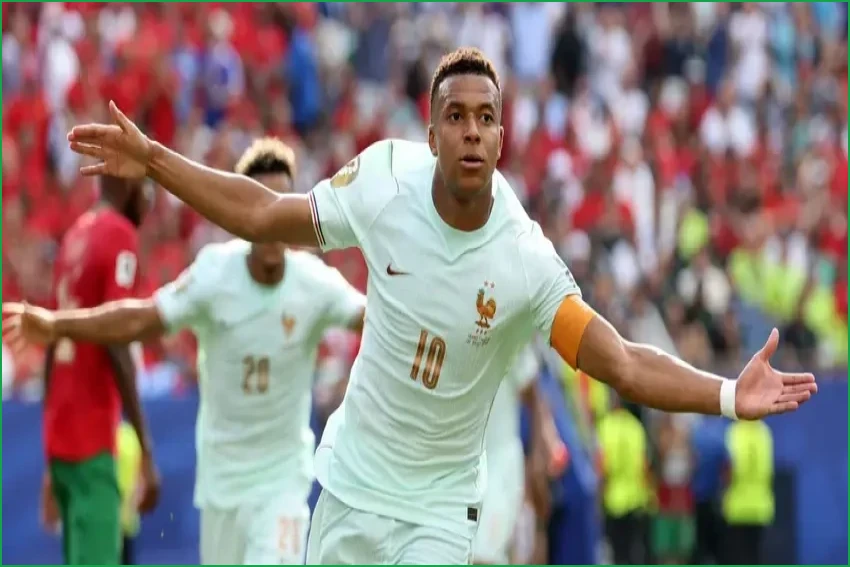
What is France’s most successful industry and most prolific export? It is not wine, cheese, or luxury leather handbags. In 2026, France’s most impressive achievement is the quality and quantity of its football. The nation’s greatest export is its footballers, and its third successive appearance in a World Cup semi-final tonight confirms a trend that has been evident for some time. Great footballers, who once emerged from the cobbled streets of England or Scotland or the favelas of Brazil, now breed on the playing fields of French provincial towns and pour off the artificial grass pitches of the multi-racial banlieues of French cities.
There are 99 French-born players at this World Cup, including 23 in the French squad. Last year, 242 French players competed in the English Premier League, the toughest football competition in the world; only England provided more players to its own leading clubs. A French victory over Spain in Dallas tonight would serve as the best possible response to the latest in a long line of racist slurs against Les Bleus. Earlier this week, former Spanish Prime Minister Mariano Rajoy claimed the French team was “of a very high level…without French players.” This judgment was based entirely on race. In terms of birthplace, the 26 players in the current France squad are actually more French than the team that won the World Cup in 1998. All but three were born in France, and all 26 hold French nationality.
The obsession with the skin color of Les Bleus is not a new phenomenon. Before the 1998 triumph, Jean-Marie Le Pen complained that the team had been “imported” and did not know the words of La Marseillaise, though he changed his tune once they won the World Cup. A couple of weeks ago, following France’s victory over Paraguay in the Round of 32, Paraguayan senator Celeste Amarilla called French striker Kylian Mbappé a “colonised Cameroonian” who was “pretending to be French” but was brought up “around chimpanzees and coconuts.” In reality, Mbappé was born in Paris and attended a private school where he learned to play the flute. Similarly, before the France-Senegal match on June 16th, Senegal parliament speaker Ousmane Sonku made an obtuse point, stating, “If you want to look at the match politically, then whoever wins, Africa will have beaten Africa.”
Public opinion remains divided. When my children attended bourgeois Catholic schools in Paris, some of their classmates claimed they no longer supported the France team because it was “too black.” Conversely, in rural Normandy this summer, I have lost count of the number of small white boys and girls wearing shirts proclaiming them to be “Mbappé 10” or “Dembélé 7.” While there was much talk in 1998 about the positive impact on race relations of the White, Brown, and Black team that beat Brazil 3-0, the political reality shifted quickly. Within four years, Jean-Marie Le Pen reached the second round of the French presidential election, and within seven years, the multi-racial French suburbs exploded into two weeks of riots, which have repeated at roughly five-year intervals since.
Rather than dwelling on arguments about skin color or ethnic background, I want to ask what French football is doing right that the rest of France might observe and imitate. In the 1990s, the French football federation was criticized for picking players born outside France. Now, France produces so many good players that they populate the squads of other countries. No less than 76 French-born players at this World Cup play for the countries of their families’ origin, including Morocco, Algeria, Tunisia, and Senegal. Some are not good enough for the France team, while others could easily have played for Les Bleus. This has sparked arguments about why these young men are supposedly disloyal to their country of birth, a criticism also leveled in England at the wonderful play-maker Michael Olise, a French national born in London who chose to play for France.
I would rather focus on the fact that the multi-racial inner suburbs and people of African and North African origin are seldom discussed in a positive way in France. The problems of the banlieue—poverty, violence, poor housing, drug-trafficking, and Islamic extremism—are real, and the resurrected Marine Le Pen will likely emphasize these issues in the next nine months. However, the banlieues are also places of great energy, courage, enterprise, and creativity. The success of the France team, heavily drawn from the greater Paris area and other inner suburbs, represents the positive side of “France beyond the Boulevard Périphérique.”
The success of French football has been achieved through good, affordable sports facilities and the hard work of amateur coaches for children’s teams. It has also been achieved by encouraging, rather than denigrating, the diverse qualities offered to France by migrants and their descendants. If that has produced a “surplus” of talent which France can export back to the players’ countries of origin, all the better. The problems of the banlieues remain, and they cannot be solved by sport alone, but the question remains: what is French football doing right that the rest of France should copy?