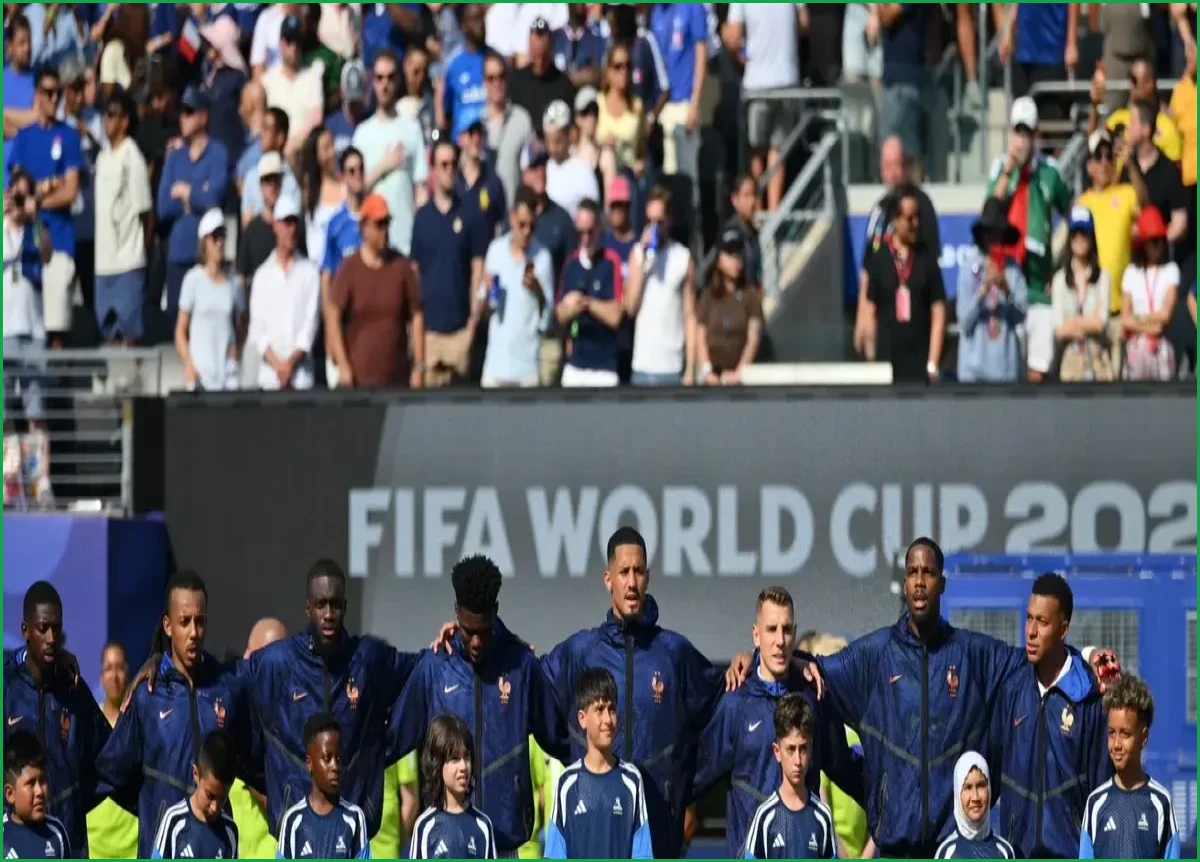
Recent inflammatory remarks from various political figures have sparked a debate regarding the nationality of players on the French national football team. Former Spanish Prime Minister Mariano Rajoy claimed in an opinion piece for the Spanish online news site El Debate that France had “no French players,” a statement that current Spanish Prime Minister Pedro Sánchez denounced as “xenophobic.” Similar sentiments have been echoed by Paraguayan Senator Celeste Amarilla, who targeted star player Kylian Mbappé after Paraguay’s elimination by France in the round of 16, calling him a “colonised Cameroonian who has really pretended to be French.” Various other far-right figures have dismissed the team as “paper Frenchmen,” while British right-wing politician and Brexit supporter Daniel Hannan shared a comment allegedly from a French friend, describing the France versus Sénégal game as “the legal immigrants playing the illegal ones.”
Under FIFA regulations, all players representing a national team must hold the citizenship of that country. Consequently, every member of the 26-man French squad possesses a French passport, and there are no restrictions regarding dual nationality. Of the 26 players currently in the squad, 23 were born in France. The three exceptions are Marcus Thuram, Michael Olise, and Brice Samba. Marcus Thuram was born in Italy while his father, Lilian Thuram, played for the Italian club Parma. Lilian Thuram, who is from the French Caribbean island of Guadeloupe, later moved back to France with his family, where Marcus grew up in the Paris suburbs.
Michael Olise was born and raised in England and could theoretically qualify for four countries through his British-Nigerian father and French-Algerian mother, but he chose to represent France. Goalkeeper Brice Samba was born in the Democratic Republic of Congo and moved to France as a child with his family, beginning his football career in Le Havre; he is the only naturalized French citizen in the team, while the rest are French from birth.
The remaining players were born and raised in France, speaking French as their first language and spending their formative years in the country. Captain Kylian Mbappé was born and raised in the Paris suburb of Bondy, as was his mother, who is French-Algerian. His father emigrated to France from Cameroon when he was one year old and has spent the rest of his life in the country. Despite this, Senator Celeste Amarilla directed intense, racially charged attacks at Mbappé on social media, describing him as a “Cameroonian, a product of colonialism, desperately trying to pass himself off as French – resentful, nouveau riche, arrogant and ugly.” She further claimed the team won due to luck and failed to score a goal.
In a second, even more inflammatory post, she wrote: “Bruto hasn’t even learnt to write; instead of his mother’s milk, he suckled coconuts, and the most cultured beings he’s ever heard were chimpanzees. You should have given him the middle finger, Orlando Gill; I do it in the Senate and nothing happens!!!” She has since deleted the posts, and a criminal investigation has been launched in France into her comments.
Some players, such as Désiré Doué, hold dual nationality. Doué was born in Angers, western France, to a French mother and a father from Côte d'Ivoire. Interestingly, his brother Guéla played for Côte d'Ivoire during the tournament. The brothers did not face each other due to the draw, though they met in a pre-World Cup friendly where Guéla enthusiastically joined in singing the French national anthem, La Marseillaise, to the delight of French fans.
Observers have noted that the questioning of the team's nationality appears to be rooted in racial bias, particularly given that high-profile white second-generation immigrants—such as far-right politician Jordan Bardella politician Jordan Bardella, whose mother was born in Italy—are rarely subjected to similar scrutiny. Naima Moutchou, France's minister for overseas territories, condemned the rhetoric as evidence of a “systematic and widespread hatred of France and what the nation is.” She noted that such racist obsessions tend to re-emerge whenever the team succeeds. This hostility is not new; the 1998 World Cup-winning squad, celebrated for its “black, blanc, beur” (black, white, and Arab) composition, faced similar denunciations from figures like Jean-Marie Le Pen, who also labeled them “paper Frenchmen.”
Apparently not, for some – would we be going out on a limb to say it may have something to do with the fact that the majority of the French team are not white?
Senator Amarilla's comments are pretty unambiguously racist, but the questioning of nationality of the kind done by Spain's Rajoy does seem to be rooted in race too.