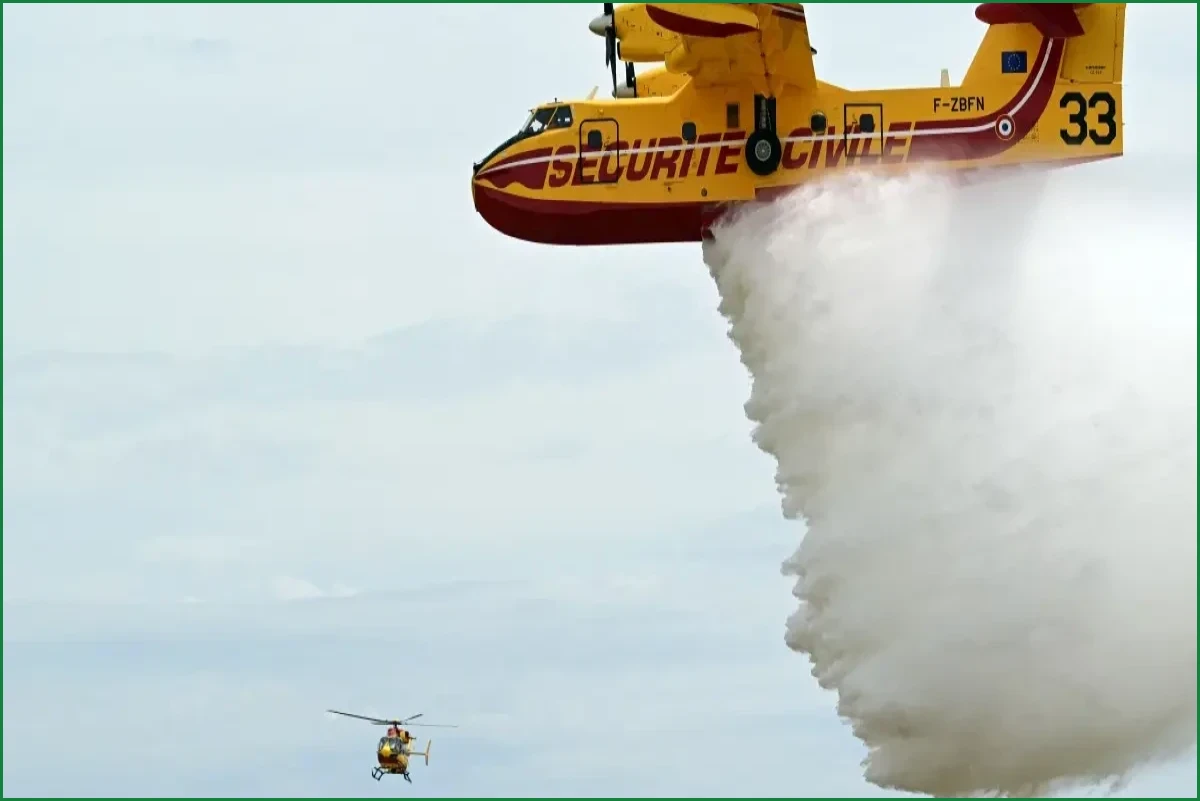
As firefighters across Europe struggle to contain some of the most severe wildfires in living memory, they are forced to contend with a reduced fleet of aerial water bombers. While the demand for these specialized aircraft is critical, production of the iconic Canadair planes is moving slowly at a factory in Canada.
Building these complex machines is a time-consuming process, significantly hampered by a nine-year production gap that left the supply chain in disarray.
Although manufacturer De Havilland restarted production in 2024, the first delivery of just two aircraft to France—one of the nations hardest hit by this summer's blazes—is not expected until at least 2028. France is currently enduring its worst wildfire season on record, with 92,000 hectares already burned, an area nine times the size of Paris.
Recently, approximately 200,000 people were evacuated in the southwest as a massive blaze approached the Bordeaux region.
The situation is equally concerning in Spain, where a wildfire in the Ávila region, northwest of Madrid, has burned around 50,000 hectares. The government has identified this as the largest wildfire in the country's modern history. As of Wednesday morning, there were 75 active known wildfires across the regions of Madrid, Valencia, Castilla y León, and Castilla-La Mancha, according to Incendios España.
The crisis has also seen tragic loss, with 14 people killed in Almería recently.
These events have triggered political friction. In France, opposition parties have accused the government of hindering firefighting efforts through budget cuts. Similarly, political blame games have emerged in Spain. However, the root of the supply problem lies in Canada.
At the Calgary plant, the fuselages of the aircraft—which are capable of scooping up nearly 6,000 liters of water in 12 seconds by gliding along a lake—are still being drilled and riveted by hand.
Operations Director Victor Ocadiz noted that the relative lack of automation compared to other manufacturers is a primary reason the factory can only produce 10 planes per year.
Production only resumed after an initial order for 22 planes was placed in 2024 by the European Union, France, Spain, Italy, Greece, Portugal, and Croatia, according to De Havilland Head of Strategy Jean-Philippe Cote. Since then, the order book has grown to 40 aircraft. France has ordered two next-generation DHC-515s as part of the European order, followed by two more in June.
Cote stated that the two aircraft for France are expected in 2028-2029, with the two announced last month scheduled for 2032-2033. French Interior Minister Laurent Nunez said in June that the 2028 deliveries would occur in April and November, emphasizing that the timetable must be respected. The first DHC-515 is expected to go to Greece in early 2028.
The near-decade gap between Bombardier's assembly lines falling silent and De Havilland starting its own caused supply chains to wilt. The company had to put more than 50,000 different parts back into production and select new suppliers because the previous ones no longer existed. While this process caused delays, it will benefit the 160 older-generation Canadairs still in service globally, half of which are in Europe.
De Havilland’s strategy chief noted that the restart makes it easier to source parts for repairs, allowing the company to quickly send components to France if an aircraft is damaged.
READ ALSO: Spain's three worst wildfires since 1961 happened in last two years
"On the fuselage, everything is done manually, so every hole, every rivet you see on the fuselage is being done manually," Operations Director Victor Ocadiz told AFP.