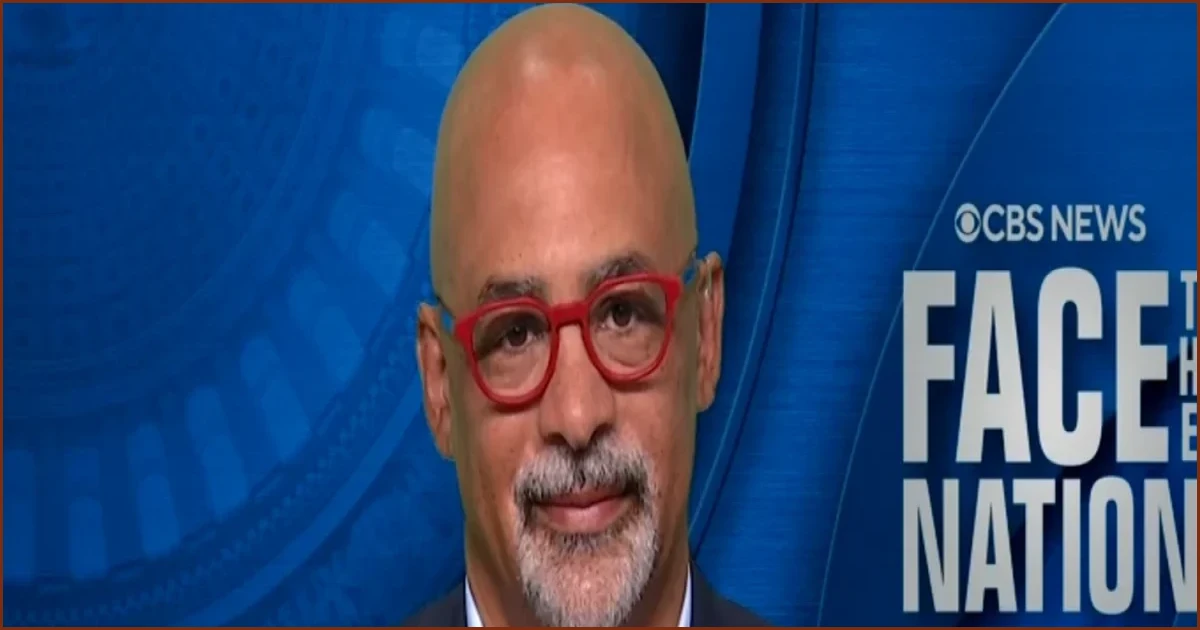
During an appearance on a national television news program on August 16, 2026, Pennsylvania State Representative Chris Rabb defended his progressive platform, his affiliation with the Democratic Socialists of America (DSA), and his path to securing the Democratic nomination in the state's 3rd congressional district. Speaking with the program's host, Rabb, who represents parts of Philadelphia, argued that his legislative goals align closely with those of working-class Americans, pushing back against criticisms from establishment Democrats and addressing national debates over the definition of socialism. Although the host noted that Rabb is not yet a congressman, they highlighted his unique position as a Democratic nominee who is also an active member of the DSA.
The conversation opened with the host asking what voters stand to gain from a candidate like Rabb compared to more moderate Democrats, such as Kentucky Governor Andy Beshear, who had appeared on the program earlier. Rabb emphasized that he had listened to Beshear's segment and believed they share a significant amount of common ground, including opposition to corruption, advocacy for working families, support for increased wages, and the belief that healthcare is a human right. Rabb noted that he supports a living wage for all, suggesting that he and Beshear have a lot more in common than people might initially assume.
However, when confronted with Beshear's assertion that "socialism is a failed experiment," Rabb offered a robust defense of mixed economic systems. He argued that in a purely capitalistic free-market system, foundational public programs such as Social Security, Medicare, Medicaid, public education, the interstate highway system, and public firefighting services would not exist. Rabb contended that modern society relies on a mixture and evolution of economic philosophies, noting that capitalism exists in countries ranging from China to Finland. He stated that pure capitalism has never worked, just as communism has not effectively worked, and questioned a system that produces its first trillionaire while veterans remain unhoused. He asked how a nation can justify such extreme wealth disparity while failing to take care of everyone.
The host pointed to a new national poll indicating that while a majority of Democrats view socialism positively, only 35 percent of all Americans share that perspective. Rabb criticized the poll's methodology, noting that it did not define terms like socialism, capitalism, free-market system, or free enterprise. He argued that the poll merely measured public reactions to labels that have been introduced into the public sphere without historical context or analytical framing. Rabb asserted that when these concepts are clearly defined, voters are capable of making more informed decisions. He emphasized that his campaign was focused on fighting for the people of Pennsylvania's 3rd congressional district rather than running on ideological labels.
The discussion then turned to the political composition of Rabb's district, which features a Democratic advantage of over 40 percentage points. The host suggested that this overwhelming partisan tilt explained how a socialist-backed candidate was able to win the nomination. Rabb strongly rejected this characterization, warning against conflating a district's Democratic performance index with inherent voter support for democratic socialism. He explained that he campaigned for months before his membership in the DSA was ever publicly highlighted, and that he ultimately won a four-person primary race by 14 percentage points because he positioned himself as a fighter who addressed local concerns. According to Rabb, the topic of socialism did not even arise during his primary campaign.
Rabb also responded to strategic criticisms from former U.S. Ambassador and Chicago Mayor Rahm Emanuel, who had argued that the Democratic Party's focus should be on flipping red districts to blue rather than turning safely blue districts "midnight blue." Emanuel had argued that winning Republican-held districts is the only viable path to achieving progressive goals like raising the minimum wage. Rabb dismissed this viewpoint, characterizing Emanuel and similar figures as "institutionalists and corporate Dems" whose advice should not be followed. He argued that current polling reflects widespread exhaustion and anger toward centrists and establishment figures. Rabb asserted that bold, non-partisan policies are what will move the country forward, adding that he could successfully make his progressive case to voters in Kentucky, where his family has lived for five generations.
When asked whether he would support Hakeem Jeffries for Speaker of the House if Democrats regain the majority in the upcoming November 3 elections, Rabb declined to commit. He noted that Jeffries had not asked for his vote and pointed out that Jeffries would not run for speaker unless a Democratic majority is secured. Rabb stated that his immediate focus is on ensuring that progressive candidates win their primaries and general elections. He expressed a desire to have a person-to-person conversation with Jeffries regarding leadership once a new Democratic majority is achieved, noting that the two have not yet met.
Finally, the host questioned Rabb about a controversial statement recently issued by the DSA. The statement commemorated the 100th birthday of former Cuban leader Fidel Castro, describing him as an organizer, fighter, and an enduring symbol of anti-imperialist struggle and self-determination for the Global South. The host asked if such celebrations validate the concerns of critics who oppose the democratic socialist movement. Rabb stated that he is not concerned with how the public construes the DSA, focusing instead on finding common ground to advance bold policies. He argued that establishment Democrats waste effort trying to convert voters who would never support progressive values like housing and healthcare as human rights. Instead, Rabb suggested that the party's most effective strategy is to engage disaffected, highly populated blue-district voters who currently decline to participate in elections because they feel abandoned by the party. Addressing the international controversy, Rabb concluded by stating that anti-imperialism and anti-fascism should not be considered controversial stances.
ED O'KEEFE: But when he says that socialism is a failed experiment, what's your response to that?
What's your response to the mayor's strategic argument there?