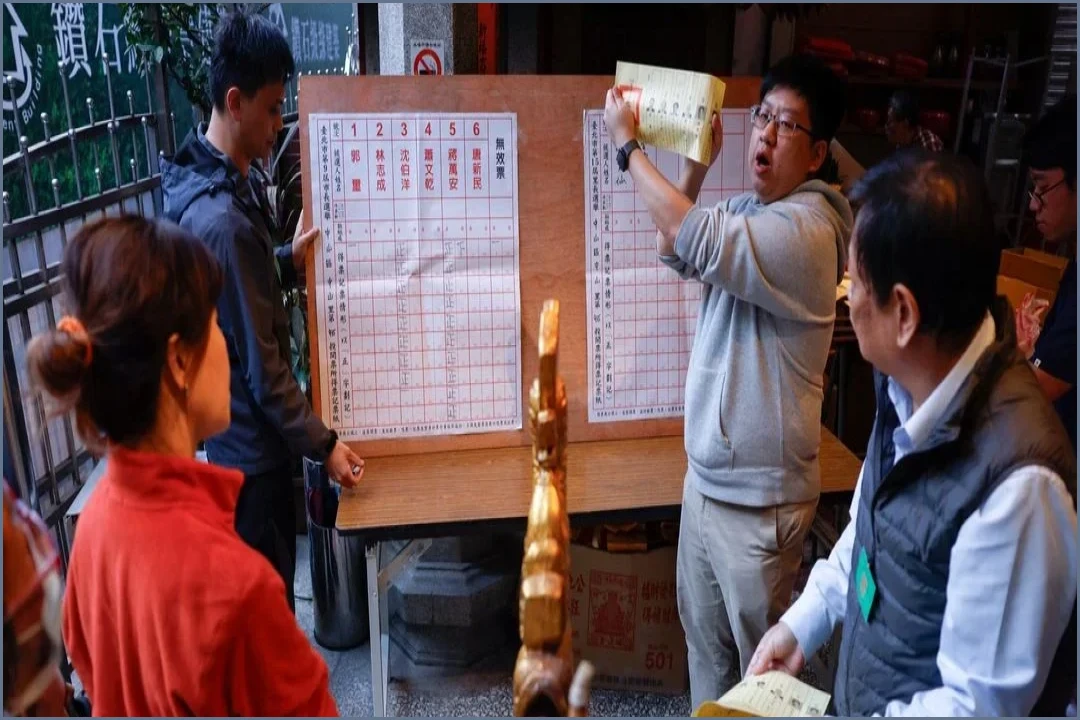
China has issued a firm warning that the "reunification" of Taiwan is an inevitable historical trend that cannot be halted, regardless of the outcomes of the island's recent local elections. The statement, released by China's Taiwan Affairs Office on Sunday, followed a voting cycle in which the ruling Democratic Progressive Party (DPP) successfully doubled the number of cities and counties under its control, although it faced a notable defeat in the Taipei mayoral contest.
In its response to the results, the Taiwan Affairs Office noted that while it observed the election outcome, it maintained that the "mainstream public opinion" in Taiwan remains focused on peace, development, exchanges, and cooperation. The office emphasized that regardless of shifts in Taiwan's political landscape, the direction of cross-Strait relations and the ultimate goal of national reunification remain fixed. Beijing declared its commitment to continue cracking down on "Taiwan independence separatist forces" while opposing external interference to advance the cause of reunification.
Taiwan's government did not provide an immediate response to Beijing's statement. China continues to view the democratically governed island as its own territory and has not renounced the potential use of force to secure control. Conversely, Taiwan’s government rejects these territorial claims. Tensions remain elevated, as Beijing refuses to engage in dialogue with Taiwan President Lai Ching-te, whom it labels a "separatist." President Lai, who also serves as the DPP chairman, maintains that the future of Taiwan is a matter to be decided solely by its own people.
Domestic issues such as school meals and water safety dominated the recent campaign, while the China issue remained in the background. However, Beijing maintained pressure throughout the run-up to the vote, including aggressive rhetoric against the DPP’s Taipei candidate, Puma Shen, who has been sanctioned by Beijing. Just days before the vote, on Friday, China deployed dozens of warplanes and warships into the air and waters surrounding Taiwan.
As the political focus shifts toward the 2028 presidential election, the Kuomintang (KMT) is assessing its path forward. While the DPP saw a promising development in the high profile gained by Puma Shen—described by Kaohsiung University of Science and Technology professor Charles Lo as a "beautiful" loss in a KMT stronghold—the KMT suffered a setback by losing control of Taichung. KMT Chairwoman Cheng Li-wun, who visited Beijing in April to meet President Xi Jinping, stated that the party must immediately begin preparations for the next cycle. Taipei mayor Chiang Wan-an, a potential future contender, has indicated he is focused on his current four-year term rather than national office.