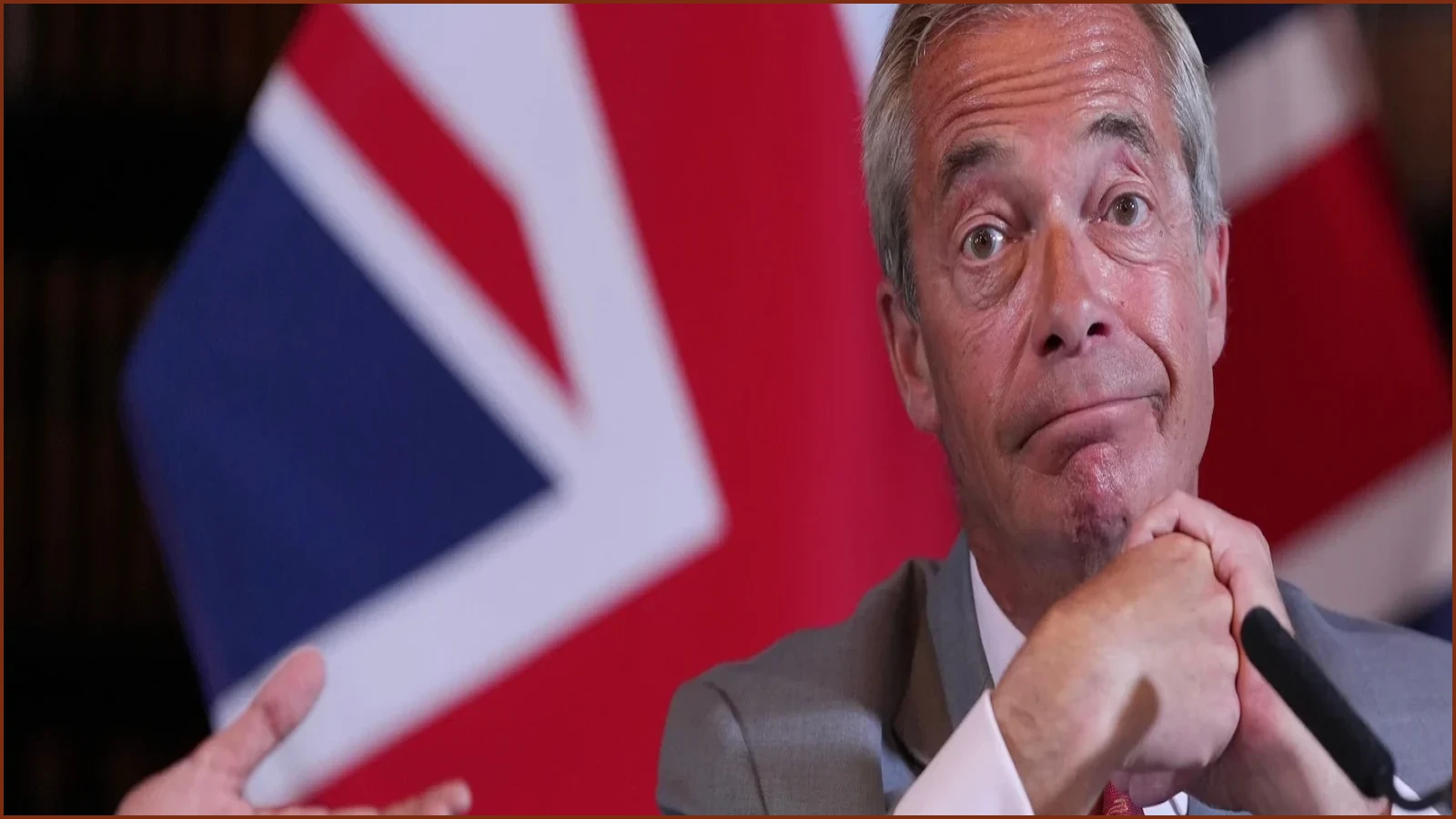
Nigel Farage, the leader of the anti-immigration party Reform UK, finds himself in an unfamiliar position as he campaigns in a special election in the English seaside town of Clacton. While he has long styled himself as an outsider challenging the political establishment, he is now the incumbent favorite in a race that has drawn a bizarre array of challengers, most notably a candidate dressed as a garbage can known as Count Binface.
Farage, a prominent ally of U.S. President Donald Trump, triggered this special election by resigning from his seat in the House of Commons last month. Amidst mounting questions regarding his personal finances, he framed the contest as a battle of “people versus the establishment.”
However, major political parties, including the governing Labour Party, the Conservatives, the Liberal Democrats, and the Greens, have declined to field candidates, viewing the election as a political stunt. This has left Farage to compete against an assortment of nearly three dozen independents, jokers, and single-issue candidates, including representatives of the Rejoin EU party, the Everyone is God Party, and the Monster Raving Loony Party.
The most recognizable figure in this unconventional field is Count Binface, the alter ego of comedian Jon Harvey.
His campaign platform includes a pledge to avoid accepting 5-million-pound gifts from cryptocurrency billionaires, a direct jab at Farage. Farage and his team, including board member and former press officer Gawain Towler, have dismissed such candidates as representatives of a hostile establishment attempting to undermine his candidacy. Towler stated in a blog post that the establishment is using every means available to undermine Farage before the country gets a chance to elect him.
The scrutiny surrounding Farage involves an investigation by Parliament’s standards watchdog into an undeclared donation of 5 million pounds ($6.7 million) received in 2024 from Thailand-based cryptocurrency billionaire Christopher Harborne. Farage maintains that the funds were a personal gift used for his security and were received prior to his election to Parliament.
Additionally, he faces inquiries regarding his financial relationship with George Cottrell, an aristocratic crypto-gambling entrepreneur who served eight months in a U.S.
prison for fraud a decade ago after offering to launder money for undercover agents posing as drug traffickers. Although Cottrell remains close to Farage and has reportedly provided funds for his staff and security, U.K. media report that police have interviewed Cottrell and his mother as part of a probe into donations to Reform UK, though they have not been arrested. Farage has vowed to stand by the man he calls “Posh George,” stating on August 3, “I don’t ditch my allies.”
Farage, 62, has a history of walking away from parties he led, having previously stepped down from both the UK Independence Party and the Brexit Party in the last decade. Beyond his parliamentary role, he has earned more than 2 million pounds ($2.7 million) in the past two years from speeches, promotional work, and television appearances.
While most observers anticipate a victory in Clacton, any formal finding of wrongdoing by the parliamentary investigation could result in his suspension and trigger another special election.
Reform UK currently holds seven parliamentary seats, or eight including Farage. Although the party led national opinion polls for over a year, it has recently encountered setbacks, including losses in a string of special elections, such as the one in June that brought Prime Minister Andy Burnham to power. Labour currently senses a “Burnham bounce,” while Conservative leader Kemi Badenoch has found her footing, and the far-right party Restore Britain is also competing for support.
Political experts offer mixed perspectives on the situation. Simon Usherwood, a professor of politics and international studies at the Open University, noted that while Farage’s charismatic, “straight-talking” persona is his greatest strength, it has also led him to believe he is immune to the scrutiny that affects other politicians.
Martin Farr, a contemporary historian at Newcastle University, suggested that Farage’s supporters will likely view his campaign as a fearless stand against the “tyranny of the establishment,” while his opponents will see it as the reaction of a thin-skinned demagogue who has reacted petulantly to scrutiny.
LONDON — LONDON (AP) — Nigel Farage depicts himself as an outsider taking on the establishment, but now the tables have turned.
For two decades, the populist Farage has led small parties with an outsized impact on British policy.