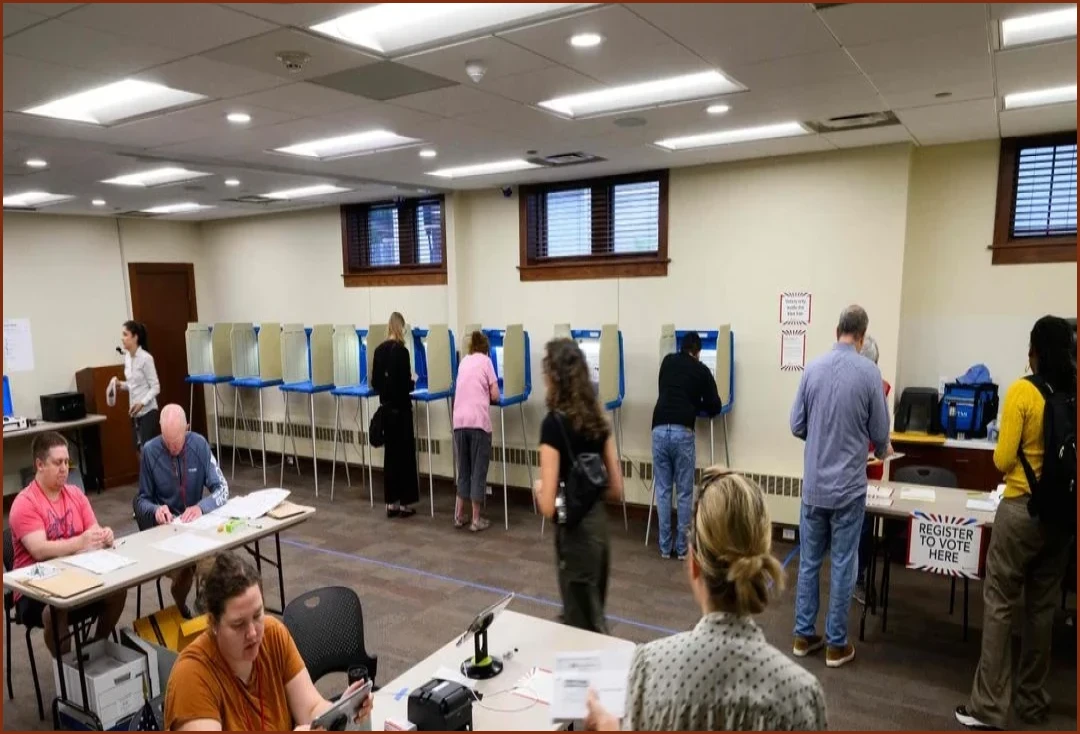
Democratic voters across multiple US states are participating in primary elections that serve as a critical test for the party's progressive wing. The results will determine whether left-leaning candidates can maintain their momentum in contests that could ultimately shape the control of Congress in the upcoming November midterms.
The most significant battleground is Minnesota, where Lieutenant Governor Peggy Flanagan is competing against congresswoman Angie Craig for the Democratic nomination to succeed the retiring Senator Tina Smith. Flanagan has secured high-profile endorsements from Smith as well as prominent progressives Elizabeth Warren and Bernie Sanders. Conversely, Craig is backed by Democrats who view her track record in competitive elections as a safer strategy for the general election. Addressing the financial influence in the race, Flanagan stated on X that special interests believe they can purchase the Senate seat with $20 million, but she remains confident in grassroots organizing.
The tension in Minnesota is further heightened by debates over immigration enforcement. Flanagan has criticized Craig for her support of the Laken Riley Act, a Republican-sponsored immigration measure. Craig, while emphasizing her focus on electability, has since expressed regret regarding that specific vote. This primary follows a recent narrow victory by Abdul El-Sayed in Michigan’s Senate primary, a win that energized progressives while highlighting the potential for polling inaccuracies in low-turnout environments.
In Wisconsin, the progressive movement faces a different challenge in the gubernatorial race. Democratic socialist Francesca Hong is widely regarded as the frontrunner, though her candidacy has sparked concern among some establishment Democrats regarding her electability in a closely divided state. Milwaukee County Executive David Crowley has emerged as the primary moderate alternative. Notably, national progressive figures like Alexandria Ocasio-Cortez and Bernie Sanders have refrained from endorsing in the race, despite Hong's candidacy representing the broader leftward pressure observed in New York, Colorado, and Michigan. Republicans have utilized these developments to frame the November elections as a choice between their own common sense and what Donald Trump describes as socialist or communist extremism.
Meanwhile, in South Carolina, Republicans are navigating their own internal dynamics. Senator Darline Graham, appointed following the death of her brother Lindsey Graham, is seeking the party nomination for a full term with Donald Trump's support. She faces a crowded field, including former governor Mark Sanford and congressmen Russell Fry and Ralph Norman. Donald Trump recently held a telephone rally for Graham, labeling her the ideal person to continue her brother’s legacy. However, opponents like Fry have criticized her lack of political experience and argued that she inherited her position rather than earning it through traditional means. A runoff is considered likely if no candidate secures over 50 percent of the vote, though the seat is considered safely Republican.
The broader ideological divide between the left and center remains a recurring theme in Tuesday's primaries, including in Alabama, where voters are selecting House nominees under a new map that eliminates one of the state's two majority-Black districts.
They've spent $20 million to do it," Flanagan posted on X ahead of polls opening."But I have seen what Minnesotans can do when we organize together.