Leaders within the Pacific Islands Forum (PIF) are being urged to closely monitor the waters east of Taiwan, a region increasingly influenced by Chinese maritime activities that have direct implications for the economic and security interests of Pacific Island nations. This strategically integrated maritime space connects Northeast Asia with Micronesia, Melanesia, and Polynesia.
The PIF, preparing for its 55th meeting in Palau from August 30 to September 4, recently saw its Foreign Ministers fail to reach a consensus on a joint statement criticizing China's submarine-based ballistic missile testing in the Pacific. This division highlights the growing geopolitical competition and differing threat perceptions among member states and external powers, despite increasing concerns over China's military presence.
Beyond missile tests, the normalization of Chinese naval and coast guard operations east of Taiwan poses a less visible but significant pressure point. These waters serve as a critical gateway to the exclusive economic zones that the PIF aims to protect, making them a crucial area for regional attention. Beijing appears to be leveraging unresolved maritime boundary negotiations with Japan and the Philippines to justify expanded coast guard patrols and the deployment of research vessels in this area. Many of these vessels are former naval ships, blurring the lines between law enforcement and strategic power projection.
China's increasing frequency and persistence of deployments along Taiwan's Pacific coast signal an effort to establish a sustained maritime security presence in the Blue Pacific. This expansion occurs alongside broader Chinese naval operations in the Western Pacific, with carrier strike groups conducting exercises beyond the first island chain and China's third aircraft carrier, the Fujian, nearing full operational capability, suggesting a regular carrier presence is becoming feasible.
The growing presence of Chinese vessels east of Taiwan indicates a gradual extension of its maritime operating space from the Taiwan Strait into the Pacific approaches. For Pacific Island countries, this development is more than just an extension of cross-strait tensions; it could lead to increased uncertainty along commercial shipping routes, higher maritime insurance premiums, longer transit times, and complications for the movement of essential imports like energy and food.
Even without direct conflict, heightened tensions or more frequent military exercises could cause delays and increased transportation costs for nations heavily reliant on this maritime corridor. China's expanding reach east of Taiwan directly intersects with the trade routes and supply chains vital to Pacific Island economies.
The PIF's motto of being "friends to all and enemies to none" should not be misinterpreted as a shield against strategic shifts. The maritime status quo east of Taiwan is being reshaped by China's growing presence. In a potential Taiwan contingency, Beijing might attempt to control the Taiwan–Philippines–Melanesia corridor, potentially restricting U.S. and allied access to the Western Pacific.
Preserving free, open, and non-militarized sea lines of communication across the Western Pacific is a vital interest for Pacific Island states. They should clearly articulate this interest before regional power balances become irreversible. The PIF's "Ocean of Peace" framework should encompass the waters east of Taiwan as part of the interconnected Pacific maritime space, rather than treating it as a separate entity.
The argument is not to redefine the Blue Pacific identity but to acknowledge the strategic integration of the maritime space stretching from Northeast Asia through the Pacific Islands. Developments in one part of this arc can directly affect access, connectivity, and security in others. Recognizing this interdependence is a practical matter of maritime awareness, not a call for Pacific states to reframe their identity or choose sides in cross-strait politics.
The core interest at stake is preserving a maritime environment where all actors can navigate freely and maintain economic access without coercion or militarization. Even if consensus on specific issues like China's missile testing remains elusive, PIF members could still agree on preserving a free, open, peaceful, and resilient Blue Pacific maritime corridor. This would involve extending the "Ocean of Peace" concept to include the waters east of Taiwan.
The forum could enhance information sharing on vessel movements and coast guard activity in this corridor, providing Pacific Island states with earlier warnings of potential disruptions to their vital shipping lanes. Such cooperation could form a common basis for working with partners on maritime domain awareness, infrastructure resilience, and the security of regional sea lines of communication, anchoring efforts in a shared interest in an open and resilient Pacific maritime space rather than specific major power behaviors.
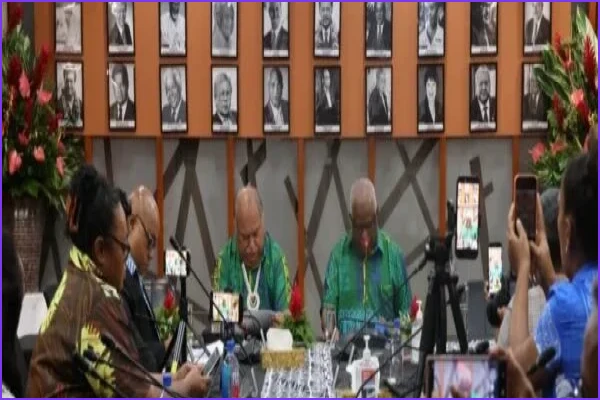
Chair and Solomon Islands Minister for Foreign Affairs and External Trade, Hon. Rick Houenipwela, joined Secretary General, Baron Divavesi Waqa, in taking questions from regional and international media during a press conference following the recent Foreign Ministers Meeting.
You have reached the limit of 2 free articles this month.