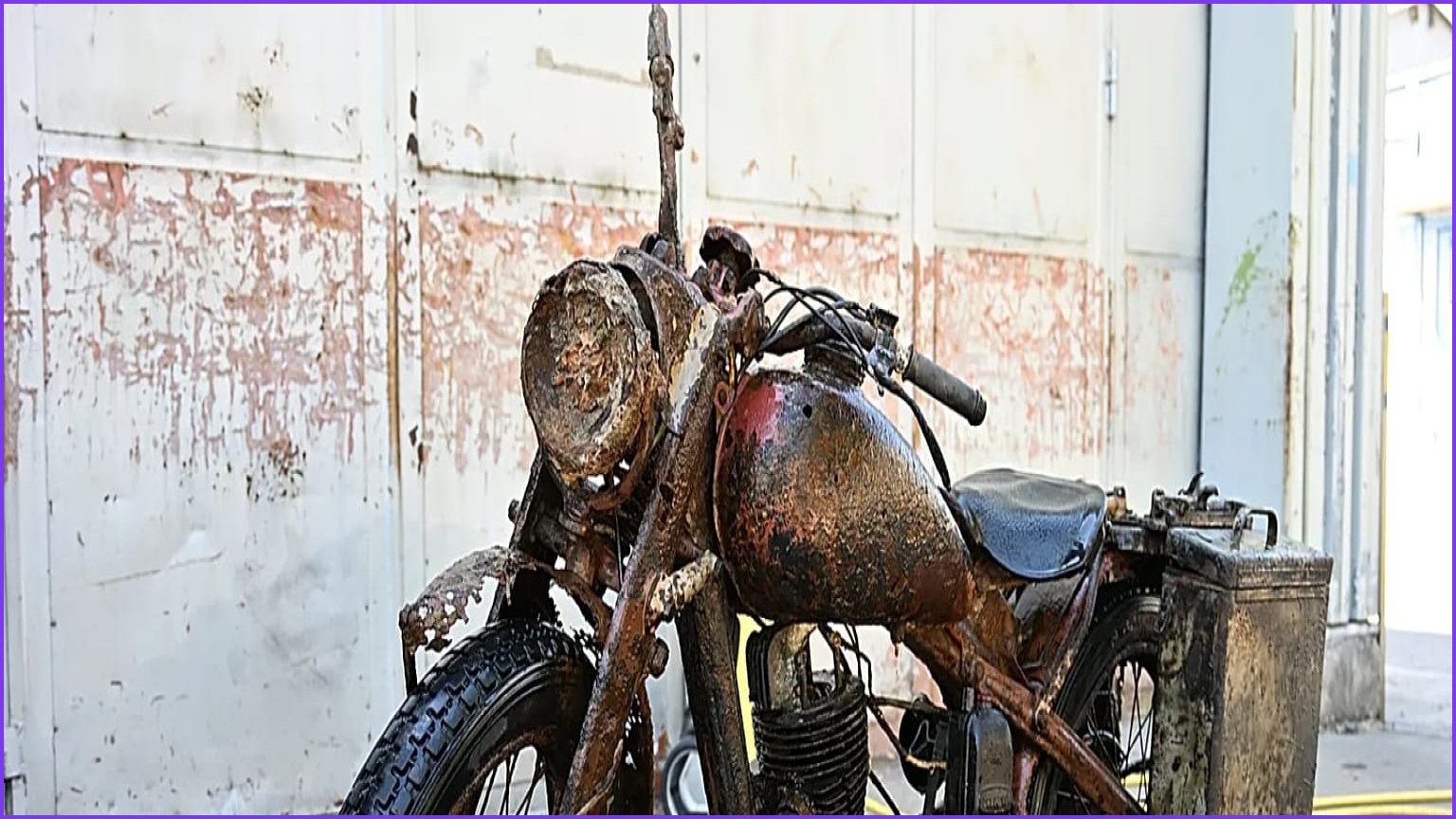
A rare and remarkably well-preserved Wehrmacht motorcycle has been recovered from the bed of the Danube River in Budapest, drawing significant global attention from media outlets ranging from the Times of India and Vietnam.VN to the British Daily Mirror and various US platforms. According to Hungary's Institute and Museum of Military History, the machine is a DKW NZ 350-1, a model specifically developed for wartime use starting in 1944. The museum successfully recovered the motorcycle on August 2 at Batthyány Square, located directly opposite the Hungarian parliament. When lifted from the water and mud, the machine weighed more than 200 kilograms. It is currently being cleaned and preserved in a museum hangar in Budapest.
The DKW NZ 350-1 was produced between 1944 and 1945, with just under 12,000 units manufactured before the end of the Second World War. These machines were part of a lineage of robust and reliable motorcycles, following the earlier NZ 250 and NZ 350 models. A notable feature of the recovered bike is a small "fin" on the rear frame, which functioned as a mud and snow scraper. This modification, likely inspired by experiences during the Russian winter, prevented debris from sticking to the tyre and clogging the chain drive. Additionally, the engine block is made of grey cast iron, a high-graphite iron casting alloy used due to the severe wartime shortage of aluminium.
The history of the DKW brand traces back to 1907, when Danish engineer Jørgen Skafte Rasmussen established a mechanical and steam engineering business in Zschopau, Saxony. The brand name, which originally stood for "Dampfkraftwagen" (steam-powered vehicle), saw its first two-stroke engine built in 1922. By 1932, DKW joined forces with Audi, Horch, and Wanderer to form Auto Union AG, with the Zschopau plant remaining the center of engine and motorcycle production. As Germany rearmed during the 1930s, the plant's output shifted heavily toward military demand. The importance of the Zschopau facility was evident in its production figures, reaching the 350,000th motorcycle in 1934 and the 500,000th by 1939.
Following the war, the Zschopau plant was dismantled by Soviet occupying forces, with machinery and equipment transported to the Soviet Union. Engineers were also transferred to Izhevsk to assist in rebuilding production there. The legacy of the NZ 350 continued with the IZh-350, a model technically based on the DKW design, which saw over 127,000 units produced between 1946 and 1951. Regarding the recent discovery in the Danube, researchers also found several original equipment items in the dried-up riverbed, including a petrol can, a Y-strap, and a bayonet frog. The Y-strap, named for the shape of its shoulder harness, was used to secure gear like ammunition pouches, bread bags, or water bottles, while the bayonet frog served as a holder for a bayonet when it was not fixed to a rifle.
The recovery also uncovered the mortal remains of two German soldiers beneath the motorcycle. Their identity tags were fully preserved, potentially offering a way to identify the individuals after more than 80 years. A "Kuban" sleeve shield was also discovered, which may indicate that the wearer had previously served at the Kuban bridgehead in the Caucasus. While it is currently assumed that the remains belong to the motorcycle's rider and passenger, the Hungarian Institute of Military History has offered an alternative theory: the site may have been a wartime rubble or refuse pit created after the siege ended, where ammunition and equipment were dumped. Consequently, the circumstances of the find do not currently allow for a definitive conclusion as to whether the two men were riding the motorcycle at the time of their deaths.