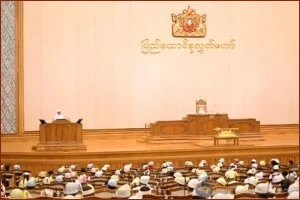
Myanmar’s President Min Aung Hlaing has publicly criticized the Association of Southeast Asian Nations (ASEAN) Five-Point Consensus, accusing member states of practicing discrimination against his country. The remarks were delivered during a joint session of parliament on July 31, 2026, marking the president's first 100 days in office since transitioning from his role as military chief following the 2021 coup.
According to a transcript provided by the Myanmar News Agency, Min Aung Hlaing stated that while certain ASEAN members have adopted positions regarded as discriminatory over the past five years, his government has maintained patience and continued to fulfill its regional responsibilities. The leader further argued that the Five-Point Consensus, established in Jakarta in April 2021, was not a collective agreement of all members but rather a statement by the then-chair, Brunei, without prior circulation of a draft. This perspective aligns with recent comments from Myanmar’s Ministry of Foreign Affairs, which claimed the Consensus was added as an annex to a chair's statement without reaching a formal regional agreement.
The military-backed administration has demonstrated increasing defiance regarding the plan, which originally called for an immediate end to violence, the appointment of a special envoy, access to humanitarian aid, and dialogue among all parties. Instead of implementing these measures, the junta has characterized opposition groups as “terrorists” and sought to defeat them by force. Consequently, ASEAN has barred Myanmar’s leadership from regional summits since late 2021. Current ASEAN special envoy Ma. Theresa Lazaro of the Philippines has stated that full reintegration for Myanmar remains distant due to a lack of compliance with the bloc’s requirements.
Despite this, Min Aung Hlaing confirmed that his government intends to pursue its own “solution” to the national conflict. He outlined a five-year roadmap, with the first two years dedicated to laying groundwork and the subsequent three years focused on accelerating nation-building. His plan includes strengthening the armed forces, establishing a “people’s militia” for internal security, and continuing unconditional talks with ethnic armed organizations, noting that discussions with 13 groups have already occurred.
The administration also plans to hold by-elections next year for 172 constituencies that were excluded from the December and January elections. Furthermore, Min Aung Hlaing emphasized infrastructure development, including the Mandalay-Muse railway to bolster trade with China, an India-Myanmar-Thailand highway project, and ongoing work on 10 power generation projects. These energy initiatives include the contentious Myitsone dam and a stated commitment to pursuing nuclear power plant construction.
You have reached the limit of 2 free articles this month.
The administration will continue to strengthen the power of the armed forces, and will set up a “people’s militia” to help ensure “internal security,” Min Aung Hlaing said. He added that the new-look administration had invited ethnic armed organizations (EAOs) to take part in talks without preconditions and “has so far held discussions with 13 EAOs.”