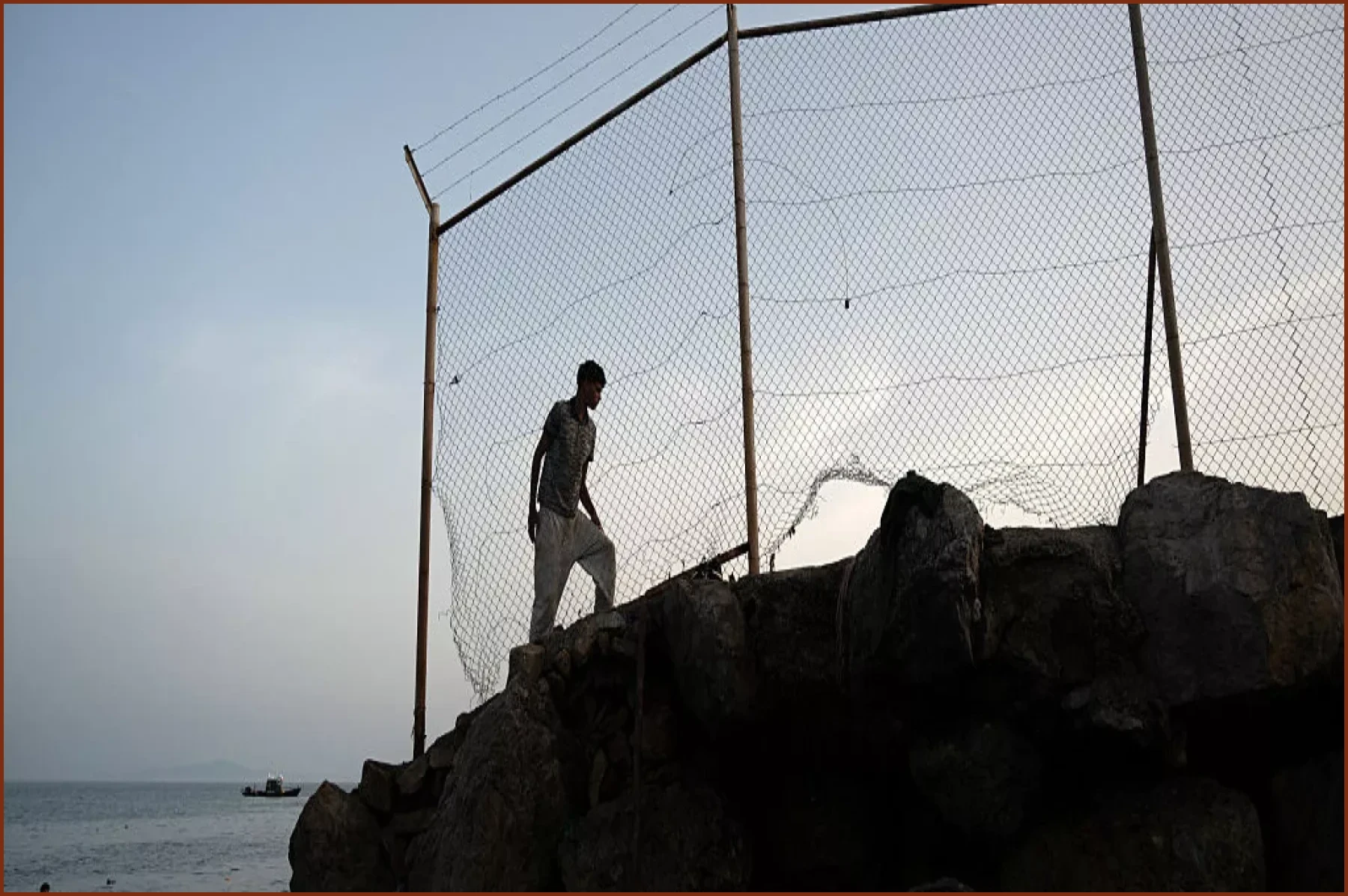
Spanish Prime Minister Pedro Sánchez is facing one of the most formidable challenges of his political career following a sudden and massive border crisis in Ceuta, the Spanish enclave bordering Morocco. Known for his ability to navigate political storms and reclaim control of the narrative, Sánchez now finds himself at the center of an escalating international and domestic dispute that threatens his standing as a leading European voice on regulated migration.
By Saturday morning, the Spanish government had declared the situation in Ceuta under control. The military was mobilized to the region, and authorities installed a 500-meter floating barrier off the border with Morocco. Spain's interior ministry has said it's deploying 60 members of the armed forces and an additional 30 Guardia Civil officers to Ceuta after tens of thousands of migrants entered the Spanish enclave.
Sánchez also sent a letter to his European counterparts, directly calling out some of them for "attacking Spain." However, the physical and political damage was already done. Images of tens of thousands of migrants crossing into Spanish territory from Morocco quickly spread across the globe, drawing sharp rebukes from conservative and anti-immigration leaders worldwide.
U.S. President Donald Trump labeled the border crossings into Ceuta a "catastrophe" and an "invasion," attributing the situation to what he described as "weak" and "very liberal" laws in Spain. The U.S. State Department also took to social media, blaming the border crisis on the migration-friendly policies of the Sánchez administration. Meanwhile, Italian Prime Minister Giorgia Meloni asserted that the crisis in Spain demonstrated the severe "threat" that irregular migration poses to European security. In response, Italy temporarily suspended its open-border Schengen agreement with Spain, reinstating air and sea border controls for travelers arriving from the country.
The crisis unfolded rapidly. What began as a moderate uptick in border crossings at Ceuta escalated into a full-scale emergency on Thursday. Within a matter of days, nearly 60,000 people crossed the border. The European Union on July 31, 2026, scrambled to contain one of the largest migrant crises faced by the bloc in recent years. Authorities have reported that at least 67 people died during the crossing, with most drowning as they attempted to swim around the breakwater that separates Spain and Morocco.
While previous mass crossing attempts have occurred in Ceuta and Melilla—including the 2021 "crisis of the minors," which primarily involved children swimming to Ceuta—the scale of this latest influx is unprecedented. Migrants attempting to enter the enclave, many of whom originate from sub-Saharan African countries, often wait near the border for months or even years for an opportunity to cross.
The sudden surge has raised questions about the role of Moroccan authorities. "I think that after almost 48 hours since the beginning of the crisis in Ceuta, we can safely say that this was a manufactured crisis," said Riccardo Fabiani, Project Director for North Africa for the International Crisis Group. Fabiani noted that testimonies from Moroccans who crossed, combined with online videos showing trucks unloading people in front of complicit Moroccan police forces, suggest this was indeed a manufactured crisis.
Conversely, Morocco's ambassador to Spain, Karima Benyaich, told reporters that the situation developed against Morocco's wishes, emphasizing that her country has always prioritized legal, orderly, and safe migration. She declined to comment on what specifically prompted the sudden mass movement.
A recent legal development in Spain may have also influenced the surge. On July 8, a Spanish Supreme Court ruling eased deportation rules for migrants entering Ceuta or Melilla. The ruling prevents law enforcement from immediately deporting migrants who swim into the territories, reversing a long-standing practice of on-the-spot expulsions without a formal legal process. Some of the migrants who successfully crossed reported reading messages on social media and messaging platforms suggesting that crossing into Ceuta had become easier and that they would be welcomed and transferred to the Spanish mainland.
The enclaves of Ceuta and Melilla have been under Spanish control for centuries, but Morocco does not recognize Spanish sovereignty over them and has repeatedly demanded their return. This territorial dispute has long been a source of diplomatic friction between Madrid and Rabat. Tensions escalated significantly in 2021 when Spain allowed Brahim Ghali, the leader of the Polisario Front—which seeks independence for the disputed, Moroccan-claimed territory of Western Sahara—to enter Spain for medical treatment.
Although Spain had historically supported a process including a potential independence referendum for Western Sahara, Sánchez's government shifted its position in 2022 to endorse Morocco's claims over the territory, a move widely seen as an effort to mend relations with Rabat.
The swift and critical responses from the United States and Israel have led some Spanish politicians to accuse foreign powers of exploiting or encouraging the border crisis. Antonio Maíllo, the general coordinator of Izquierda Unida—a key coalition partner in Sánchez's government—publicly accused Moroccan authorities of failing to prevent the crossings. Maíllo suggested the security lapse may have been an intentional act of retaliation against Spain for its diplomatic stances.
Pointing out Morocco's close alliances with both the U.S. and Israel, Maíllo argued that these nations harbor resentment toward Sánchez after Spain took a firm stance "against the genocide in Gaza" and refused to allow the U.S. military to use jointly operated bases on Spanish soil for the war in Iran.
Relations between Spain and Israel have been highly strained due to Spain's position as one of Europe's most prominent critics of Israel's military actions in Gaza. Similarly, friction between Trump and the Spanish government has persisted since last year, when Spain refused to increase its military spending to 5% of its GDP as demanded by Trump for NATO members. Tension peaked in late February, shortly after a joint U.S. and Israel attack on Iran, when Spain blocked the U.S. military from utilizing joint bases in southern Spain. Following this decision, Trump criticized the Spanish government from the Oval Office in early March, stating that Spain has "great people" but lacks "great leadership," and threatened to halt all trade with the country.
The events in Ceuta have also energized European right-wing parties. Italian Prime Minister Meloni declared that Italy would "not back down by a single millimetre" in its efforts to halt illegal immigration. Italian Foreign Minister Antonio Tajani defended the suspension of Schengen travel with Spain as a necessary measure to protect citizens and defend European borders against potential security and terrorist threats. On Saturday, Meloni co-initiated a letter signed by leaders of 22 of the EU's 27 member states, calling for an emergency meeting to address the Ceuta border crisis and secure Europe's external borders.
This collective action has framed Sánchez's relatively liberal migration policies as a broader liability for the European Union. Danish Prime Minister Mette Frederiksen echoed these concerns, calling uncontrolled immigration a threat to Denmark and Europe, and suggesting the EU consider suspending Schengen cooperation with Spain.
While Sánchez has championed regulated migration, his administration has consistently rejected the idea of open borders. Under his leadership, Spain has provided millions of euros in loans and grants to West African nations, such as Senegal and Mauritania, to fund coastal patrols and deter migrant departures. The Spanish Civil Guard remains actively deployed along those coasts to intercept departing vessels. However, Sánchez has actively supported legal pathways, recently approving residency and work permits for hundreds of thousands of eligible undocumented migrants already residing in Spain, a program that drew over a million applications.
In a February op-ed published in The New York Times, Sánchez defended his approach, writing that Spain's economic success was partially driven by its integration of migrants. He warned that governments could either adopt the "zero-sum thinking of the far-right" or choose to harness migration to help societies thrive. Despite his defense, the crisis in Ceuta highlights Sánchez's growing isolation within a changing European political landscape. How he handles the fallout will test his well-established reputation for surviving major political crises, which have previously included the COVID-19 pandemic, the devastating 2024 Valencia floods, a nationwide blackout in 2025, and ongoing historic wildfires.
Spaniards even joke about his capacity to handle one crisis after another: "the only thing left is an alien invasion."
Maíllo concluded: "Nothing is a coincidence when it comes to Morocco's actions."