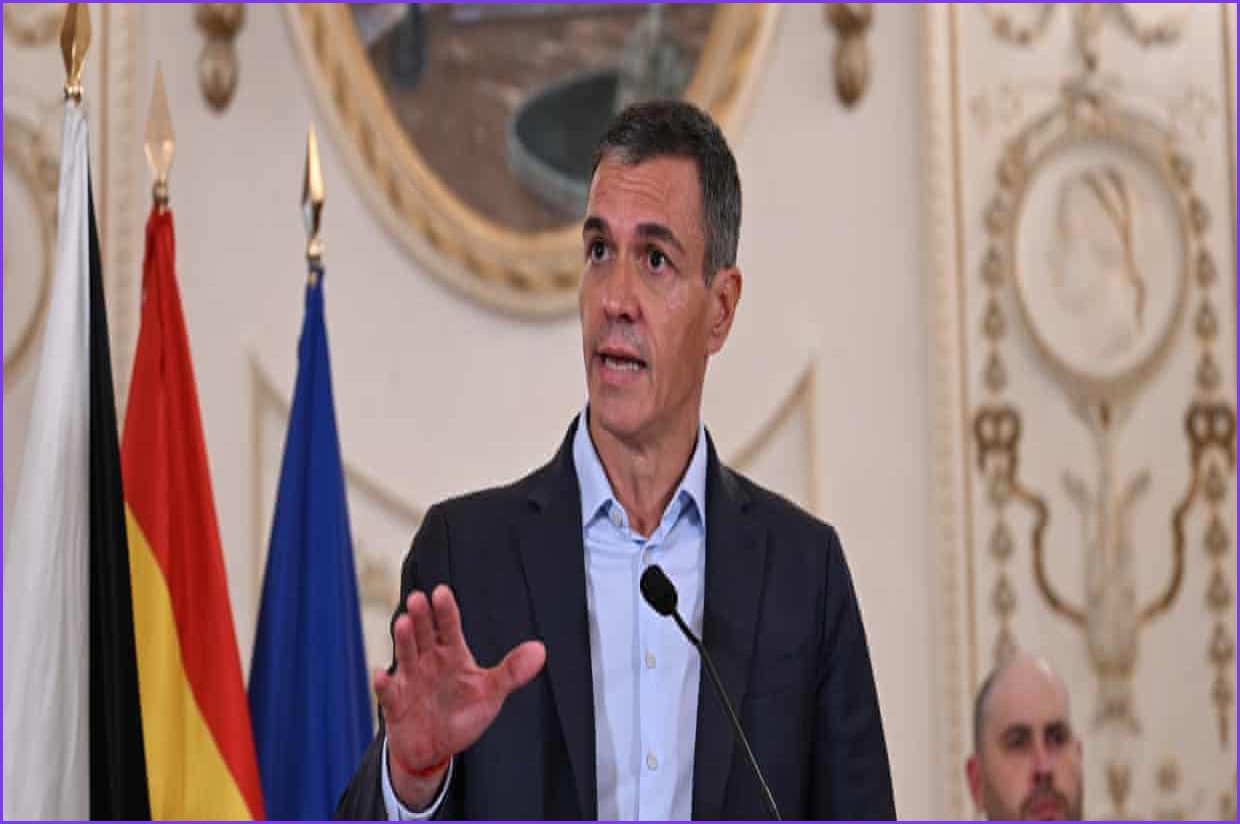
Spanish Prime Minister Pedro Sánchez has formally requested an urgent meeting of European Union interior ministers in response to the recent mass border crossing into the north African enclave of Ceuta. Sánchez condemned what he termed the “selfish, polarising and unlawful” reaction of some member states following the events of Thursday and Friday, during which over 50,000 people entered the territory from Morocco.
The crisis resulted in at least 67 deaths, with victims either drowning or being crushed while attempting to navigate a breakwater barrier. While the Spanish government reported that more than 48,000 individuals had voluntarily returned to Morocco by Friday evening, local officials in Ceuta remain cautious. Juan Jesús Vivas, the president of Ceuta, stated that several thousand people have yet to depart, describing the current atmosphere as one of continued unease and concern. Vivas has urged that security measures currently deployed in the city remain in place to ensure public safety.
The influx has strained unity within the European Union regarding external border policy. Italy notably announced on Friday that it would suspend Schengen arrangements with Spain for one month, a move that Sánchez criticized as being driven by “prejudice, fake news, ignorance or political interest.” In a letter addressed to European Commission president Ursula von der Leyen, European Council president António Costa, and Irish Prime Minister Micheál Martin, Sánchez defended Spain’s record, citing Frontex data that suggests Spain’s external borders are significantly less porous than those of Italy.
In response to the tension, von der Leyen welcomed the proposal for a video conference to address the situation, emphasizing that managing migration requires a unified European response. Meanwhile, French interior minister Laurent Nuñez clarified that suspending Spain from the Schengen free-movement zone is not being considered, noting the strong cooperation between the two nations. A “political crisis response team,” chaired by Ireland’s justice minister, Jim O’Callaghan, was scheduled to meet on Saturday to discuss the developments.
By Saturday morning, the situation in Ceuta was reported as calm, with Spanish authorities reinforcing police and military presence. Workers began installing new containment barriers at the Tarajal beach breakwater, including a 500-metre-long inflatable structure and anchored buoys. Migrants remaining in the area, such as 19-year-old Souleil Boyan from Senegal, cited a lack of opportunity in Africa as the primary driver for their journey.
The recent surge far exceeds the scale of the May 2021 crossing, when approximately 10,000 people entered the enclave amid diplomatic tensions between Madrid and Rabat. While some analysts have sought to link the current events to recent political shifts or court rulings, migration experts like Mauricio Valiente, director general of the Spanish Refugee Aid Commission, argue that the causes are complex and that simplifying the situation into a direct cause-and-effect relationship is unfounded.
Although more than 48,000 people had voluntarily returned to Morocco by 6pm on Friday, the influx triggered a political crisis for the Madrid government and led some fellow EU countries to call for Spain to be suspended from the Schengen free-movement zone.
In a pointed rebuke to Italy, he noted that Spain was “according to Frontex, one of the least porous external borders of the European Union, with a number of irregular entries that is half that recorded, for example, in Italy in recent years (2021–26)”.