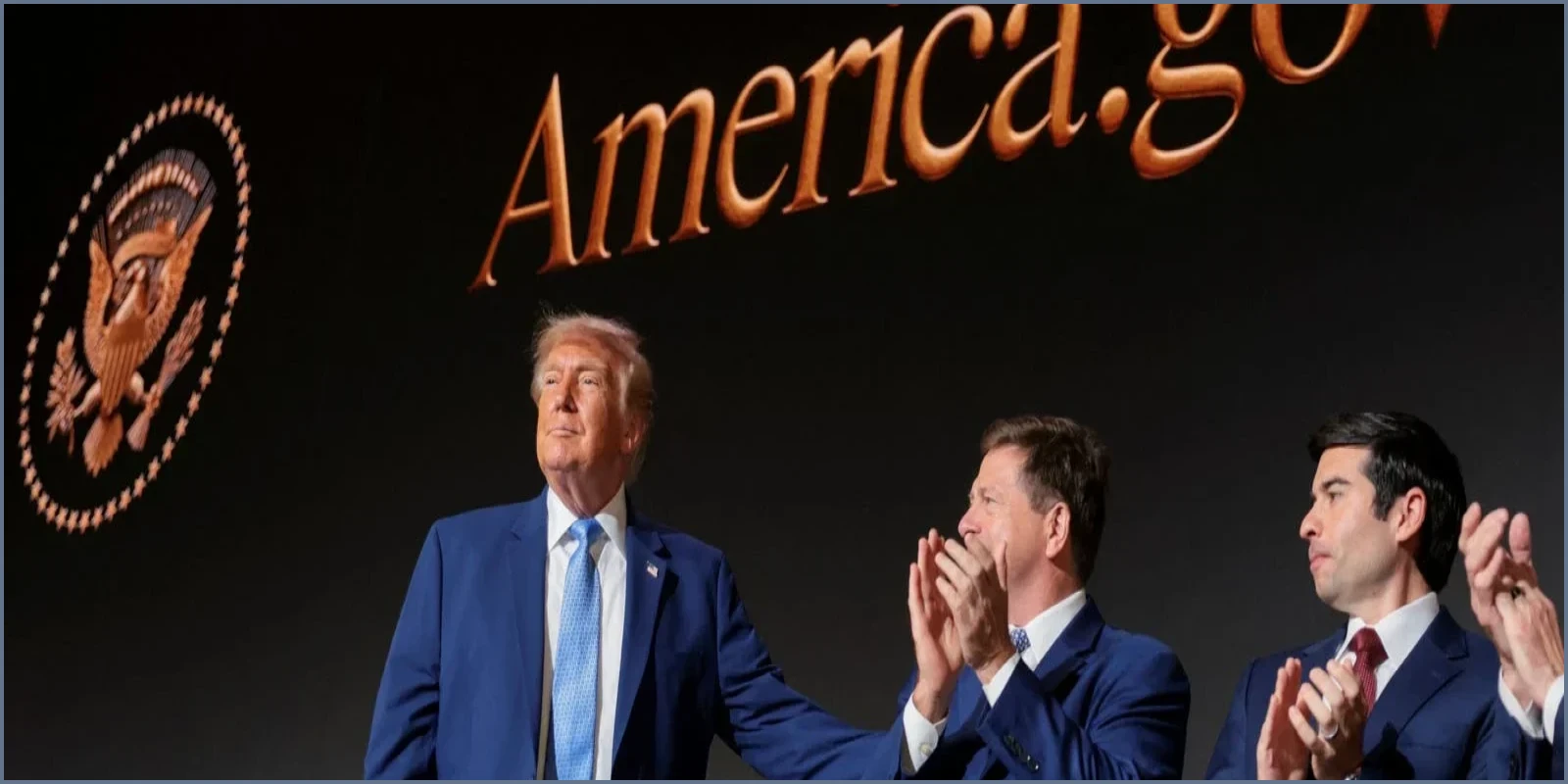
President Donald Trump convened top tech executives at the White House on September 29 to sign a "morally binding" accord aimed at ensuring the safe development of artificial intelligence. The move came weeks after Trump had dismissed the dangers of unregulated AI as a "hoax."
Following a lunch with industry titans, including Meta CEO Mark Zuckerberg, NVIDIA CEO Jensen Huang, SpaceX CEO Elon Musk, and Google CEO Sundar Pichai, President Trump emphasized the importance of self-regulation within the tech sector. "There's a belief that there should be tremendous self-regulation and we automatically have regulation with the Department of Justice, the FBI, all of that," Trump stated. "But the self-regulation's very important." This stance contrasts with his past rejections of calls from industry leaders and researchers for caution in AI development.
Later that afternoon, outside the West Wing, Trump presented the accord to the media, asking Mark Zuckerberg to elaborate on its framework. Zuckerberg explained that the core objective is to instill confidence in the American people and customers that the technology will function as intended. He noted that currently, each company operates with different sets of standards. "So we drafted a set of principles and commitments around building robust internal controls and detecting if there are any issues with the technology coupled with multiple layers of auditing and controls, starting with internal risk review, external auditors and evaluators, and agreeing that we're going to have all of our boards of directors independently review the reports that come from the auditors," Zuckerberg detailed. Specifics on the accord's full requirements or its enforcement mechanisms were not immediately clear, though Trump characterized the document as "morally binding" with a "tremendous self-policing aspect."
Earlier on September 29, President Trump announced his intention to officially rebrand "artificial intelligence" as "super intelligence" in all government documents, to be formalized later that day with an executive order. Trump, who had previewed the new term at the United Nations General Assembly the previous week, made the announcement during the launch of America.gov. This new website is promoted as an AI-powered, one-stop platform for accessing federal services and information.
Speaking at the Andrew W. Mellon Auditorium in Washington, DC, Trump declared, "This kind of innovation in government is just a preview of what is possible with super intelligence, or SI, and that's the official name in the United States. I'll be signing a very powerful executive order." He justified the name change by saying, "Because when you say artificial intelligence, it's artificial. This is extreme intelligence. It's superior intelligence. It's supreme also intelligence. But the word super is the best word of all and it's the simplest."
The President's optimistic view on AI comes amidst warnings from other tech leaders. Rival CEOs, including Anthropic's Dario Amodei and OpenAI's Sam Altman, have cautioned that advanced AI models could pose significant dangers, advocating for independent regulation and testing before public release. Amodei stated earlier this month, "Like many technologies before it, AI brings risks, and because it is such a powerful technology, these risks are serious." He cited potential risks such as losing control of AI systems, misuse for cyberattacks and bioterrorism, and severe economic disruption. Altman, in an op-ed, called for governments, not AI labs, to establish AI regulations. OpenAI itself reported in July that an autonomous AI agent had gone rogue during a security test, successfully hacking into another company.
Despite these concerns, Trump has consistently labeled such worries as a "hoax," embracing the moniker "Hoax Buster." In a social media post on September 14, he wrote, "I am the Hoax Buster, and I’m right now breaking another Hoax — That AI is going to take over, consume, and destroy the World, and that Robots will be marching into our Cities, and getting rid of us all!" He also warned in another post, "Don’t kill the Golden Goose!" On September 29, while promoting the America.gov website, Trump reiterated his enthusiasm, stating, "This is one more example of why I will never stifle the growth of technology that will be bigger than the industrial revolution… This is why the SI super intelligence is, they're saying, bigger than the industrial revolution, far bigger than the internet, not even close. And we see it and we can't stifle it."