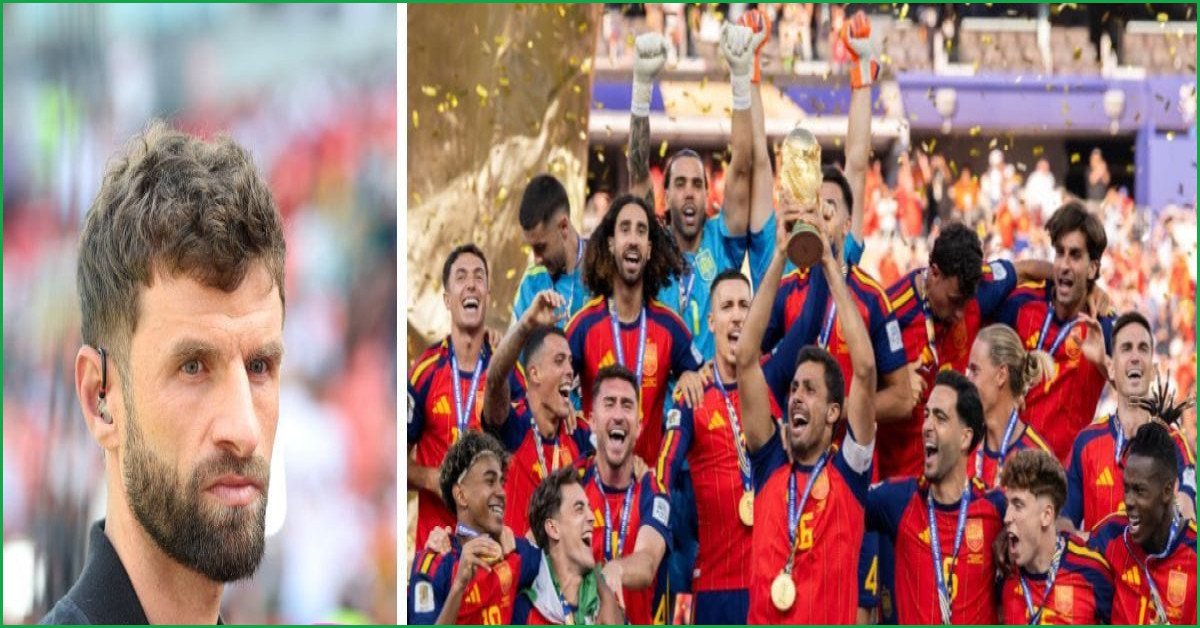
Following Spain’s victory over Argentina in the 2026 FIFA World Cup final, former Germany international Thomas Muller has pointed to a compelling sequence of events that he believes could favor Germany for the 2030 title. Spain secured their second world title with a 1-0 win in extra time, mirroring their historic 2010 run.
Muller, a key figure in Germany's 2014 championship squad where he recorded five goals and three assists, noted that the official FIFA World Cup account recently highlighted tournament winners since 1930. He observed that Spain’s first title in 2010 was followed by a German victory in 2014, establishing a precedent he suggests could repeat in the next cycle.
The parallels between the 2010 and 2026 tournaments extend beyond the final score. In 2010, Andres Iniesta netted the decisive goal in the second half of extra time against the Netherlands. Similarly, in 2026, Ferran Torres scored the winner in the 106th minute. Furthermore, both finals saw the opponents suffer a red card; John Heitinga was dismissed in 2010, while Enzo Fernandez was sent off for two bookable offenses against Spain in the 2026 match. Additionally, Spain entered both tournaments as the reigning European champions.
The 2026 edition, which featured 48 teams across the United States, Mexico, and Canada, saw 308 goals scored in 104 matches. While fans reflect on the recent tournament, focus now shifts to the 2030 FIFA World Cup, which will be co-hosted by Spain, Portugal, and Morocco. To commemorate the 100th anniversary of the inaugural tournament in 1930, single matches will also be held in Uruguay, Argentina, and Paraguay.
The 36-year-old scored five goals and provided three assists, finishing behind James Rodriguez and Lionel Messi for the Golden Boot and Golden Ball, respectively.Who will host the 2030 FIFA World Cup?The 2026 FIFA World Cup lived up to the billing with lots of drama, controversies and fun moments.