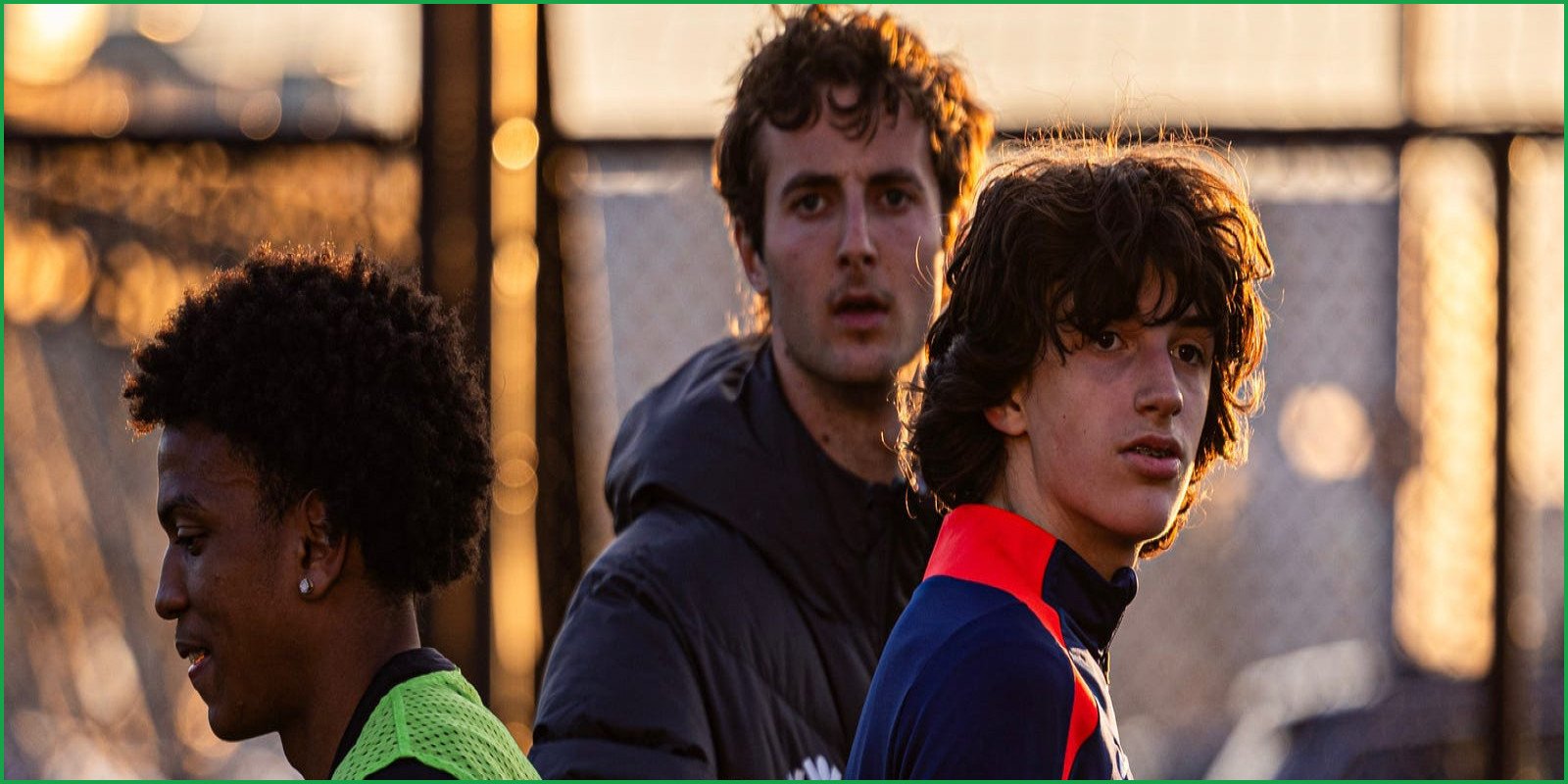
The journey of Keanu Stingone in youth sports began in Austria, where his parents, Pascal and Natascha, had relocated to be closer to Natascha’s family after originally meeting in the United States. Between the ages of 2 and 6, Stingone fell in love with soccer through a local grassroots program where he became completely absorbed in the sport. However, when the family eventually relocated back to the United States, Keanu was suddenly thrust into the intense and demanding realities of the American youth sports system—an experience he describes as feeling less like a game and more like drowning.
"Some 8-year-olds over here are, compared to over there, just taking it full tilt already," says Keanu Stingone, who is now a 21-year-old rising senior at Manhattanville University, where he plays on the collegiate soccer team. "I was just looking to have fun. I joined an academy at 6 years old, ended up playing there for a few years, ended up moving to another academy, immersing myself into this American youth landscape where it gets real competitive at a young age, kind of cutthroat at a young age. Not really a thing in Europe. Europe is more developmental, more enjoying yourself, more having a good time, nurturing the players."
By the time Stingone reached the age of 12, he was playing for a highly competitive professional academy in the United States. However, the relentless pressure and cutthroat environment took a heavy toll, leading him to burn out and walk away from the sport entirely. "It's like, 'Wow, this went from like 0 to 100 really quick,'" Stingone recalls. "And that's a lot for a young kid to take on. Sometimes people say, 'You just don't have the mentality.' I don't expect a 12-year-old to have that mentality."
This narrative of early burnout is a familiar one for many soccer parents, who often find themselves shelling out thousands of dollars each season to keep their children enrolled in elite clubs and on the perceived "track" to success. Many parents resign themselves to this financial and emotional burden, believing there is simply no other way for their children to participate. However, as soccer fans watched Team USA flame out of the World Cup round of 16 against Belgium, while three European nations—Spain, France, and England—joined the powerhouse Argentina in the tournament's semifinals, Stingone and Youth 4 Youth FC founder Brando Babini are challenging parents to adopt a completely different perspective on youth athletic development.
Babini, now 21, is a former professional academy player and collegiate recruit who took matters into his own hands at a young age. He was only 16 years old when he founded Youth 4 Youth FC as an enterprising high school student, driven by the desire to carve out a different path for himself and others. He wanted to teach the game, believing that the best people to coach young players are "peers" like himself and Stingone, who are only a few years older than the children they are mentoring.
"I was unguided through the whole process," says Babini, who, like Stingone, grew up in New York City and was raised by a household featuring one European and one American parent. "My parents never really understood what was happening. I didn't have a big brother who played soccer, and that's exactly what I was missing. I was missing that peer-to peer-mentorship." Today, Stingone serves as the organization's director of coaching, working alongside Babini to reshape how young athletes experience the sport.
The recent World Cup cycle has sparked intense national conversations about the structural flaws within the American youth soccer system. Following Team USA's exit from the tournament, American soccer icon and television personality Landon Donovan spoke candidly about the deep-seated issues plaguing the country's developmental pipeline. Donovan suggested that the current American system does not necessarily identify or cultivate the most talented children; instead, it merely sifts through the pool of families who can afford to pay the exorbitant fees charged by elite clubs.
To illustrate this point, Donovan shared a deeply personal story during an interview with Front Office Sports. His own eight-year-old son had been playing for a large, prominent youth club in San Diego for two years. However, as the club began prioritizing physical metrics, seeking out bigger, faster, and stronger children, Donovan's son was abruptly demoted to a lower-tier team.
"These kids love each other," Donovan said of his son's teammates. "I mean, they are brothers. They're hanging out all the time. It has brought my son so much joy. … I called the people, and I said, 'What are you guys doing?' I was crying in bed with my son and my wife, telling him he was now on the B team and that he's not gonna be with his friends. And we're trying to couch it, like, 'This will be great for you. You'll play more.' And he just said to me, 'I just wanna play with my friends.' And it broke my heart. Now he's gonna fall out of love with the game a little bit because of this, and that's not worth it."
Donovan's warning about children falling out of love with sports resonates deeply with Stingone's own path. After walking away from club soccer at age 12, Stingone sought refuge in a different sport entirely, turning to pickup basketball to find the temporary escape and joy that soccer had once provided him. "I was playing basketball my freshman, sophomore year(s) during COVID, playing outdoors all the time, just having fun with my friends," Stingone says. It was not until his junior year of high school that he decided to return to soccer, but he chose to do so on his own terms. He bypassed the high-pressure academy system entirely, opting instead to play high school soccer for Archbishop Molloy in Queens alongside his close friends.
This decision to prioritize fun and camaraderie over elite academy pressure ultimately led to an unexpected opportunity. During his high school career, a scout from Manhattanville University—a Division III school located in the northern suburbs of New York City—attended one of his games to evaluate a different player. Stingone played exceptionally well, catching the scout's eye. During his freshman year at Manhattanville, Stingone was deeply inspired by his coach, Sean Reilly, who instilled in him a desire to one day lead and coach a collegiate soccer program of his own.
Babini experienced a similar journey of self-discovery and pressure during his own high school years. When he looks back at old video footage of himself playing soccer in high school, he sees a young athlete who was visibly stressed and unable to fully enjoy the moment. Today, when playing recreationally, he feels much looser and more at ease. This transformation occurred during his college recruiting process, when he came to the realization that the demanding lifestyle of a collegiate student-athlete was not the right fit for him. Although he was recruited to play soccer by Division III Pomona College, he was also accepted to Brown University as a non-athlete. With the patient guidance of Pomona's coach, Babini was able to evaluate his goals and ultimately chose to attend Brown, where he is currently pursuing his undergraduate degree as a part-time student while actively running his business.
"I tell kids, 'Playing college might not be for you,'" Babini says. "Who knows where the journey will take you? Just know if you always play to win, play to improve, you'll end up in a good place."
For parents trying to navigate the complex and often overwhelming youth sports landscape, Babini and Stingone offer practical guidance. Babini questions why parents should feel obligated to master the confusing alphabet soup of competitive leagues. "Why should you be the one who has to understand the intricacies between GA and ECNL or between MLS and MLS2," Babini points out. "All these things that are also ever-changing and keeping up with them is impossible. That's kind of our job to stay in the pulse, and also to navigate a system that we've already been through."
Because most parents are not former collegiate or professional athletes, Babini suggests that their primary role should be finding a trusted mentor—whether it is a team coach, a family friend, or an experienced guide—to help map out a tailored plan of action for their child. Stingone adds that the ninth-grade year is typically the pivotal moment when a young athlete needs to decide whether to commit to the intense workload required to reach the next level. For younger children, the approach should remain simple and pressure-free. When parents call Stingone asking what the next step should be for their nine-year-old, his advice is straightforward: keep playing and do not worry about the next move.
Donovan shared a similar sentiment when discussing his son's situation, urging a complete shift in priorities for young children. "Make sure they love the sport, first and foremost, and then make sure they're getting better," Donovan told Front Office Sports. "Throw the winning, and throw all that crap, out the window. When they get older, yes, I agree. But these are 8-year-olds, 10-year-olds, 6-year-olds. We need to stop. It's not worth it."
Today, Youth 4 Youth FC has grown to include 1,000 active players and a network of 50 coaches and ambassadors, many of whom are active professional players or collegiate athletes. While the organization is headquartered in New York City, it has expanded its reach by hosting programming throughout the Northeast, in Dallas, and offering virtual mentorship services. The organization's core philosophy is heavily inspired by the spirit, joy, and accessibility of European youth sports.
A prime example of this alternative approach can be seen in Norway, which made a surprise run to the World Cup quarterfinals. Norway's youth sports ecosystem is built on a low-cost, high-participation model. A profile of this system in the Wall Street Journal highlighted how Norwegian superstar Erling Haaland grew up within this framework. One of Haaland's former teammates noted that the Norwegian system is deliberately structured around equal playing time and ensuring that children simply enjoy themselves.
"I think the less pressure at a young age, the better," Stingone explains. "Elementary and middle should just be developing your love and passion for the sport. If you've done a good job at that during your earlier years, that passion will turn into a dream and that dream will turn to hard work and that hard work will eventually pay off. So it's all kind of a chain reaction."
While athletic journeys often begin on local sandlots, neighborhood rinks, or makeshift fields, their long-term success depends on consistent, self-driven practice. Babini emphasizes that true skill development comes from getting high volumes of touches on the ball, which can be achieved through formal games, pickup matches, or simply kicking a ball against a wall.
"If your player needs to come to us or needs to have a supplemental trainer to actually put in the extra work, then they're not going to go very far," Babini says. "Just make sure that you're getting more touches than the 300 that you're getting in your club sessions, because that's just not enough. People think, 'Oh, but they're gonna burn out.' No. You burn out from working in the wrong environment. You don't burn out from overworking unless you're training twice a day. The 17-year-old body can handle training once a day."
Stingone believes this accessibility and focus on raw passion is why other regions consistently produce world-class talent. "There's a reason these Europeans and South American teams are always better than us," Stingone says. "It's because they find these hidden gems. They find these players that might not afford to play at clubs, but they see the potential in them. And they invest in them young. And then they grow up, they develop, and they become superstars."
Even for children who do not reach elite levels, sports can serve as an invaluable tool for personal growth. Organizations like TrueSport focus on utilizing athletics as an educational laboratory for life, providing young people with endless opportunities to experience both success and failure. Babini cautions parents against letting their children quit sports entirely without a constructive alternative.
"Don't quit," Babini advises. "People say, 'Oh, I just want what my kid wants.' Sometimes that's not what they truly want in the long term. Make sure they're doing something else instead. Maybe he'll run track or play basketball (or be) a rock climber, play chess. They should know what they're quitting for."
Ultimately, reframing the youth sports experience can lead to unexpected and fulfilling outcomes. For Stingone, stepping away from the high-pressure academy system to play high school soccer with his friends was one of the best decisions of his life, paving the way for his collegiate career and inspiring his future coaching aspirations. By prioritizing joy, mentorship, and personal growth over early specialization and intense pressure, coaches and advocates believe the American youth sports system can be transformed into a healthier, more rewarding environment for young athletes.