China and North Korea have engaged in a series of high-level diplomatic exchanges, underscoring Beijing's efforts to maintain its influence as Pyongyang deepens its relationship with Moscow. On July 15, 2026, Wang Huning, the fourth-ranked leader in China’s Communist Party and a member of the Politburo Standing Committee, met with North Korean leader Kim Jong Un in Pyongyang. Earlier that same day, Wang held formal talks at the Pyongyang Assembly Hall with Jo Yong Won, a secretary of the Central Committee of the Workers’ Party of Korea and a member of the Presidium of its Political Bureau.
During their meeting, Jo emphasized the necessity for both nations to strengthen their militant unity and solidarity, citing the 1961 DPRK-China Treaty of Friendship, Cooperation and Mutual Assistance. According to reports from the Korean Central News Agency (KCNA), Jo stated that the current international political climate requires the two countries to develop their friendly relations in a many-sided way to advance the common cause of socialism. Wang echoed these sentiments, noting that the treaty provided the legal foundation for a militant friendship forged at the cost of blood.
These meetings follow a visit to Beijing by North Korean Cabinet Premier Pak Thae Song, who held discussions with Chinese President Xi Jinping between July 10 and 12. This diplomatic activity follows Xi’s own visit to Pyongyang just one month prior, which marked his first trip to North Korea in seven years. While these exchanges are officially framed around the 65th anniversary of the bilateral friendship treaty, observers note that the 60th anniversary passed without similar attention, suggesting that the current geopolitical landscape is the primary driver for the renewed engagement.
During his summit with Kim in Pyongyang, Xi agreed to bolster a strategic relationship rooted in socialist principles. Notably, Chinese readouts from these meetings have omitted references to North Korea’s nuclear weapons program or denuclearization, a shift that many interpret as a de facto acceptance of North Korea as a nuclear-armed state. In his discussions with Pak, Xi urged both nations to strengthen strategic coordination and defend their respective security and development interests, rather than addressing nuclear concerns.
This shift in Beijing’s posture coincides with the deepening military cooperation between Moscow and Pyongyang following Russia’s invasion of Ukraine. With reports suggesting North Korea has provided ammunition and troops to Russia in exchange for potential economic and missile technology assistance, China appears to be moving away from its traditional role as a mediator. By aligning more closely with Pyongyang and avoiding criticism of its nuclear program, Beijing is creating space for North Korea to navigate international sanctions while strengthening the trilateral dynamics of the region against the growing cooperation between Washington, Seoul, and Tokyo.
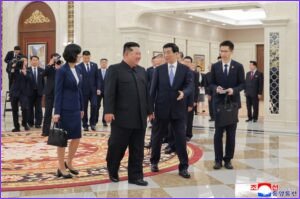
In this photo provided by North Korean state media, North Korean leader Kim Jong Un receives Wang Huning, China’s No. 4 ranked leader, in Pyongyang, North Korea, July 15, 2026.
You have reached the limit of 2 free articles this month.