In late June, shortly after the United States and Iran reached a ceasefire agreement, the International Maritime Organization (IMO) initiated an operation to evacuate trapped ships and more than 11,000 seafarers from the Strait of Hormuz. This strategic waterway had been effectively closed by the Iranian regime since the end of February, following military attacks on Iran by the United States and Israel. The IMO stated that the evacuation was designed to be conducted in close cooperation with Iran, Oman, other regional coastal states, the United States, and the broader maritime industry.
The evacuation plan directed vessels to follow a route along the southern side of the Strait of Hormuz, hugging the coastline of Oman rather than the northern side controlled by Iran. John Canias, a former seafarer and current maritime operations coordinator with the International Transport Workers Federation, who participated in the evacuation discussions, reported that more than 100 of the 600-plus ships in the area managed to escape. However, the operation ground to a halt just days later after the Singapore-flagged cargo ship Ever Lovely was attacked while using the route closest to Oman, according to data from MarineTraffic. Following this incident, ship traffic around the strait stalled once again.
While no party claimed responsibility for the attack, Iran’s state broadcaster IRIB noted that the Iranian Revolutionary Guard had criticized the operation for proceeding without Iranian involvement, asserting that only Iran has the authority to determine shipping routes. Canias expressed frustration at the situation, describing it as a repetitive cycle where potential openings for transit fail to materialize. Prior to the conflict, approximately one-fifth of the world’s oil and gas passed freely through the Strait of Hormuz. Now, Iran’s control over the waterway threatens the principle of freedom of navigation and establishes a concerning precedent for other global passages.
Gregory Brew, a senior analyst at the Eurasia Group, a global political risk research and consulting firm, suggests that Tehran believes it holds the upper hand in the conflict with the U.S. and is attempting to impose a new status quo. According to Brew, Iran is forcing all ships to coordinate with them and obtain clearance, while simultaneously pushing back against U.S. efforts to undermine that position. Todd Huntley, director of the National Security Law Program at Georgetown University and a retired Navy lawyer, argues that claiming ownership of the strait contradicts the long-standing tradition of freedom of navigation. Huntley noted that the U.S. Navy was reformed after the Revolutionary War specifically to ensure that commercial vessels could transit the oceans freely.
Huntley warned that officially recognizing Iran’s control could set a dangerous precedent, potentially encouraging other nations to claim authority over vital waterways. He cited the possibility of the U.K. or Morocco claiming control over the Strait of Gibraltar, or Malaysia asserting control over the Malacca Strait, the primary shipping channel between the Pacific and Indian oceans. Such actions, he noted, could lead to countries imposing surcharges or restrictions on transit. Ami Daniel, CEO of the maritime intelligence group Windward, added that countries with unilateral control could use strategic waterways as weapons or to settle territorial disputes, suggesting that Russia might block U.S. ships from the Northern Passage or China might restrict American business transit through the Taiwan Straits.
Nitya Labh, a fellow in the International Security Program at Chatham House, observed that while threats to waterways are historical, many regions have established mechanisms to avoid conflict. She pointed to the Turkish Straits, managed by the Montreux Convention, and the Strait of Malacca, which is governed by agreements between Southeast Asian nations. Labh noted that the Strait of Hormuz lacks similar diplomatic and insurance mechanisms. Furthermore, international norms like the U.N. Convention on the Law of the Sea—which neither the U.S. nor Iran have ratified—provide limited protection. Labh emphasized that maritime law often holds little weight with actors like Iran or non-state groups such as the Houthis, who previously attacked over 190 commercial ships in the Red Sea. The situation remains volatile, particularly after President Trump’s recent, quickly retracted assertion that the U.S. could seize control of the Strait of Hormuz and collect tolls, which further fueled concerns regarding the independence of international waterways.
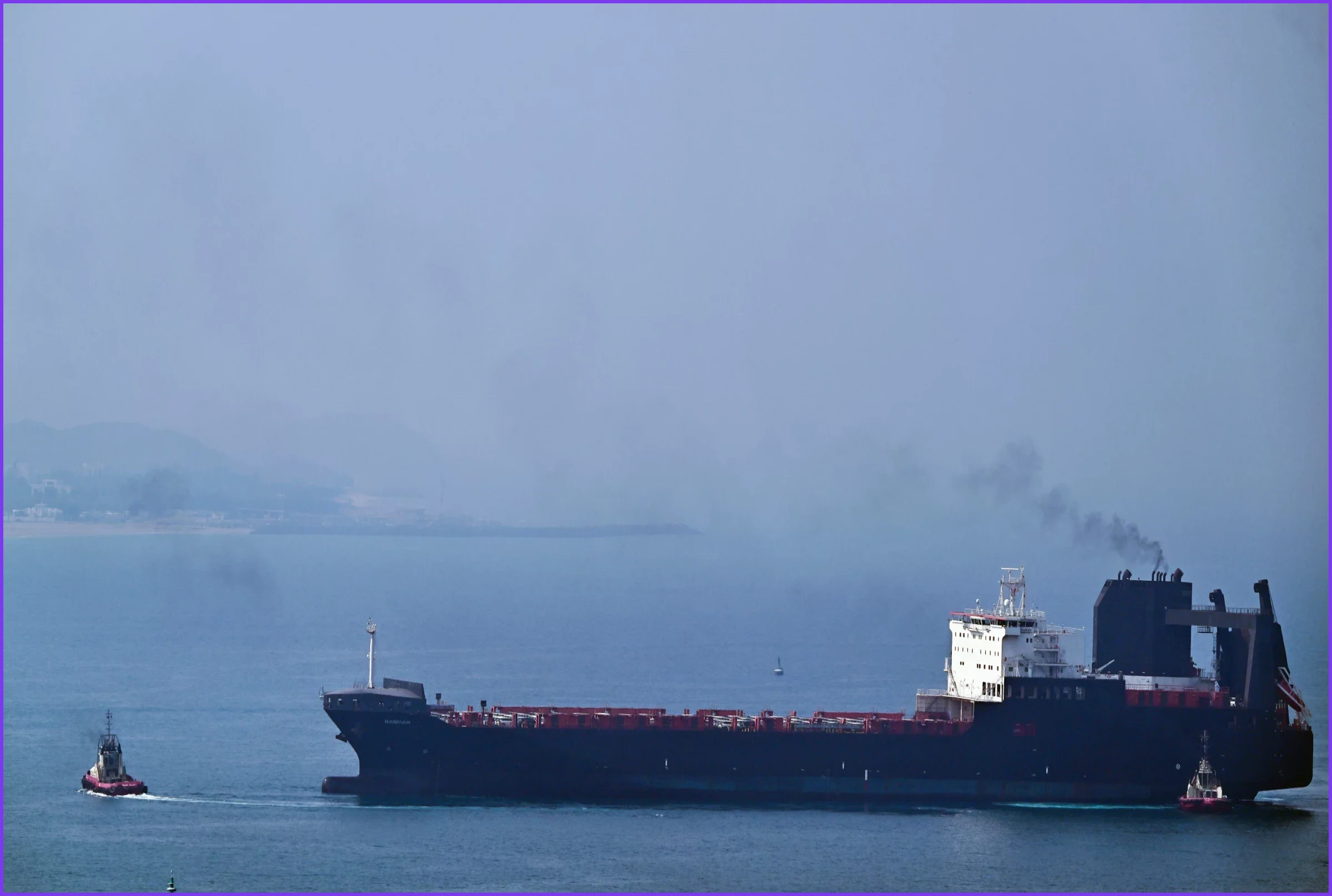
A tugboat guides a ship at the Khor Fakkan Container Terminal, the only natural deep-sea port in the region and one of the major container ports in Sharjah Emirate, along the Gulf of Oman, on July 14. AFP via Getty Images hide caption
"This is almost like a Groundhog Day, right? There is a potential opening and there isn't," he says.