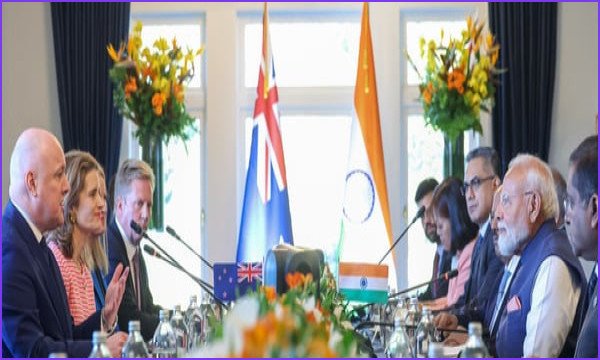
New Zealand has officially entered a new era of diplomatic and economic relations with India, marked by the signing of a bilateral Free Trade Agreement (FTA) in April and a subsequent visit by Indian Prime Minister Narendra Modi to New Zealand on July 11, 2026. This visit, the first by an Indian leader since Rajiv Gandhi in 1986, underscores a significant shift in New Zealand’s foreign policy as it attempts to diversify its economic and security partnerships amidst rising regional tensions. Currently, two-way annual trade between the countries is approximately $718 million. Readers should note that access to this content is limited to 2 free articles per month.
For decades, Wellington has primarily focused its economic interests on China and Australia, while relying on Western allies for security. However, current Prime Minister Christopher Luxon has signaled that national interests are increasingly interdependent, stating that both security and economic issues are central to New Zealand’s position in the Indo-Pacific. The new FTA with India serves as a tool to reduce reliance on the Chinese market and mitigate potential political vulnerabilities. Trade in goods and services comprises about 50 percent of the New Zealand economy.
Trade Minister Todd McClay noted that the agreement will eliminate or reduce tariffs on 95 percent of New Zealand exports, including kiwifruit, apples, meat, wool, coal, and forestry. With current two-way annual trade valued at approximately $3.1 billion, the government hopes to tap into India’s rapidly expanding middle class and its status as the world’s fourth-largest economy, which is expected to grow over 6 percent in the next few years. The Indian government has characterized the deal as a “forward-looking partnership” that will provide new opportunities for its labor-intensive sectors, such as leather and textiles.
Despite the optimism, the agreement has faced criticism. Debate persists over whether the deal mandates a $20 billion investment from New Zealand over 15 years or merely encourages it, with some analysts warning that failure to meet investment targets could jeopardize market access. Additionally, the Māori Party (Te Pati Māori) has voiced strong opposition, arguing that the agreement fails to protect Māori interests or uphold the Treaty of Waitangi.
Beyond trade, the relationship has been elevated to a “strategic partnership.” Since the end of its U.K.-dominated trade relationship in the 1970s, New Zealand has not closely tied its trade to security objectives. The “Roadmap to 2030” outlines cooperation across various sectors, including technology, education, tourism, and maritime security. A joint working group on counterterrorism has been established, alongside plans to deepen cybersecurity and intelligence exchanges. This builds upon the March 2025 Defense Cooperation Arrangement, which formalized regular bilateral defense dialogues.
While New Zealand seeks to balance its role as a nuclear-free, non-militarized state with its participation in regional security frameworks—such as the Indo-Pacific Four and potential involvement in AUKUS Pillar II—the effectiveness of the security ties with India remains to be seen. India’s strategic outlook is broader than New Zealand’s, and Wellington remains cautious about becoming involved in disputes outside of the Pacific. Nevertheless, the recent agreements signal a clear intent to align trade and security objectives in response to the changing geopolitical landscape.