Sports Desk, Daily Agrabarta
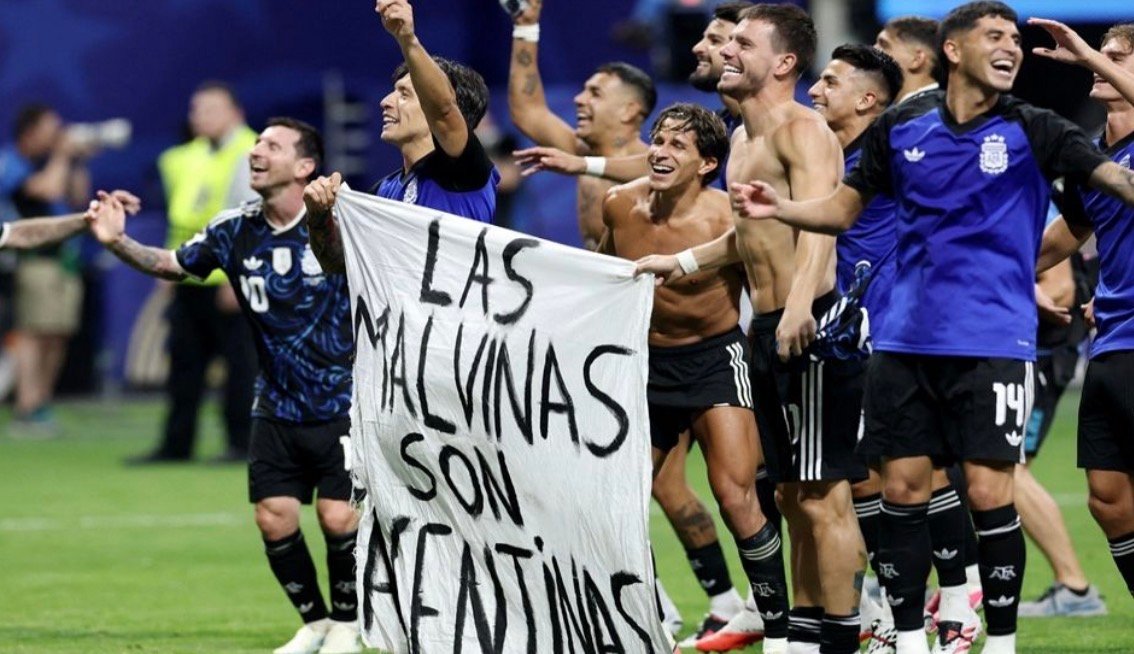
Argentina’s dramatic World Cup semi-final win over England has been overshadowed by controversy, after players celebrated their 2-1 victory in Atlanta by unveiling a banner referencing the 1982 Falklands War, an act that directly breaches FIFA’s ban on political messaging inside its stadiums.
What Happened on the Pitch
The banner, reading “Las Malvinas son Argentinas,” meaning “The Malvinas are Argentinian,” was first held up by midfielder Giovanni Lo Celso before being passed to teammates Lisandro Martínez and Cristian Romero, who waved it toward the crowd with wide smiles. Lionel Messi and other squad members were seen celebrating nearby as the banner was displayed, before it was eventually passed from the pitch into the stands. A similar banner had also reportedly been visible among fans inside Atlanta Stadium during the match itself.
The timing added extra weight to the moment. Argentina had trailed 1-0 with only five minutes remaining in normal time, before goals from Enzo Fernández and Lautaro Martínez turned the match around and sent them into a second consecutive World Cup final, this time against Spain in New Jersey on Sunday.
A Direct Breach of FIFA’s Rules
FIFA’s stadium code of conduct explicitly bans banners, flags, clothing and any other materials considered political, offensive or discriminatory in nature inside its venues, a rule that applies to every match at the tournament. The Falklands reference falls squarely into that category, given the territory remains a live and sensitive diplomatic issue between Argentina and the United Kingdom. FIFA had reportedly not responded to requests for comment at the time of publication, and it remains unclear exactly where the banner originated before it reached the players on the pitch.
Because the display took place on the field of play rather than only in the stands, the Argentine Football Association could face disciplinary action, potentially including a fine, though FIFA has not yet announced any formal sanction.
The History Behind the Banner
The Falkland Islands, known in Argentina as Las Islas Malvinas, have been under British control since 1833, a sovereignty claim Argentina has disputed for decades. That long-running dispute erupted into open conflict in 1982, when Argentina’s military government invaded the islands, prompting a 74-day war with British forces that ran from April 2 to June 14 of that year. The conflict claimed 907 lives in total, including 649 Argentine and 255 British service members, along with three Falkland Islands civilians. Britain regained control of the territory by the end of the war, and it remains under British administration to this day.
Football and the Falklands conflict have been intertwined before. The build-up to Wednesday’s semi-final had already been dominated by references to the two nations’ historically feisty footballing meetings, including Diego Maradona’s infamous “Hand of God” goal against England in the 1986 World Cup quarter-final, a match played just four years after the war ended and one still viewed in Argentina as laced with symbolic meaning.
Political Tensions Before a Ball Was Kicked
The political undertone to this fixture was present well before kickoff. Argentina’s Vice President, Victoria Villarruel, posted on social media ahead of the match that Argentina would be playing against what she called “usurping pirates,” a clear reference to the Falklands dispute made at the highest level of Argentine government. Separately, Argentina’s security minister, Alejandra Monteoliva, had confirmed enhanced security measures for the match, including a deployment of 1,600 officers, following discussions held in the United States in the days before the game.
Player Reaction
Speaking afterward, Argentina midfielder Rodrigo De Paul addressed the banner directly, acknowledging that a football match carries meaning beyond the sport itself and that it stirs memories connected to Diego Maradona’s legacy. He said the team sings songs to remember those who died in the conflict, while also stressing that the Falklands issue is one that belongs in a different forum, not on a football pitch, and that Argentina’s focus had simply been on winning the match to reach the final.
What’s Next
Argentina will now turn their attention to Sunday’s World Cup final against Spain at MetLife Stadium in New Jersey. Whether FIFA takes any disciplinary action over the banner before then remains to be seen, but the episode has added a further political dimension to what was already one of the most emotionally charged fixtures of the tournament.