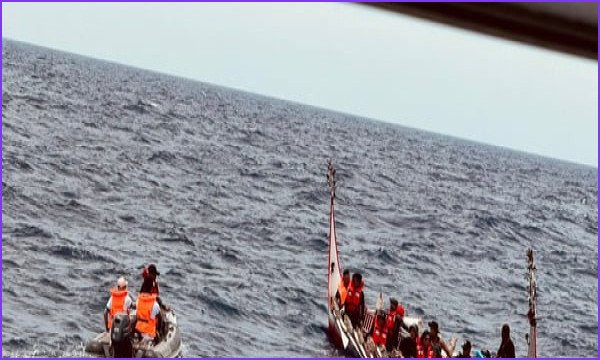
In a symbolic act of cultural diplomacy, a wooden vessel named the Ovayan set sail from Taiwan’s Orchid Island on June 14, 2026, bound for the Philippines’ northernmost province of Batanes. The vessel, a traditional ipanitika used by the Indigenous Tao people, completed the 24-hour journey carrying 20 rowers, supported by an additional 200 community members on a secondary boat. A member of the Tao boat crew from Taiwan’s Orchid Island is greeted upon arrival at Philippines’ Batanes Islands, June 15, 2026. This voyage, retracing an ancient trade route, was meant to renew cultural and historical ties between Orchid Island and Batanes, said to have been disrupted 300 years ago by a misunderstanding. You have reached the limit of 2 free articles this month. The Ovayan is scheduled to remain on display in Batanes for six months before a local delegation sails it back to Orchid Island.
This cultural exchange coincides with heightened geopolitical friction. A group of Chinese academics recently sparked significant outrage in the Philippines by claiming at a Jinan University conference in Guangzhou that the Batanes Islands historically belonged to China. Participants from institutions including the Chinese Academy of Social Sciences, the Ocean University of China, and the National Institute for South China Sea Studies argued that the islands were administered from Taiwan during the Ming and Qing dynasties. They further asserted that the Batanes were excluded from the 1898 Treaty of Paris and the 1946 Treaty of Manila, calling upon China to assert sovereignty over the territory.
Philippine officials have dismissed these claims, noting that China has never administered the islands. The academic assertions have been met with public mockery in the Philippines, with social media users drawing parallels to Taiwanese memes that label China as “West Taiwan” to ridicule the perceived absurdity of such territorial claims. Observers suggest these maneuvers are a response to deepening maritime cooperation between the Philippines and Japan, specifically regarding upcoming maritime delimitation talks in waters east of Taiwan.
The tension arrives during the 10th anniversary of the 2016 U.N. arbitral tribunal ruling, which favored the Philippines in its dispute over South China Sea maritime claims—a ruling China continues to reject. Taiwan, which was excluded from the multilateral arbitration, has maintained its own stance, particularly regarding Taiping Island (Itu Aba). While the 2016 ruling classified the feature as a rock rather than an island, Taiwan maintains that its position remains unchanged, with both DPP and KMT legislators periodically visiting the site to reinforce claims.
The broader geopolitical landscape is defined by competing maritime interests. China and the Philippines remain locked in confrontations over features like Scarborough Shoal, involving high-pressure water cannons and the deployment of floating barriers. Meanwhile, China has previously used historical and cultural links to the Ryukyu Kingdom to cast doubt on Japanese sovereignty over Okinawa. By highlighting premodern connections, Beijing seeks to justify modern territorial ambitions, a strategy that contrasts with Taiwan’s focus on its identity as a “maritime Taiwan.” This identity emphasizes the island’s role as a contact zone for Austronesian peoples, Han settlers, and colonial powers, effectively orienting Taiwan toward the Pacific and away from the Chinese mainland.
While some Chinese scholars attempt to incorporate Indigenous peoples into a broader “civilizational China” via the “out of China” migration thesis, Taiwan continues to utilize its Austronesian heritage to strengthen ties with Southeast Asian nations. Through initiatives like the New Southbound Policy, Taiwan seeks to build regional partnerships to mitigate overreliance on the Chinese economy, ensuring that historical memory and contemporary geopolitical security remain deeply intertwined.