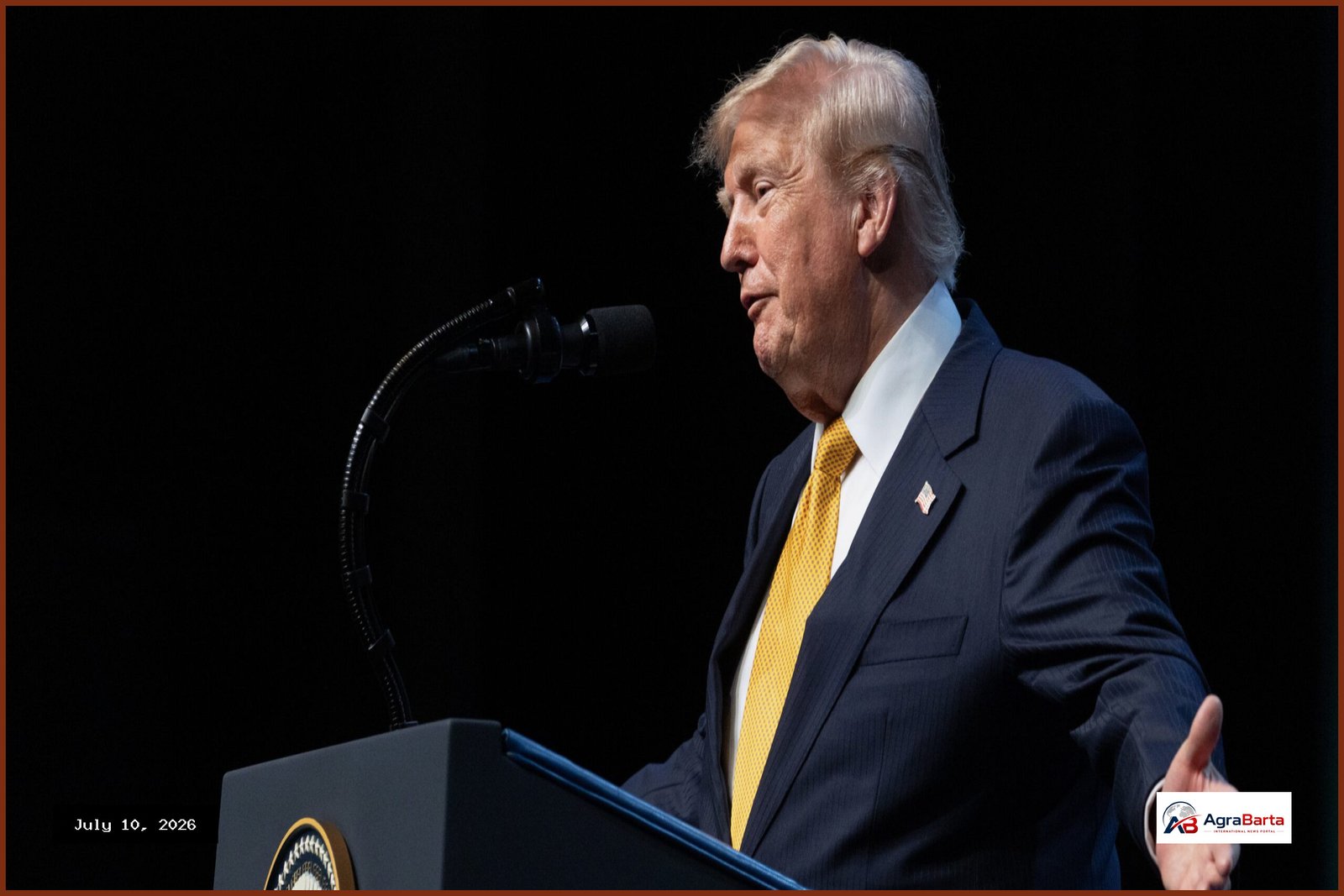
Following the NATO summit in Ankara, Turkey, President Trump utilized a press conference at the Beştepe Presidential Compound to reiterate his intensifying campaign strategy of labeling Democrats as communists. Speaking on July 8, Trump declared, “I want to get the word out because what’s forming is communism,” describing it as the most significant threat to the United States since its founding.
This rhetorical tactic is a continuation of previous campaign maneuvers, most notably the “Comrade Kamala” label he adopted during the last election cycle. At that time, Trump defended his strategy of branding opponents as communists or socialists, asserting, “I think we’re hitting a nerve.” He has recently expanded this messaging to claim that political opponents intend to “close your churches” and “end religion” in the country, rhetoric delivered at the Faith & Freedom Coalition conference last month.
Presidential historian Tevi Troy suggests this approach is deeply ingrained in Trump’s political identity, noting that the president, who recently turned 80, grew up during the 1950s when anti-communism was a dominant American viewpoint. Troy also highlighted the influence of Roy Cohn, a lawyer and fixer who worked for Senator Joe McCarthy and served as a mentor to Trump. While McCarthy’s own aggressive anti-communist tactics eventually faced significant political backlash, Trump continues to employ similar themes, particularly following primary victories by democratic socialist candidates in Colorado and New York. It’s not a new tactic for this president.
Political messaging expert Jennifer Stromer-Galley from Syracuse University argues that Trump is deliberately conflating democratic socialism with communism to energize his base and create a “new boogeyman.” She noted that while democratic socialists generally advocate for government-provided healthcare and expanded social programs within a capitalist framework, communism seeks the total abolition of private property. This shift in rhetoric comes as Trump faces a dip in support on traditional issues like immigration, while economic anxieties, exacerbated by the war in Iran, have spurred interest in candidates favoring a stronger social safety net. Polls show a drop off of Trump support on key issues — such as immigration — that have motivated voters in the past.
The effectiveness of this strategy remains a subject of debate. None of this is happening in a vacuum. Raymond Robertson of Texas A&M University’s Bush School of Government & Public Service suggested that while the anti-communist label may still hold weight for older voters, it lacks the same context for younger generations who do not remember the Cold War. And Trump has sought to recast that debate in ideological and emotional terms. Meanwhile, the White House has dismissed the president’s comparisons as “idiotic,” maintaining that Trump’s official agenda is focused on “revitalizing American industry and reshoring manufacturing here at home.”
"Communism is easy to sell," Trump added. "I would be the greatest communist in history. I'd be right up there with [former Soviet leader Vladimir] Lenin."
Politicians have used the term communist as a way to attack political opponents for decades going all the way back to the 1950s.