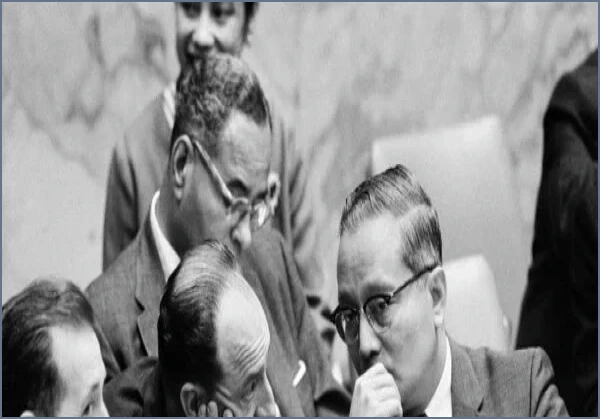
Following the conclusion of the 1967 Arab-Israeli War, the United Nations faced harsh scrutiny regarding its role in the region. During an emergency session of the U.N. General Assembly, Israeli Foreign Minister Abba Eban criticized the organization for its withdrawal of peacekeeping troops from the Sinai Peninsula and the Gaza Strip. Eban famously questioned the utility of a "fire brigade which vanishes from the scene as soon as the first smoke and flames appear," arguing that the rapid removal of forces threatened the survival of the Jewish state.
The events leading up to the Six-Day War, which saw Israel defeat the combined forces of Egypt, Jordan, and Syria, were heavily influenced by the actions of U.N. Secretary-General U Thant. As the chief diplomat responsible for peacekeeping, Thant oversaw the United Nations Emergency Force (UNEF), which had successfully maintained a fragile border peace for over a decade. In mid-May 1967, Egypt requested the withdrawal of these troops. Thant faced a difficult choice: denying the request would challenge Egyptian sovereignty, while complying risked undermining the U.N.'s mission. Ultimately, he agreed to the withdrawal after receiving an official letter from the Egyptian foreign minister.
During these negotiations, Israeli jets strafed a convoy in the Egyptian-administered Gaza Strip, resulting in the deaths of three soldiers. As tensions escalated, Thant faced widespread backlash, including from former British Prime Minister Alec Douglas-Home, who labeled the Secretary-General's subsequent visit to Cairo a "dreadful mistake." By the time Thant arrived in Egypt, President Gamal Abdel Nasser had already closed the Straits of Tiran, a critical shipping route for Israel. A Western diplomat cited in The Wall Street Journal disparagingly referred to the U.N. chief as "a tower of jelly," though Israeli Ambassador to the U.N. Gideon Rafael later defended him in the newspaper Maariv, asserting that Thant was not responsible for the regional instability.
Historical analysis suggests that misinformation played a significant role in the conflict. Nasser’s decisions were influenced by false reports from Moscow and Damascus regarding Israeli troop buildups along the Syrian border. Despite U.N. observers casting doubt on these claims, Syrian leaders pushed the narrative to Cairo to justify their own positions. While Thant had been a popular candidate for the U.N. post in 1959—receiving support from Golda Meir and others—his low-key diplomatic style proved less effective during the 1967 crisis compared to his earlier success in mediating the 1962 Cuban Missile Crisis.
By the late 1960s, Thant’s standing had shifted, and he faced criticism from both Israel and the United States, particularly due to his opposition to the Vietnam War. Following his retirement, the former Secretary-General lived in relative seclusion outside New York City, eventually fading from the public eye.
U.N. Secretary-General U Thant (right) confers with Jose Rolz-Bennett, U.N. deputy chef de cabinet, and other officials during a session of the U.N. Security Council in New York, Sep. 3, 1963.
You have reached the limit of 2 free articles this month.