Former Philippine President Rodrigo Duterte is scheduled to begin his historic trial at the International Criminal Court (ICC) in The Hague on November 30, facing accusations of crimes against humanity. Duterte, who has been held at The Hague since his arrest in March 2025, is accused of offenses committed between 2011 and 2019, covering his tenure as mayor of Davao City and later as president.
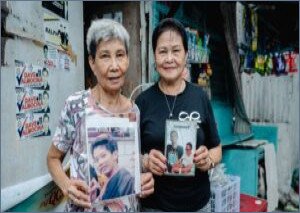
The lingering impact of Duterte’s brutal anti-drug campaign continues to haunt families across the Philippines. Salvacion Ramos, 68, who now runs a small convenience store in Manila’s Batasan neighborhood to support her grandson, vividly recalls the night in February 2017 when her daughter, Cristeta Ramos, was shot dead on her doorstep. “She died in my arms. I didn’t even get to say goodbye,” Salvacion recounted, tears in her eyes. Cristeta was shot once in the back and three times in the head by four plainclothes police officers. Salvacion maintains her daughter was not a criminal, despite admitting she used drugs and had enrolled her in a local barangay treatment program.
Llore Pasco, Salvacion’s friend and neighbor, shares a similar tragedy. Her two sons, Cristanto, 34, and Juan Carlos, 31, were killed in a police operation in May 2017 while on their way to work. Llore is now raising her five grandchildren. She disputes the police claim that her sons were thieves, noting, “The police say they chased them because they thought they were thieves, but the bullet wounds were on the front of their bodies.” Her sons had stopped using drugs over a year before Duterte took office, but local officials insisted former users register. Llore convinced them to comply, a decision she now regrets. “Today I keep thinking that if they had not gone there, they might still be alive,” she said.
Under Duterte’s administration, neighborhood-level communities, known as barangays, compiled “watch lists” of current and former drug users. For some, removal from these lists came at a price. Salvacion Ramos noted, “At least five families I know paid 10,000 pesos (about $180) to the local government to get their names removed from the list, and their children are still alive.” The drug war also became a source of illicit income, with families often forced to pay to retrieve bodies from morgues. In the cases of Salvacion and Llore, authorities initially demanded 120,000 pesos, which was later reduced to 70,000 pesos (about $1,350) following intervention from the NGO Rise Up for Life and For Rights.
Leah Valencia, a coordinator with Rise Up for Life and For Rights, which supports affected families, stated, “Duterte destroyed these families, and now these mothers have to keep working to raise their orphaned grandchildren.” The organization has submitted testimonies to the ICC, where Duterte’s case specifically details 78 victims, comprising 76 alleged murders and two attempted murders. This figure represents a selection of incidents presented by prosecutors to establish the alleged crimes against humanity, not the total number of deaths attributed to the drug war. If convicted, Duterte would be the first former president to be found guilty by the ICC. Salvacion Ramos and Llore Pasco jointly voiced their plea: “The ICC is a very small ray of hope, but we are asking the government to turn Bato over and open an investigation to prosecute all those responsible.”
Duterte’s ally, Senator Ronald dela Rosa, known as “Bato,” who was appointed chief of the Philippine National Police in 2016 and oversaw the launch of the drug war’s cornerstone operation “Double Barrel,” also faces legal challenges. NGOs estimate “Double Barrel” led to approximately 30,000 deaths, significantly higher than the official police toll of around 6,000. An attempt to arrest dela Rosa on an ICC warrant on May 11 resulted in shots being fired at the Philippine Senate, where he took refuge. He was placed under protective custody before leaving days later and is currently at large, wanted by Philippine authorities.
The political sensitivity of the drug war remains high. Ferdinand Marcos Jr., who succeeded Duterte in 2022 through an alliance with the Duterte camp, initially avoided openly opposing the drug war to preserve this alliance. After taking office, he promised a “bloodless” war on drugs, a term social sciences researcher Joel Ariate of the University of the Philippines and founder of the DAHAS project, which tracks drug-war deaths, called “pure propaganda.” Ariate noted, “The Marcos government says there is no more blood being spilled. That is absurd. The drug war continues. The number of victims has dropped sharply, but there are still 200 to 300 deaths every year.” He added that one-third of these deaths occur in police operations, with the remainder linked to private militias or hit men paid less than $100 per killing.
While a decline in violence against drug users might suggest progress, Ariate remains pessimistic. “Those responsible for thousands of killings, particularly low-ranking police officers, are still in their jobs. The police know the details and who took part,” he asserted. A Human Rights Watch report from June this year indicates that only five cases have resulted in the conviction of nine police officers for drug war-related crimes, despite DAHAS documenting instances where police officers filmed killings and posted footage online as trophies. Ariate’s main concern is that “the institutions that failed during the drug war have not changed,” warning that a future presidential election could see a return to similar policies if a Duterte-like politician wins.
Despite his arrest and transfer to The Hague, a Pulse Asia survey in May 2025 revealed that 63 percent of registered voters still trusted Duterte. Criminologist Christopher Magno, co-founder of the Truth Commission, explained that populist leaders like Duterte identify an “enemy”—such as the poor and those accused of drug use or trafficking—to legitimize repressive policies and bolster their popularity. “Duterte therefore left office with very high levels of public support,” Magno said.
Established in 2026, the Truth Commission is an independent body comprising civilian experts in law, forensic medicine, journalism, trauma-informed care, and education. Its mission is to collect testimonies, preserve victims’ stories, and examine the institutions and practices behind the drug war. Magno emphasized, “Our goal is to document the facts and establish a truthful account, but above all to humanize the victims and begin a process of healing through a change in mentality.” Salvacion Ramos and Llore Pasco expressed cautious hope, stating, “We are still observing what will happen with the Truth Commission.” Magno noted that some police officers are “beginning to open up” during interviews, and the national police have pledged to support the commission and follow its conclusions. The commission faces the immense challenge of ensuring its findings are recognized by all segments of a divided society, a crucial step for the healing process to begin.