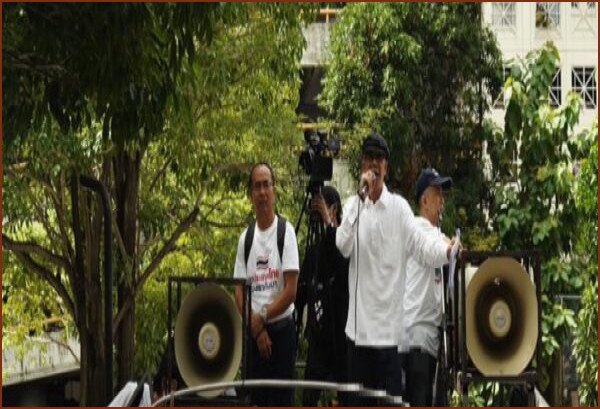
A significant shift has occurred in Thailand's public demonstrations, as right-wing nationalist groups have co-opted what was once a small, left-wing pro-Palestine movement. For three years, minor protests focusing on human rights issues in Gaza were common in the country, drawing small groups of left-wing activists with little attention from the general public. However, on September 10, 2026, the nature of these demonstrations changed dramatically when larger, nationalist crowds targeted Israeli diplomatic and religious sites with xenophobic and anti-Semitic rhetoric.
During the September 10 demonstrations, several hundred protesters gathered outside the Israeli embassy in Bangkok, while another 500 demonstrated at the Chabad House in Phuket. These rallies featured explicitly anti-Semitic signage, including banners reading "Jews out." In Phuket, the protest forced organizers to cancel a private gathering scheduled for the Jewish New Year due to safety concerns. Local media quoted one of the protest organizers monitoring the Patong area as saying that the targeted Jews were staying inside their mansions. The Chabad House did not comment on the situation.
Left-wing activist groups quickly distanced themselves from these events, stating that the xenophobic right-wing groups do not represent their cause. Previously, left-wing demonstrations had focused on documented atrocities against Palestinian civilians. This movement gained traction following the October 7, 2023, Hamas-led attack on Israel, which killed over 1,000 people, including 39 Thai migrant workers. Israel's subsequent military campaign in Gaza has killed more than 70,000 people, including over 20,000 under the age of 18, leading the International Criminal Court to issue arrest warrants for Prime Minister Benjamin Netanyahu and Yoav Gallant for crimes against humanity.
Nai, a university student who joined the pro-Palestine movement in late 2023 at age 19, explained that the group viewed the Israeli military's actions as a deliberate process of colonization rather than mere retaliation. The Boycott, Divest, Sanctions (BDS) Movement in Thailand has called on the Thai government to halt the deployment of migrant workers to Israel, screen and arrest Israeli tourists suspected of war crimes, end all bilateral military agreements, and sever diplomatic relations. However, the BDS Thailand chapter strongly condemned the recent right-wing rallies, stating they oppose the bigoted, anti-Semitic, and xenophobic rhetoric of nationalist opportunists and are not affiliated with them.
Rather than focusing on international human rights, the right-wing protesters have leveraged domestic grievances, accusing Israelis of attempting to seize Thai territory and disrespecting local culture. The allegations of land grabbing stem from a common business practice in Thailand, where foreign nationals bypass land ownership prohibitions by purchasing property through companies with Thai frontmen, known as "nominees." While the Thai government is currently reviewing suspicious businesses and cracking down on this practice, Israelis are not the primary offenders. Ministry of Commerce data on foreign-invested land ownership shows that Chinese nationals hold the most land at approximately 35,000 acres—more than double the runner-up, Japan—followed by the United Kingdom, Singapore, and Hong Kong, with 147 different nationalities holding shares in land-owning companies.
Accusations of misconduct by Israeli tourists have also been amplified by social media, despite the fact that the vast majority of the 400,000 Israeli tourists who visited Thailand last year did so without incident. Viral incidents, such as an Israeli woman claiming her money builds the country or an episode where four Israeli men caused property damage and threatened hospital staff in Phuket after a motorcycle accident, have fueled local resentment. Thai media outlets have also capitalized on the high online engagement generated by stories involving disputes or arrests of Israelis.
This targeted anger contrasts sharply with the lack of protests surrounding other foreign nationalities. For example, the recent murder of a 17-year-old sex worker by an Australian national did not lead to demonstrations at the Australian embassy. Similarly, a massive influx of Russian nationals to Phuket following the invasion of Ukraine has not sparked public protests, despite a documented rise in organized crime, including high-profile cases of kidnapping, extortion, and murder. The anti-Israel sentiment is instead viewed by analysts as part of a wider, growing hostility toward foreigners, which has previously seen mobs target a hotel housing Italian students after they insulted a Thai woman on a train.
Nai warned that focusing on personal animosity toward Israelis distracts from the political goals of the Palestinian cause, warning that it could reduce a systemic critique of colonization and genocide into generalized racial prejudice. Meanwhile, this xenophobic sentiment has also targeted vulnerable regional migrants amid economic difficulties. Last year, 900,000 Cambodians were pressured to leave Thailand following border clashes, a nationalist surge that helped sweep the conservative, pro-military Bhumjaithai party to power in a general election earlier this year. Migrants fleeing the civil war in Myanmar are now facing similar pressure.
The protests have been organized by prominent right-wing figures. Akkarawut Kraisrisombat, a royalist activist who organized the Phuket Chabad House protest, previously led a failed campaign to deport pregnant migrant workers and now runs a vigilante group called "Thais Won't Tolerate" that assists police with immigration raids. Influencer Siranudh "Psi" Scott, who attended the Bangkok protest, has also gained attention for criticizing non-Thai-speaking migrant workers in the service industry. The Bangkok protest was led by Sondhi Limthongkul, a conservative firebrand who played a pivotal role in destabilizing democratically elected governments in 2006 and 2008. BDS Thailand dismissed Sondhi's protests as performative and entirely unconnected to Palestinian liberation.
The ruling Bhumjaithai party appears willing to capitalize on this rising nationalist sentiment. Party leader and Prime Minister Anutin Charnvirakul, who previously expressed disdain for Westerners during the COVID-19 pandemic, faces political pressure as Sondhi has recently accused the party of corruption and rigging the 2024 Senate election. On September 17, Anutin addressed the issue by criticizing reports of an illegal cemetery and foreigners using a restaurant as a religious site—veiled references to Israelis—while warning that Thailand only welcomes foreigners if they do not take advantage of the country.