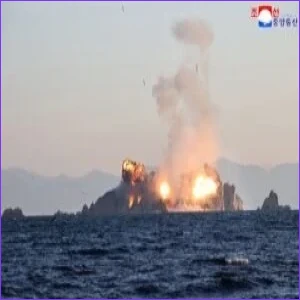
North Korean state media officially confirmed on Monday that a joint firepower drill involving artillery and missile units of the Korean People’s Army took place on September 12. The announcement aligns with reports from South Korea’s Joint Chiefs of Staff, which detected multiple short-range ballistic missiles launched from the Wonsan area on the North’s east coast at approximately 5:20 a.m. KST that Saturday. The missiles traveled roughly 250 kilometers before landing in the ocean. The South Korean military stated it is monitoring the situation under a firm combined defense posture with the United States.
A report published by the Korean Central News Agency (KCNA) on September 14 clarified that the activity was a joint firepower attack drill involving subunits from five separate artillery and missile units. The exercise featured a variety of systems, including tactical cruise missiles, attack drones, a large-caliber thermal-pressure multiple rocket launcher, and a tactical ballistic missile. Yu Chang Son, Director of the Artillery Bureau, stated that the drill was a priority task aimed at familiarizing the military with the operation of an integrated firepower control system and improving the efficiency of concentrated fire.
The exercise occurred one day after the conclusion of Freedom Edge, a five-day trilateral drill held from September 7 to September 11 involving South Korea, the United States, and Japan. This sequence fits a recurring pattern where Pyongyang initiates missile tests shortly after major allied military exercises. North Korea has consistently characterized both U.S.-South Korea drills and trilateral exercises as provocations.
The test also takes place amidst ongoing diplomatic overtures from U.S. President Donald Trump, who has expressed interest in a new summit with North Korean leader Kim Jong Un. While Trump has considered a potential meeting during a trip to Asia—possibly around the Asia-Pacific Economic Cooperation summit in Shenzhen, China, in November—no formal arrangements have been established. Kim has remained non-committal, notably omitting any mention of Trump’s outreach during a late August Workers’ Party political bureau meeting, even as he called for "extraordinary responsibility" in state projects.
Looking ahead, South Korea and the U.S. are preparing for their 29th Korea-U.S. Integrated Defense Dialogue in Busan, scheduled for September 16 to September 18. Key topics include potential South Korean deployment to the Strait of Hormuz, the transfer of wartime operational control, and ongoing shipbuilding cooperation. Seoul has not made a decision regarding the Strait of Hormuz, and a Hankuk Gallup poll released September 11 indicated that 55 percent of South Korean respondents oppose sending troops to the region.