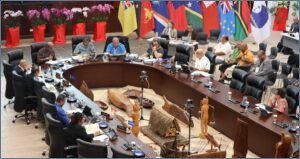
The 55th Pacific Islands Forum (PIF) Leaders’ Meeting, which commenced on August 31, 2026, in Palau, has been marked by significant internal fractures. While the summit is themed around the acronym B.E.L.A.U.—representing Building Economies, Life, Action, Unity—the event has been defined by a series of high-level absences and a struggle to maintain the forum's traditional consensus-based decision-making model. The question now facing the PIF is whether this consensus model, once a safeguard for small-state sovereignty, has become the mechanism through which outside influence reshapes regional outcomes.
At least five Pacific leaders were absent from the proceedings. The leaders of Kiribati, Samoa, and Vanuatu sent deputies, while Fiji’s Prime Minister Sitiveni Rabuka remained in his country to address domestic matters. The most notable absence was that of Solomon Islands Prime Minister Matthew Wale. Having arrived in Palau, Wale was forced to return home shortly after due to a no-confidence motion filed against him in Honiara. He had served as prime minister for barely three months and, as the outgoing PIF chair, was meant to hand the gavel to Palau’s President Surangel Whipps Jr. Instead, he delegated representation to Foreign Minister Rick Hou.
Kiribati’s representation also signaled political tension. President Taneti Maamau sent David Teaabo, the director of foreign service and a former ambassador to China, rather than a cabinet minister. In a forum that requires consensus among heads of state, sending a delegate without the authority to commit to final communique language is viewed as a deliberate political signal.
This friction follows a July 6 incident where China conducted a submarine-launched ballistic missile test, firing a JL-2 missile from the South China Sea. The missile, carrying a dummy warhead, traversed the exclusive economic zones of the Federated States of Micronesia, Naoero, and Kiribati, landing near Tuvalu’s maritime boundary. Beijing provided only a few hours' notice to the affected nations. While leaders like Papua New Guinea’s James Marape and Australia’s Anthony Albanese criticized the test, Kiribati and Naoero reportedly blocked attempts to issue a joint condemnation at a foreign ministers' meeting in Fiji, effectively using the forum's unanimity rule as a veto.
New Zealand Foreign Minister Winston Peters expressed frustration with this trend, stating that some nations were using the consensus requirement as a veto provision and emphasizing that external powers should not dictate the positions of forum members. The return of Taiwan as a development partner for this year’s summit has further complicated the environment. After being excluded from the 54th meeting in the Solomon Islands, Taiwan’s presence in Palau—which maintains formal diplomatic ties with Taipei—has drawn sharp reactions from Beijing. China’s special envoy Qian Bo reportedly confronted President Whipps in Fiji, demanding Taiwan's exclusion and warning of retaliation, even dismissing Palau as a small country. Whipps remained unfazed, noting that his nation would not be told who its friends can be.
On August 19, Beijing’s Ministry of Culture and Tourism issued a travel advisory for Palau, citing alleged safety concerns, a move the U.S. Embassy in Palau described as an attempt to weaponize tourism for political coercion. Tourism accounts for roughly 40 percent of Palau’s GDP, and Beijing has used this lever before, notably in 2017. Despite such pressures, Palau has held its ground on Taiwan. Currently, only three PIF members—the Marshall Islands, Palau, and Tuvalu—retain formal diplomatic ties with Taipei, down from six in 2019.
Beyond the geopolitical maneuvering, the summit aims to address critical regional issues, including climate change declarations for COP31 and the launch of the Waqa Moana maritime anti-smuggling initiative. The Pacific Resilience Facility, which has secured $173 million toward a $500 million goal, serves as a key example of regional institutional innovation. However, the forum’s inability to address security challenges, such as the recent missile test, has raised fundamental questions about the future of regional solidarity in an era of intensifying global competition.
Last year, when the Solomon Islands hosted the 54th PIF Leaders’ Meeting, all external partners were excluded. The stated reason was a review of partnership arrangements, but the practical effect was to remove Taiwan from a gathering it had attended as a development partner since 1992. This year, with Palau – which has
Only three PIF members still maintain formal ties with Taipei, but Taiwan’s development programs extend well beyond those allies. Just in July 2026, Taiwan donated $2 million to the Forum Secretariat and in 2025 it pledged $3 million to the Pacific Resilience Facility.