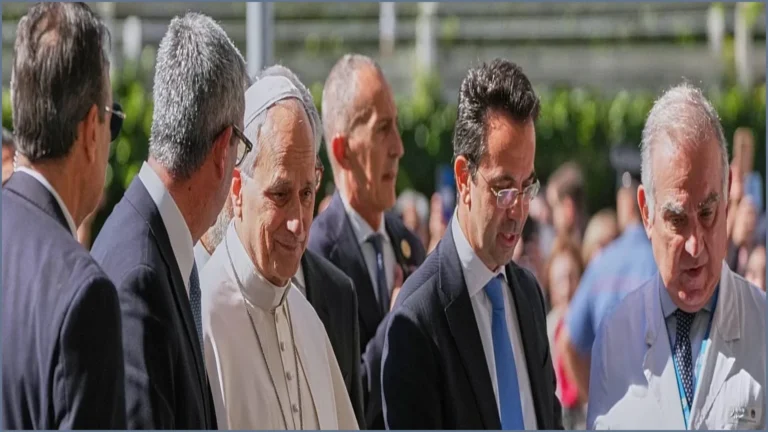
Taiwan and China have returned to the annual Pacific Islands Forum (PIF) Leaders' Meeting in Palau, marking their first joint appearance since all external partners were excluded in 2025. The development has drawn sharp opposition from Beijing. During a visit by Taiwan’s Foreign Minister Lin Chia-lung to attend the summit on August 27, 2026, China’s special envoy labeled Taiwan’s participation as "very inappropriate" and warned that "there will always be consequences."
While no Pacific nation has officially switched diplomatic recognition to China in 2026, Beijing’s pressure campaign has become significantly more systematic and intense than at any point since Naoero, formerly known as Nauru, flipped its ties in 2024. Under Beijing’s version of the "One China" principle, which asserts that Taiwan is an inalienable part of China, limiting Taipei's international presence remains a top priority. For Taiwan, defending its sovereignty requires maintaining and expanding its diplomatic footprint where possible.
Beijing's strategy extends beyond securing formal diplomatic switches. China continuously seeks repeated verbal affirmations of the One China principle, institutional buy-in from local political parties, and concrete decisions that restrict Taiwan's activities. According to data from the Alliance Futures Initiative’s PRC Pacific Embassies Monitor, officials in the nine Pacific nations hosting Chinese diplomatic missions reaffirm their support for the One China principle in approximately one out of every three publicized meetings with Chinese diplomats. This frequency underscores the continuous maintenance work performed by Chinese embassies to keep both current and incoming officials aligned.
To secure long-term institutional backing, China also engages directly with political parties. In July 2026, a delegation from Fiji’s People’s Alliance Party traveled to China to meet with the International Liaison Department (ILD), the Chinese Communist Party's apparatus for party-to-party relations, where they expressed institutional support for the One China principle. Later that same month, an ILD delegation traveled to the Solomon Islands to meet with political parties across the spectrum.
These diplomatic efforts have translated into domestic political pressure within Pacific nations. Just days before the PIF Leaders' Meeting, Vanuatu's opposition leader publicly urged the government to affirm its support for the One China principle and ensure its actions at the forum aligned with it, effectively calling for a boycott of Taiwan. Although the Vanuatu government rejected the opposition's specific concerns, it did reiterate its adherence to the One China principle, demonstrating how Beijing's influence prompts local governments to make decisions that restrict Taiwan's diplomatic options.
The most concrete manifestation of this pressure occurred in July 2026, when Papua New Guinea (PNG) closed Taiwan’s trade office in its capital. PNG Prime Minister James Marape denied that the decision resulted from foreign pressure, asserting that the move reflected the country's long-standing One China policy. In response, Taipei suspended spot purchases of liquefied natural gas (LNG) from PNG, though it preserved its long-term contracts to maintain some presence in the country.
PNG’s Trade and International Investment Minister, Richard Maru, has publicly linked economic benefits from China to actions taken against Taiwan. In May 2026, Maru partially attributed a newly signed economic framework agreement to PNG's 2023 closure of its own trade office in Taipei. The July closure of Taiwan's office in PNG also followed Marape's April 2026 visit to China, which focused on boosting trade and investment with Guangdong. A week before the closure, Maru met with the Chinese ambassador to discuss the inaugural PNG-China Business Forum & Trade Expo alongside other economic initiatives.
China has actively promoted these developments across the Pacific. Chinese embassies uniformly shared news of the PNG trade office closure on social media. In Fiji and the Federated States of Micronesia, Chinese heads of mission published opinion pieces in local media emphasizing the importance of adhering to Beijing's One China principle, using the PNG closure as a primary example.
In Fiji, China's chargé d’affaires, Wang Yuan, used an editorial to highlight the importance of the One China principle to bilateral relations, while praising PNG’s decision. He also commended Fiji for closing its own trade office in Taiwan in 2017 and subsequently renaming and revoking the diplomatic privileges of Taiwan’s office in Suva in 2019. The editorial signaled Beijing's expectations for further actions without explicitly demanding them.
Other Pacific nations have also taken steps to formalize their support for Beijing. In May 2026, Naoero's Cabinet issued an official directive ordering all government and state-owned enterprise employees to strictly adhere to the One China principle in their communications and official practices, while banning all official interactions with what it termed "Taiwan Province."
Meanwhile, in Kiribati, President Taneti Maamau recently advocated for a proposed constitutional amendment that would restrict diplomatic relations solely to United Nations member states. If passed, the bill would legally prevent Kiribati—which switched its diplomatic ties from Taiwan to China in 2019—from ever re-establishing relations with Taipei. The timing of the bill, introduced just days before the PIF Leaders' Meeting in Taiwan-recognizing Palau, highlights the significant influence Beijing maintains in the country. Observers note that the key question for Taiwan and its allies is no longer which country will switch diplomatic recognition next, but rather which piece of Taiwan's remaining regional presence will be dismantled next.