The International Federation of Red Cross and Red Crescent Societies (IFRC) has warned that at least 93,000 people are in urgent need of assistance following devastating flash floods along the Nepal-Tibet border. The death toll from Wednesday's disaster has climbed to 543, and humanitarian workers fear the casualty count will continue to rise as rescue teams struggle to reach isolated mountain communities where roads and bridges have been completely wiped out.
"The trauma of this event is enormous," said David Fisher, the IFRC head of delegation for Nepal. He noted that thousands of homes have been destroyed or severely damaged, leaving tens of thousands of residents in desperate need of aid.
Tell us: have you been affected by the flash floods?
The catastrophe began on Wednesday morning when an enormous section of a Himalayan glacier broke loose and crashed onto the valley floor within Nepal's Langtang National Park. The impact unleashed a massive torrent of water, mud, rock, and ice that surged down river systems, obliterating entire villages, power stations, and infrastructure. Lila Pieters Yahia, the UN resident coordinator for Nepal, described the scale of destruction as "incredible," noting that more than 40 bridges have been destroyed or severely damaged, and over 40 kilometers of road have been completely ruined.
By Friday afternoon, the confirmed death toll stood at 543, with 538 deaths recorded in Nepal and five across the border in Tibet, China. Nepali authorities reported that 1,942 people remain missing, including hundreds of foreign nationals who were in the region for trekking, employment, or religious pilgrimages. Rescue teams have recovered bodies hundreds of miles downstream in Nepal's Chitwan district. Nepali army personnel using helicopters have successfully rescued more than 100 individuals and transported dozens of injured survivors to Kathmandu for advanced medical treatment.
However, rescue operations were temporarily suspended on Friday morning after a debris dam overflowed, triggering fresh fears of secondary flooding. In Nepal's Rasuwa district, on the Tibetan border, witnesses observed anxious residents fleeing up hillsides to escape potential river surges. Chinese state broadcaster CCTV confirmed that a barrier lake formed by mudslide debris had begun to overflow, sending water toward the rescue zones and forcing teams to pause their operations.
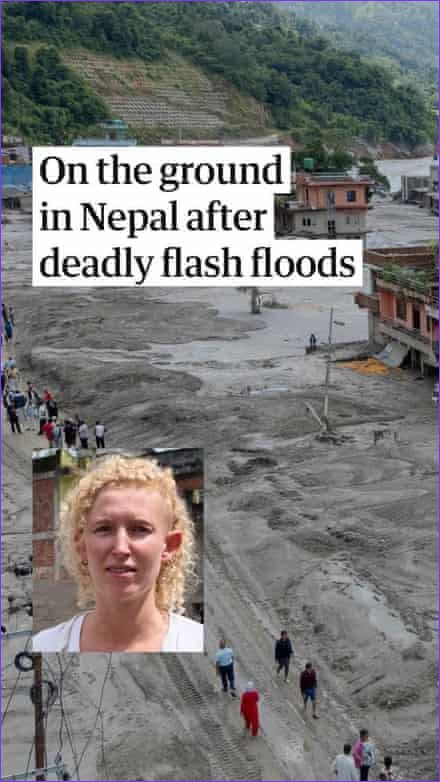
The rising Trishuli River also disrupted recovery efforts in Bidur, the capital of Nuwakot district in Nepal's Bagmati province. Rescue workers and residents attempting to salvage their belongings were ordered to evacuate immediately as water levels rose. Bidur, once a bustling riverside town, now lies in ruins after being inundated by mud and rocks early Wednesday. While most homes were swept away, a few mangled concrete structures—including a bank, a government office, and an ATM booth—remain standing but are deeply submerged in mud. Officials believe bodies are trapped inside these buildings, but recovery efforts remain too dangerous to proceed.
At the Bidur army camp, which serves as the hub for the rescue coordination, military helicopters have been arriving every five minutes to transport traumatized survivors who have lost their families, homes, and livelihoods.
Despite the immense challenges, Nepal has stated it does not yet require international search and rescue assistance. Several nations, including India, China, the United States, Great Britain, Japan, South Korea, Sri Lanka, and Bangladesh, have requested permission to deploy emergency teams to the region. Dinesh Bhattarai, a former Nepali ambassador to the UN in Geneva, suggested that the government's reluctance to accept foreign aid might be tied to geopolitical sensitivities regarding the Rasuwa district and its proximity to the Tibetan border. “They may have thought about the locational sensitivity of the region and decided not to accept foreign teams,” Bhattarai told Reuters. However, an official named Chhetri disputed this claim, asserting that Nepal's domestic rescue teams are fully capable of handling the operations independently. Meanwhile, very little information has emerged from Tibet, where Chinese authorities have tightly restricted media coverage, confirming only five deaths and focusing reports primarily on state rescue efforts.
Visual guide: how the deadly flooding unfolded
Nearby, people gathered along the muddy road, calling out for lost relatives and trying to dig out what was left of their belongings.