The legendary Japanese avant-garde artist Yayoi Kusama, who rose from outsider status to become one of the world's most celebrated global superstars while choosing to live in a psychiatric facility, has died at the age of 97.
Kusama passed away in a Tokyo hospital on August 14, according to an announcement released on Thursday by her company, Yayoi Kusama Inc. In their statement, the company paid tribute to her extraordinary life, which was entirely dedicated to her craft. They described her as a pioneering avant-garde figure whose extensive career spanned visual art, performance, poetry, and fiction. "Throughout an extraordinary lifetime devoted entirely to artistic creation, Kusama pursued an internationally acclaimed career as a pioneering avant garde artist whose creative practice encompassed visual art, performance, fiction, and poetry," the statement read. "She continued to paint until her final days, never setting aside her brush, and continued exploration of forever love and eternal soul." The company added, "We will carry forward Kusama’s wishes and, through art, continue to bring hope and strength for the future to people around the world."
Born in Matsumoto, Japan, in 1929, Kusama's early life was marked by unhappiness. She grew up with an abusive mother and a philandering father. Although her wealthy family ran plant nurseries, her mother repeatedly tried to stop her from drawing. It was during her childhood that Kusama first experienced the vivid hallucinations that would shape her artistic vision, seeing flowers swarm around her and speak to her. Drawing what she saw became her primary coping mechanism. During the Second World War, a 13-year-old Kusama was conscripted to sew fabric for Japanese military parachutes. She later studied the traditional Japanese painting style known as nihonga in Kyoto, but quickly grew frustrated by its rigid limitations.
Determined to escape an arranged marriage and a conventional life of domesticity, Kusama left Japan for New York in 1958. There, she established a close connection with the artist and theorist Donald Judd and achieved a major creative breakthrough with her "infinity net" paintings—massive canvases covered in dense fields of impastoed polka dots. Her financial situation during this era was modest; in 1962, she sold her first infinity net painting to artists Frank Stella and Judd for just $75. Decades later, in 2014, her painting White No 28 fetched $7.1 million (£5.7 million) at auction, which set a record at the time for a living female artist.
In 1963, Kusama began creating "soft sculptures," which consisted of domestic items like furniture and ladders covered in white, fabric-stuffed phallic shapes. These works, she explained, were a conscious effort to confront and heal her deep-seated disgust regarding sex, which her conservative upbringing had taught her to view as dirty and shameful. Despite her prolific output, she struggled to find acceptance within the male-dominated art world of pop art and minimalism. Kusama frequently asserted that her innovative concepts were appropriated by prominent white male artists, including Andy Warhol, while she was actively written out of art history.
Her artistic philosophy centered heavily on infinity and the concept of "self-obliteration," a state directly inspired by her hallucinations. Describing her experience while painting the 1954 work Flower (DSPS), Kusama recalled looking at a red flower pattern on a tablecloth, only to see the design spread across the ceiling, windows, walls, and eventually her own body and the entire universe. "I was looking at the red flower patterns of the tablecloth on a table, and when I looked up I saw the same pattern covering the ceiling, the windows and the walls, and finally all over the room, my body and the universe. I felt as if I had begun to self-obliterate, to revolve in the infinity of endless time and the absoluteness of space, and be reduced to nothingness," she explained.
Kusama also developed a reputation for staging provocative, highly political "happenings." During the hippie era, she organized "body festivals" where naked performers were painted with polka dots, and she famously wrote to US President Richard Nixon, offering to sleep with him if he would end the Vietnam War. These actions deeply scandalized her conservative family in Japan. Her activism extended to staging New York’s first "homosexual wedding" in Tribeca in 1968, and washing a "dirty" Soviet flag outside the United Nations building to protest the invasion of Czechoslovakia.
In New York, Kusama maintained an obsessive, platonic relationship with the outsider artist Joseph Cornell, which continued even after she eventually returned to Japan. Her mental health had been fragile, leading to frequent hospitalizations during her time in the United States. Following Cornell's death in 1972, her condition worsened, marked by severe hallucinations, panic attacks, and suicide attempts. In 1977, she voluntarily checked herself into a Tokyo psychiatric hospital that offered art therapy. Finding the structured environment gave her the stability she needed to work without distraction, she chose to live there permanently, traveling daily to work from morning until night in her nearby studio.
After a period in the 1980s and early 1990s where her public profile waned and she focused partly on publishing novels, Kusama experienced a major career revival. In 1993, she represented Japan at the Venice Biennale, winning widespread acclaim for a mirrored room filled with small pumpkin sculptures. The pumpkin was a deeply personal motif for Kusama, dating back to an encounter at age 11 when she was with her grandfather; she believed a pumpkin began speaking to her when she tried to pick it. This motif recurred in major later works, such as her 2016 installation All the Eternal Love I Have for the Pumpkins.
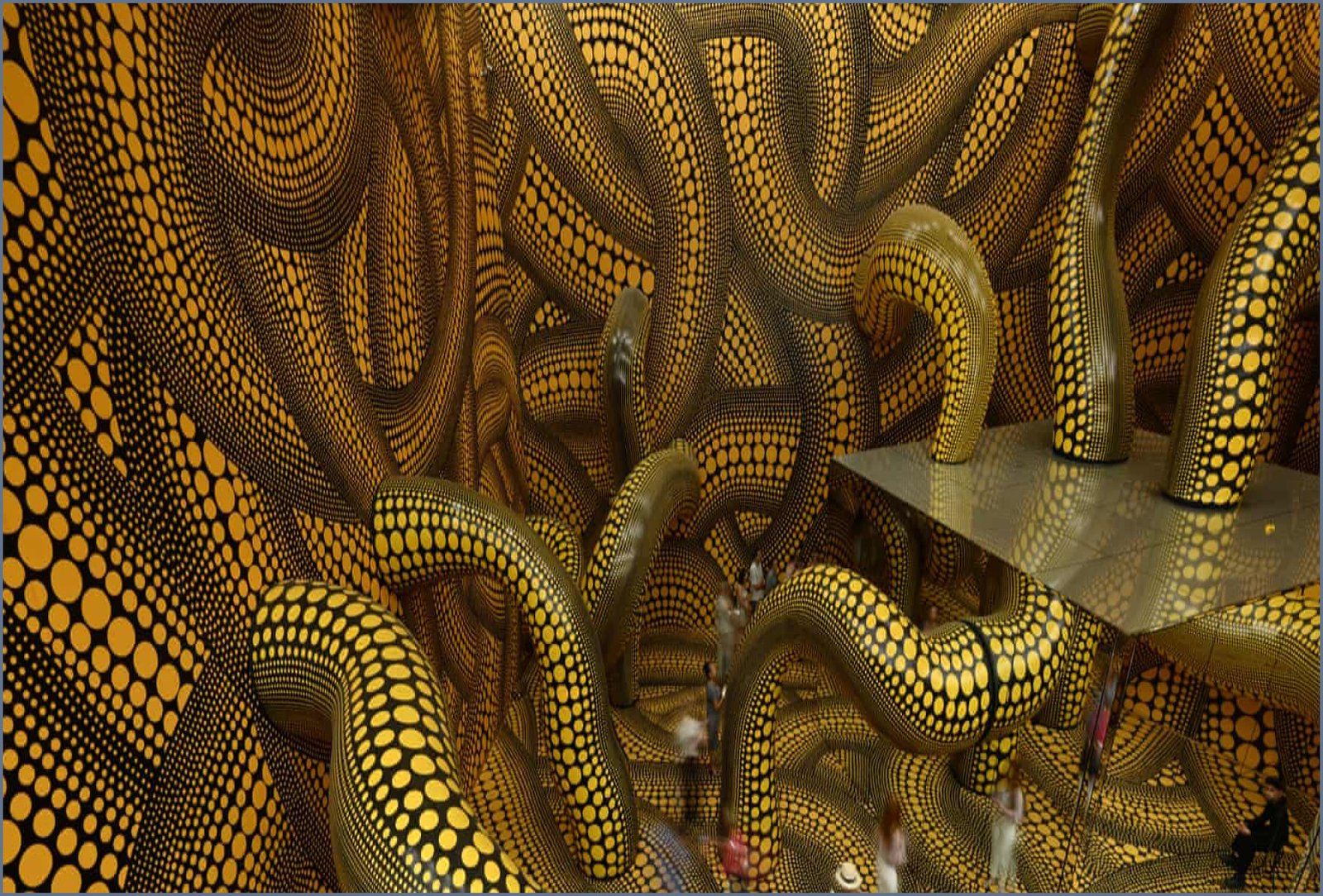
In her later years, Kusama’s focus shifted toward large-scale immersive installations that built upon her 1965 work Infinity Mirror Room: Phalli’s Field. These mirrored, light-filled environments became a global phenomenon, particularly in the social media era, where her brightly colored pumpkins and endless lights attracted millions of visitors seeking the perfect photo. The intense popularity of these rooms occasionally brought complications; in 2017, an exhibition at the Hirshhorn Museum in Washington DC had to be temporarily closed after a visitor damaged an artwork while attempting to take a selfie.
Kusama was honored with major retrospectives at prestigious institutions, including New York’s Museum of Modern Art in 1998, Tate Modern in London in 2012, and the Hirshhorn Museum in 2017. Her exhibitions routinely sold out, with fans waiting in queues for hours to experience just 30 seconds inside her infinity rooms. Reflecting on her legacy, Kusama once remarked, "I cannot imagine how I will be classified after my death," adding, "It feels good to be an outsider."