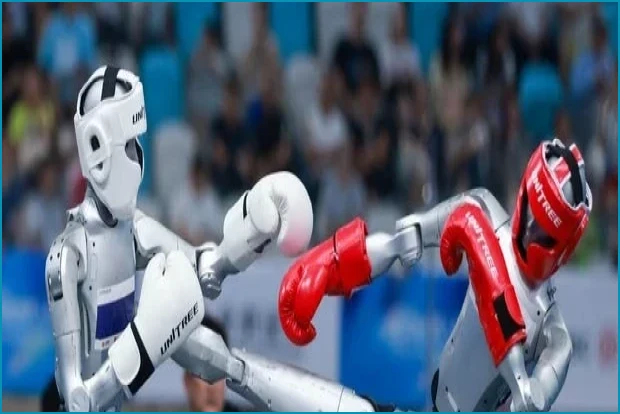
The prospect of humanoid robot soldiers marching onto the battlefield is no longer confined to science fiction, with a leading Chinese developer predicting their deployment is likely only five to ten years away. This timeline was shared at the 2026 World Humanoid Robot Games in Beijing, where rapid technological breakthroughs have sparked both excitement and apprehension about the future of warfare.
The games, which are being hosted by China for the second consecutive year, took place inside the speedskating venue built for the 2022 Beijing Winter Olympics. The event showcased the massive scale of the global robotics boom, featuring more than 2,000 robots from over 600 teams representing 16 countries. Spectators cheered from the stands as a diverse array of machines demonstrated their capabilities. In a boxing ring, two humanoids equipped with red and black headgear exchanged punches and kicks. Nearby, robots waited their turn to perform flips and spins on a gymnastics spring mat, while child-sized machines played soccer on a synthetic grass field. Other robots scrambled through an obstacle course, running, crawling, and climbing toward the finish line.
The physical capabilities on display reached historic heights on Sunday when a humanoid robot completed a 100-meter sprint, running the 109 yards in just 9.39 seconds. This performance shattered the long-standing human world record of 9.58 seconds, set by Jamaican track star Usain Bolt in 2009. However, the event was not without its failures. During competition, a number of humanoid robots have tripped, collapsed, burst into flames or slammed into safety barriers and then been stretchered off the track. Crowds here have been thoroughly entertained.
Despite the entertaining mishaps, the impressive agility of the machines has intensified questions about when these technologies will be weaponized. Many of the athletic events, such as sprinting, weightlifting, long jump, and boxing, showcase physical traits that are directly transferable to combat scenarios.
Yang Kun, a robotics engineer with the Shanghai-based humanoid robotics company AG BOT, confirmed that military application is the ultimate objective. Yang, whose company entered a robot named "A3" into the kickboxing competition, stated that Chinese firms are within five to ten years of producing functional robot soldiers. According to Yang, the development of these machines is intended to act as a deterrent. "That's what we really want to do as we can make sure people in the world will not be attacked," he said. "We will use the robots to show the power of a country like China that will ensure no other country would attack. This will prevent war."
When asked about the potential danger of autonomous machines turning against humanity—a scenario reminiscent of the Terminator film franchise—Yang dismissed the concern. He argued that robots do not have emotions and that their behavior ultimately depends entirely on the humans who design and control them.
The World Humanoid Robot Games serve as a major showcase for China's technological ambitions. Under the leadership of President Xi Jinping, Beijing has invested heavily in artificial intelligence and robotics, aiming to establish global dominance in science and technology. While Yang noted that robots like the A3 will initially find roles in daily life, such as cleaning homes and hotels to make daily life better through technology, he acknowledged that their path will inevitably lead to military deployment, combat roles, and other applications in the near future.
Smaller robots — the size of children — gather on a miniature soccer field, kicking a ball up and down the synthetic grass. Others compete in an obstacle course, running, crawling, weaving and climbing their way to the finish.