Tehran has rejected U.S. President Donald Trump's promises of severe economic retaliation, asserting that decades of American sanctions have proven ineffective. On Friday, Iranian Parliament Speaker Mohammad Baqer Qalibaf, who serves as the country's chief negotiator with the United States, argued that Washington’s pivot to what Trump called an "economic D-Day" is a direct admission of military failure.
Speaking during a visit to neighboring Iraq, Qalibaf stated that the U.S. and Israel have realized they cannot defeat Iran in a conventional military conflict. "The Americans and the Israelis have realised that they cannot handle Iran…in the field of a hard military war, so they have entered into a cognitive war and an economic war," Qalibaf said. His remarks followed a commemoration ceremony in Karbala, Iraq.
Iranian Foreign Minister Abbas Araghchi also denounced the escalating U.S. rhetoric, labeling the strategy of economic warfare as "economic terrorism." In a social media post, Araghchi claimed the threats were designed to distract from domestic economic difficulties in the U.S. He warned that continuing with failed pressure tactics would only intensify anti-American sentiment in the region.
The diplomatic clash comes after Trump posted on Truth Social earlier in the week, pledging to execute "the most crushing economic operation ever taken against any country" and urging international allies to join the effort. The escalating tension coincides with a complete standstill in diplomatic efforts to revive peace negotiations, occurring just days after the expiration of a 60-day memorandum of understanding aimed at ending the war. A U.S. naval blockade remains active, while Iran continues to severely limit maritime traffic through the Strait of Hormuz, a critical global choke point for oil shipments.
The United States already maintains sweeping sanctions that block most of Iran's trade with Western nations. In June, Washington expanded its pressure by targeting refineries and companies purchasing Iranian crude. Now, U.S. Treasury Secretary Scott Bessent is threatening to impose secondary sanctions directly on foreign governments that maintain trade ties with Tehran. On Wednesday, Trump warned on social media that any country providing a financial or logistical lifeline to Iran would face "tremendous economic consequences."
In a Thursday interview with CNBC, Bessent declared that Iran would soon experience the "greatest coordinated economic isolation in the history of the world," adding that the goal is to collapse the Iranian regime. Bessent specifically pointed to China, noting that Beijing has been purchasing approximately 90 percent of Iran's oil exports. While Bessent declined to confirm whether China would face direct sanctions, a Chinese foreign ministry spokesman reacted on Friday by rejecting pressure tactics and calling for diplomatic negotiations instead. Bessent is scheduled to hold a press conference on Monday to outline the operational details of the planned economic campaign.
Sina Toossi, a senior fellow at the Washington-based Center for International Policy, observed that ideological hardliners now control key sectors of Iran's government and economy. According to Toossi, economic hardship is not their primary concern. "There's this existential threat that the Iranians have been faced with. So they're willing to bear much greater economic costs to kind of secure their survival," Toossi explained.
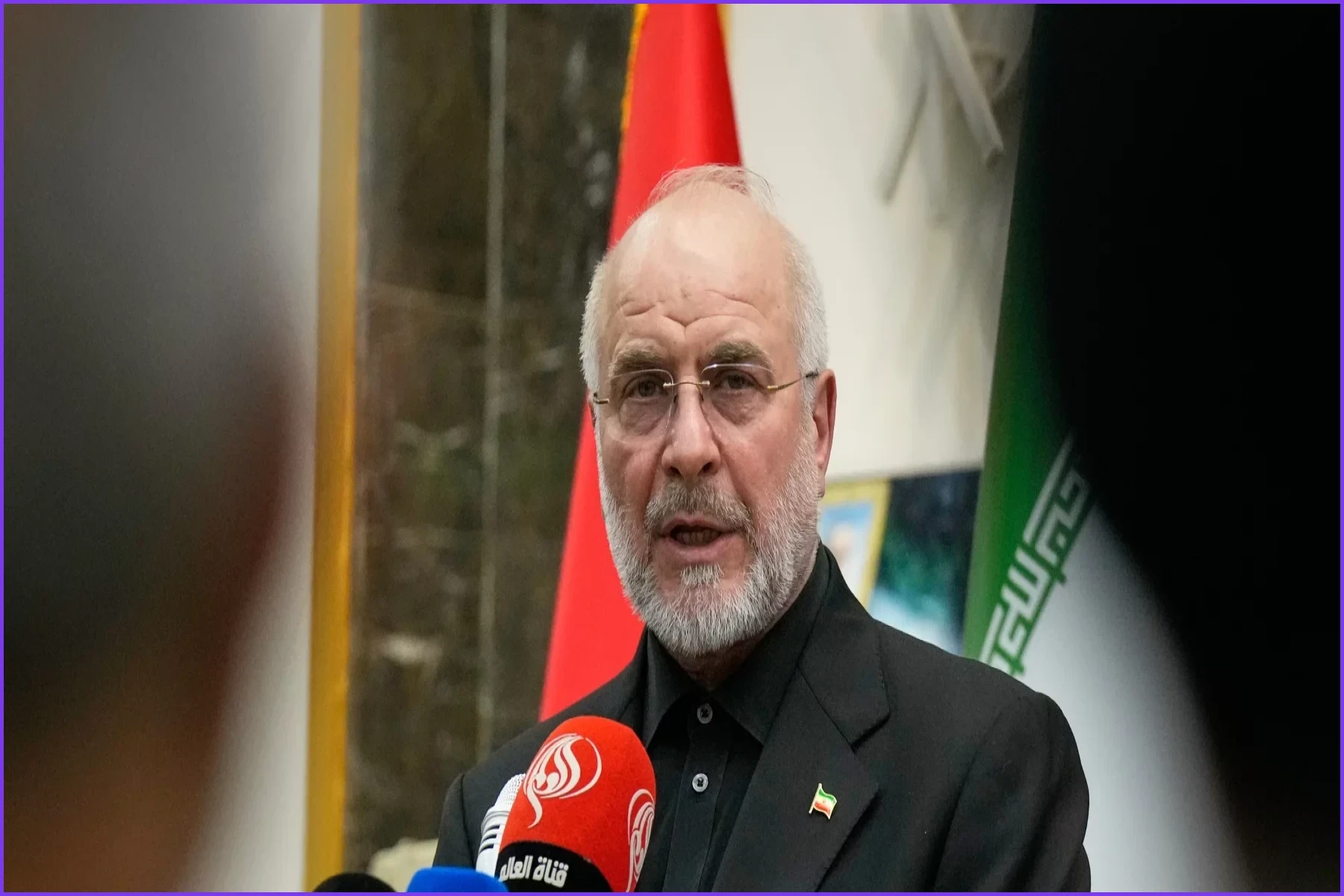
Iran's Parliament Speaker Mohammad Bagher Qalibaf speaks during a 40-day commemoration ceremony for the late Iranian Supreme Leader Ali Khamenei at the Imam Hassan Mosque in Karbala, Iraq, Thursday, Aug. 20, 2026. Hadi Mizban/AP hide caption