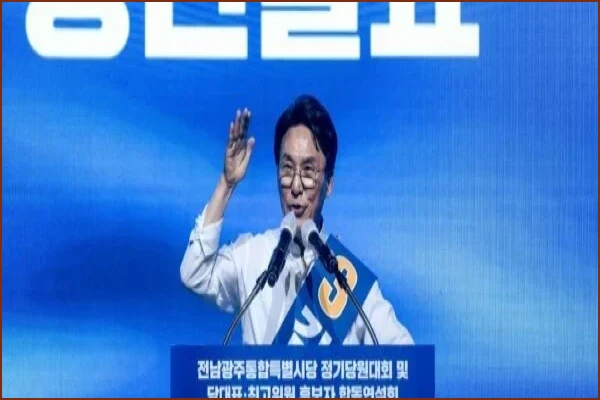
Former South Korean Prime Minister Kim Min-seok has been elected as the leader of the ruling Democratic Party (DP) following a historic ranked-choice runoff. Kim, a four-term lawmaker, secured 54.08 percent of the final vote, defeating incumbent party chair Jung Chung-rae, who garnered 45.92 percent. The victory concludes a six-week campaign that highlighted deep internal divisions between factions aligned with South Korean President Lee Jae-myung and those supporting the outgoing chair.
The election marked the first time the Democratic Party implemented a ranked-choice runoff system. Because Kim fell short of an outright majority in the initial round of voting—which combined ballots from party members, delegates, and public opinion polls—the party triggered its newly adopted reallocation process. Under these rules, second-choice votes from supporters of the third-place finisher, Representative Song Young-gil, were redistributed between Kim and Jung to determine the final winner. This election was also the first conducted under the DP's new "one-member, one-vote" system, where dues-paying members and delegates hold 70 percent of the voting weight, and a national opinion survey accounts for the remaining 30 percent. The public poll was conducted over two days by two polling firms, surveying 4,000 respondents while restricting participation to DP supporters and independents to exclude conservative opposition voters.
The election unfolded in regional waves starting on August 1 in Chungcheong, where Kim narrowly led Jung by 45.05 percent to 44.61 percent, with Song trailing at 10.34 percent. Jung rebounded the following day, winning in Busan, Ulsan, and South Gyeongsang Province with 46.65 percent to Kim's 43.85 percent. On August 8, Kim secured victories in Jeju and Incheon with 47.75 percent to Jung's 42.08 percent. The fourth round on August 9, covering Gangwon Province, Daegu, and North Gyeongsang Province, saw Kim lead with 48.54 percent to Jung's 44.40 percent, narrowing the cumulative gap to 1.48 percentage points. To consolidate the pro-Lee faction's position, lower-ranked candidates Im Mi-ae and Kim Young-ho withdrew from the race late on August 16 to back Kim Yong, aiming to block Jung's faction from capturing three of the five Supreme Council seats.
As the newly elected DP chair, Kim will direct candidate nominations for the upcoming general elections in April 2028. The leadership race was widely viewed as a critical assessment of President Lee's consolidation of power within the party since taking office in 2025. Observers described the contest as a proxy battle between the pro-Lee camp and Jung’s more hardline faction, which has occasionally clashed with the presidency over the pace of judicial reforms. During a July campaign speech, Kim framed the race as a direct referendum on supporting President Lee's legislative agenda. Kim's strongest support materialized in Gwangju, the Jeolla provinces, and the greater Seoul area, following President Lee's announcement of an 800 trillion won ($564 billion) semiconductor investment package for the Gwangju region. However, local media reports indicate that Lee's overall approval rating recently fell to 44 percent, his lowest since taking office.
Despite Kim's victory, he faces a challenging leadership environment. Lawmakers aligned with his defeated rival, Jung, secured a majority of the elected seats on the party's Supreme Council. This division is expected to complicate Kim's efforts to unify the party behind President Lee's administration ahead of the 2028 elections.
Kim, 62, belongs to South Korea's "86 generation" of former student activists who led the pro-democracy movement in the 1980s before transitioning into mainstream politics. While serving as Seoul National University's student council president, he was recruited into politics in 1990 by the late President Kim Dae-jung, joining the merger of Kim's party with the New Democratic Alliance Party, which earned him the nickname "first son of democratic unification." He became the youngest lawmaker of his era when elected to the National Assembly in 1996 at age 32, and won a second term in 2000.
His political trajectory stalled in October 2002 after he left the party during a dispute over unifying the presidential candidacies of Roh Moo-hyun and Chung Mong-joon—an action Jung repeatedly raised as a campaign criticism. Kim lost his National Assembly seat in 2004 and spent years outside elected office, studying in both the United States and China. He returned to party leadership as a Supreme Council member in 2008 but was subsequently barred from running for office for five years due to a political funding case. In 2014, he founded a small breakaway party that eventually merged back into the DP in 2016 under then-chair Choo Mi-ae.
Kim reclaimed his National Assembly seat in 2020 and won a fourth term in 2024. His alliance with Lee Jae-myung grew closer during the 2022 presidential campaign, where Kim managed strategy. He later served as the DP's policy chief and, starting in 2024, as a senior Supreme Council member under Lee's chairmanship. Following the impeachment of Yoon Suk-yeol and Lee's subsequent presidential election, Kim was appointed as the first prime minister of the Lee administration in mid-2025. In that role, he managed the APEC summit in Gyeongju and traveled to Washington to meet with U.S. President Donald Trump and Vice President J.D. Vance. Kim stepped down from the prime minister post at the end of June 2026 to launch his bid for the party chairmanship, and he is now considered a potential future presidential candidate within the DP.