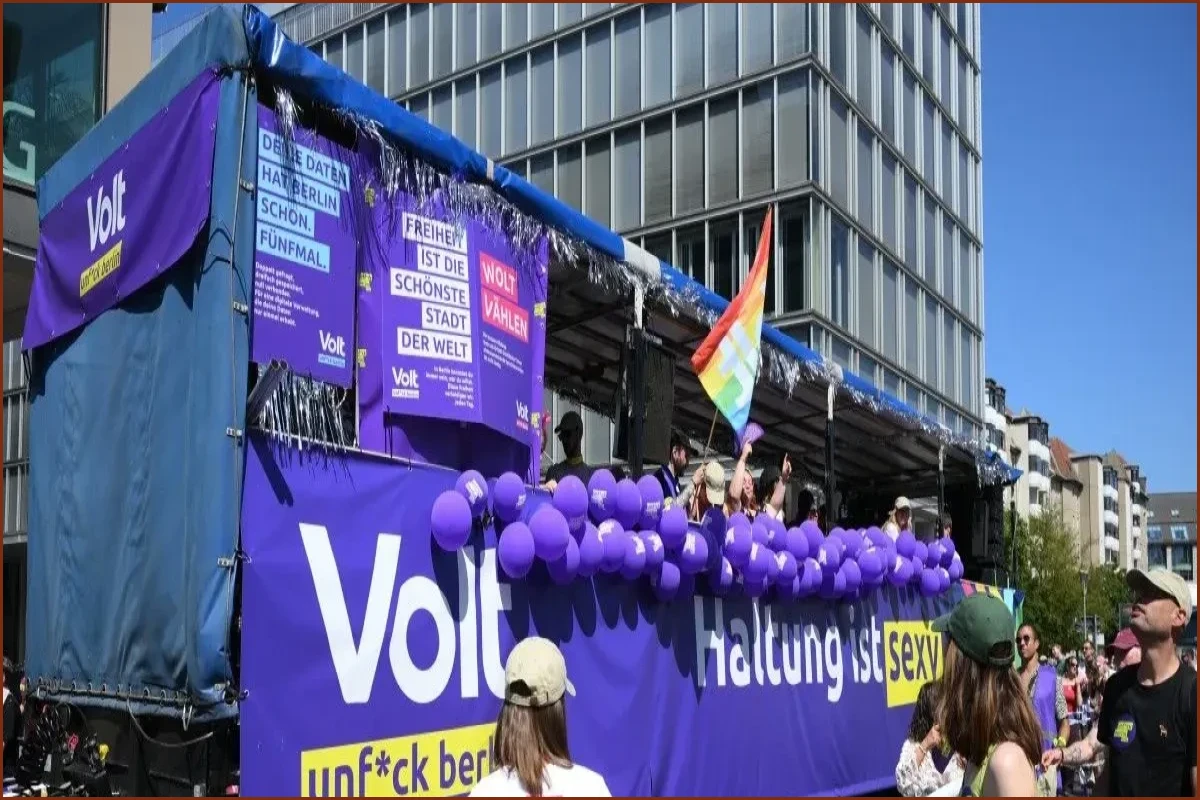
As Berlin approaches its upcoming election on September 20th, a lesser-known political party is capturing the attention of voters with a bold, purple campaign poster carrying a simple two-word slogan: "unf*ck Berlin." The party behind the eye-catching campaign is Volt, a pan-European political movement that aims to bring pragmatic, evidence-based solutions to the German capital.
With ambitious plans to make the city cleaner, more digital, and more efficient, the party is pitching itself as a fresh alternative to traditional, ideologically driven politics.
Among those running under the Volt banner is Matt Bristow, a candidate for the House of Representatives and the local assembly in Neukölln’s 2nd district. Born in Britain, Bristow is a clinical psychologist who permanently relocated to Berlin in 2018 under the shadow of the Brexit deadline.
Having since acquired German citizenship, he is now eligible to run for public office in Germany. For Bristow, Volt represents a necessary shift in how modern politics is conducted.
The party itself was founded in the wake of Brexit and the first election of Donald Trump. According to Bristow, the founders were looking at global political trends and realized there had to be a different way to reach voters without relying on populist extremes. While many associate Volt primarily with its pan-European identity, Bristow notes that its core appeal lies in its highly pragmatic approach.
He observes that politics frequently becomes gridlocked along ideological lines, where parties champion fixed solutions simply because they represent specific groups, such as car drivers or low-income residents, without asking whether those solutions actually work in practice.
To break this deadlock, Volt’s platform focuses on importing proven ideas from other metropolitan areas. The party's campaign program includes 98 specific "best-practice" examples borrowed from successful initiatives in cities like Amsterdam, Helsinki, Vienna, and Copenhagen. To get these ideas noticed, Volt launched its campaign using guerrilla tactics, including chalk spray, stickers, and its provocative slogan.
Bristow explains that the message is not that Berlin is a terrible place, but rather that the city has immense potential to be better if it adopts the right ideas.
One of the most pressing issues in Bristow's own district of Neukölln is the accumulation of rubbish and bulky waste on the streets. While the current Berlin government has focused on raising fines for illegal dumping, Bristow points out that evidence shows this punitive strategy fails due to a lack of enforcement.
Instead, he advocates for a low-cost, high-impact psychological tactic successfully used in his former London borough of Newham.
There, local authorities placed crime-scene-style tape around illegally discarded furniture to signal that an investigation was underway. This simple visual cue created a deterrent by making people feel they might get caught, significantly reducing littering and fly-tipping without requiring a massive budget.
Another major priority for Volt is fixing Berlin's notorious public administration and IT systems. Drawing from his professional experience working in the city's parenting and family guidance centres, Bristow criticizes Berlin's digital infrastructure as being decades behind the private sector. He finds it particularly disappointing for a city globally recognized for its digital startups and creative industries.
To show that reform is possible, he points to Frankfurt, where fellow Volt member Eileen O'Sullivan has driven administrative modernization in her role as the Commissioner for Citizens, Digital and International Affairs.
To modernize Berlin's administration, Bristow proposes two key structural reforms. The first is the "once-only" data principle, which ensures that citizens only have to submit their information to the city once. This data would then be securely shared among different municipal departments, eliminating the need for residents to repeatedly submit the same paperwork or for staff to manually re-enter printed data.
The second reform is the introduction of "Approval Fiction" (Genehmigungsfiktion). Under this system, complete applications for permits and registrations would be automatically approved if the city administration fails to process them within a designated deadline, effectively ending the long wait times that currently plague Berlin's residents.
Take a stroll down any given street in Berlin these days, and you’ll probably see one of their signs. A purple campaign poster with a two-word slogan: “unf*ck Berlin”.
READ ALSO: 'No promises' – Decoding the political slogans plastered all over Berlin