Zhu Rongji, the former premier of China who was instrumental in guiding the nation's economic reforms through the 1990s, has died at the age of 97. State media reported his death was due to illness.
An engineer by training and known for his sharp intellect, Zhu's premiership was marked by ambitious efforts to steer China away from the post-Maoist era towards a more global, market-oriented financial system, while maintaining the Communist Party's overarching control.
Despite largely withdrawing from public life after leaving office in 2003, Zhu remains a significant and debated figure in China. His reforms are credited with generating substantial wealth over the subsequent decades by freeing up labor and financial resources, but also with embedding future vulnerabilities within the economic system.
Charlene Barshefsky, a former U.S. trade representative who negotiated with Zhu for years on China's entry into the World Trade Organization (WTO), described his approach. "From the point of view of a policymaker, [he] embraced the notion of a China whose economic system was more compatible with that of the West. And by compatible, I mean vastly reformed, more open, less state-dominated, very limited state intervention," she said.
China's accession to the WTO required securing preferential trading status with the United States, a process that involved difficult concessions and opening the Chinese economy to American companies. Zhu was under immense pressure to reach a compromise during these protracted negotiations.
The U.S. Senate approved preferential trading status for China in 2000, paving the way for the country's WTO membership in 2001. This agreement proved to be a major boon for China's developing economy, transforming it into an export powerhouse and attracting significant foreign investment.
Kenneth Lieberthal, a China expert and former national security adviser to President Bill Clinton, recalled the WTO negotiations as a period of intense give-and-take, noting that Zhu, despite his formidable reputation, appeared inquisitive and flexible. "This was not talking points. It was a lot of give and take," Lieberthal stated.
Born in Changsha, Hunan province, in 1928, Zhu graduated from Tsinghua University with a degree in electrical engineering. He officially joined the Chinese Communist Party in October 1949, shortly after its founding.
An orphan who lost his father before birth and his mother at age 9, Zhu developed a resilient and direct personality shaped by the need to survive. He once declared in 1987, before becoming mayor of Shanghai, "My defining characteristic is independent thought. I say what I think."
His candor was evident even in difficult times. Following the 1989 Tiananmen Square events, Zhu did not adhere to the official propaganda line, writing in a Shanghai newspaper that the incident was a historical fact that could not be concealed and that the truth would eventually emerge.
This outspokenness led to significant challenges. In 1958, he was labeled an ideological "rightist" and briefly expelled from the party for criticizing Chairman Mao Zedong's economic policies, though he retained a position in state planning. During the Cultural Revolution in 1970, he was purged again and sent to perform manual labor for five years at a party reeducation school.
Zhu's political fortunes improved after Mao's death in 1976 and Deng Xiaoping's rise to power. He systematically rebuilt his career through pragmatism, mirroring the methodical approach he learned as an engineer.
In 1999, addressing American businessmen, Zhu humorously conveyed China's openness to foreign investment: "Regardless of what country your company is from, when you arrive in China, you should receive fair and equal treatment. I just want you to pay taxes."
As premier, appointed in 1998, Zhu vowed to reform indebted state banks within two years and inefficient state enterprises within three, a bold promise that garnered both support and opposition.
His tenure included the controversial restructuring of China's large state-owned enterprises. This process involved closing smaller, inefficient companies, resulting in an estimated 30 million state workers losing their jobs. Worker protests ensued across China, but Zhu maintained his course, a decision critics viewed as callous.
Dorothy Solinger, a professor emeritus at the University of California, Irvine, who studies migrant labor in China, commented on the government's approach: "The central government decided that the laid-off worker problem could just be ignored and forgotten."
To mitigate the impact of these layoffs, Zhu established a basic social welfare system and took steps to improve healthcare, particularly in rural areas. However, regions heavily reliant on state-owned heavy industry, especially in the northeast, faced prolonged economic hardship. Solinger noted the intergenerational impact, stating, "I think their children also have a problem because they miss out on the things that the better-off part of the population could do, such as hiring tutors or going on extracurricular activities, going to the better schools. It's a growing underclass."
Zhu handled criticism with a characteristic flair, often engaging with the press and improvising responses, unlike many Communist leaders who relied on prepared scripts. Rose Luqiu, a former journalist who covered Zhu extensively, recalled his willingness to answer tough questions, often deflecting sensitive ones with humor.
His dark humor was a tool to navigate internal party opposition. During an anti-corruption drive, he quipped, "I have prepared 100 coffins: 99 for the corrupt officials and one for myself."
Some of Zhu's reform initiatives, such as reducing bad debt in state banks and reforming the pension system, did not fully materialize, partly due to his difficulty in building the political patronage networks needed to overcome resistance within the Communist Party.
In contemporary China, under leader Xi Jinping, Zhu Rongji is often remembered with nostalgia as representing a different era. Barshefsky observed, "I think that Zhu Rongji represented really a different time, a different era for China: the time when China wanted to find its way in what, due to that time, was the best possible way, which was to move towards Western-style economics, to move toward Western-style rules."
Zhu Rongji spent his final years at his home in Beijing, where he enjoyed Peking Opera and music, and reportedly offered quiet advice to a new generation of Chinese technocrats, though not all appear to have heeded his counsel.
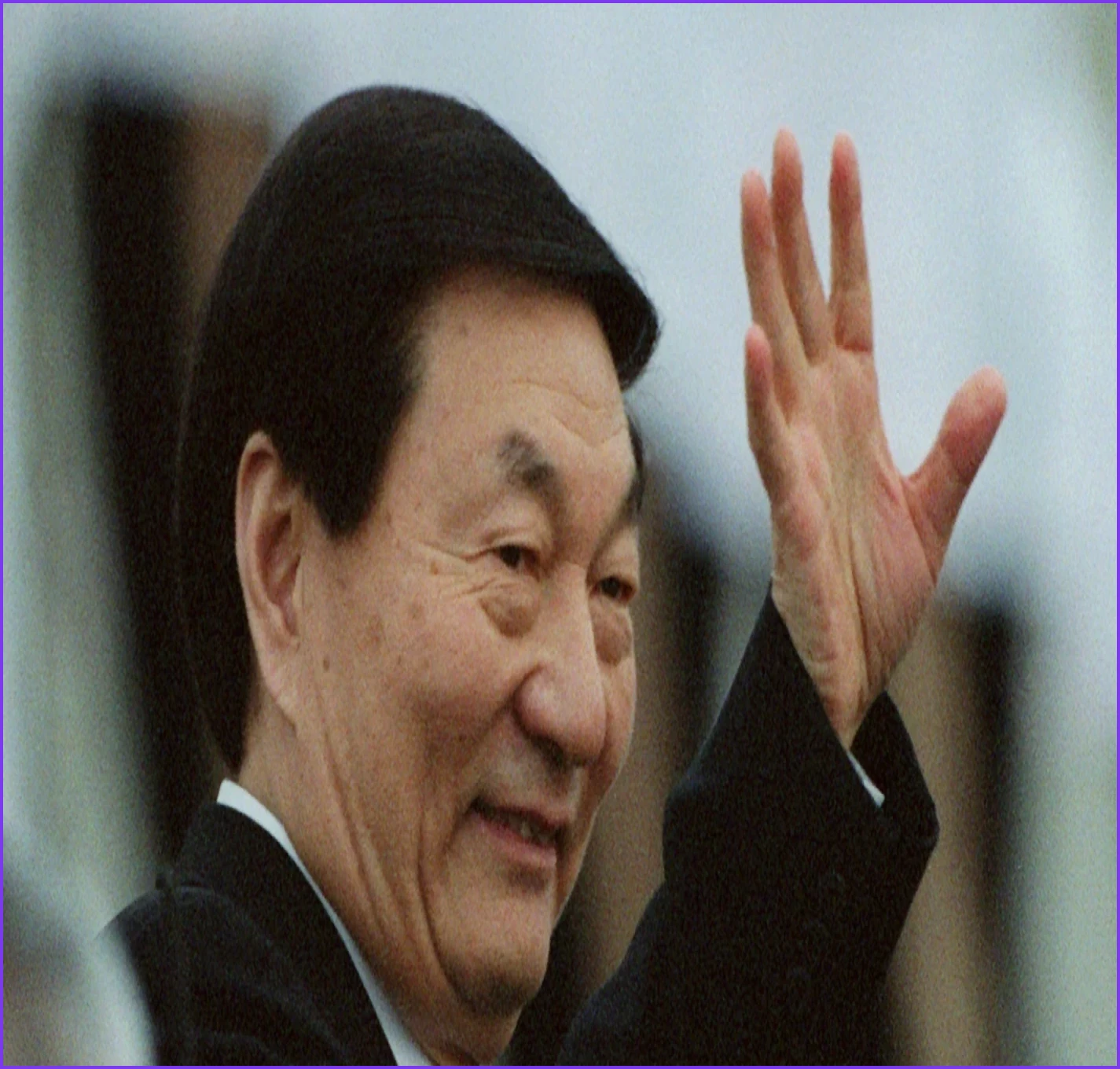
Then-Chinese Premier Zhu Rongji arrives at Hong Kong's international airport on Nov. 18, 2002, for the opening of the World Congress of Accountants. K.Y. Cheng/South China Morning Post via Getty Images hide caption
Then-Chinese Premier Zhu Rongji arrives at Hong Kong's international airport on Nov. 18, 2002, for the opening of the World Congress of Accountants.