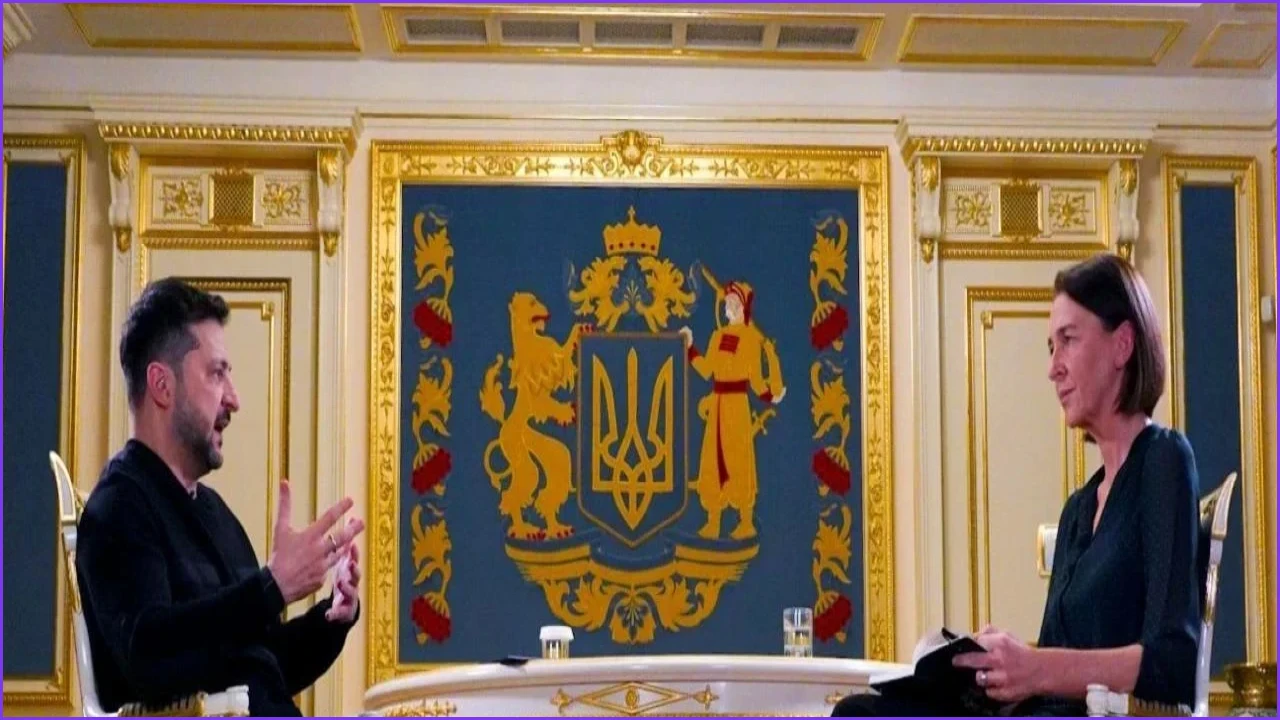
Ukrainian President Volodymyr Zelensky has expressed intense frustration with the United States over its diplomatic posture and critical military support, arguing that Washington is failing to exert sufficient pressure on Russia during peace talks while delays in providing anti-ballistic missile systems are costing civilian lives. Speaking in English during an interview at his central Kyiv office, the leader voiced concern over the US approach to Moscow and warned that American strategic priorities have shifted away from Ukraine.
Zelensky specifically criticized Donald Trump for publicly referring to Russian President Vladimir Putin as "my friend" and posting a photo of himself embracing the Russian leader, calling the public display "strange." Rebutting the characterization, Zelensky emphasized that Putin is an aggressor and a killer who cannot be considered a friend, likening such a description to claiming friendship with Adolf Hitler during World War Two. Relations between Kyiv and Washington have remained delicate since a bruising Oval Office meeting with Trump in 2025.
With diplomatic talks expected to resume in December, Zelensky highlighted growing obstacles to a resolution as Russia appears to have regressed across all negotiating points to its initial, hardline positions. Although American envoys previously indicated that European negotiators would take part in the upcoming discussions, Zelensky revealed that their presence remains uncertain due to apparent resistance from the Kremlin. The push for diplomatic progress comes as Ukraine endures five exhausting years of Russia's full-scale invasion, marked by increasingly frequent and lethal strikes that have pushed civilian casualties to an all-time high.
Directly appealing to Washington, Zelensky urged the US to demonstrate its power and respect by acting as a genuinely helpful ally capable of forcing Russia toward peace. Warning against diplomatic neutrality, he stated, "When you try to be very neutral with the aggressor… it means you support victims and you support also aggressor. It's not right." Zelensky expressed particular disappointment over Washington's focus on conflicts in the Middle East, noting, "It's a pity they made a focus on Middle East and they help them more… It's a pity. We have huge questions with this," adding that "the deficit of these missiles – that is people's lives."
The deficit in air defense capabilities comes at a critical time as Kyiv struggles daily against Russian aerial bombardments. Day and night air alerts have become a routine feature of life in major cities, where jet-powered drones and ballistic missiles systematically target power stations, bridges, and civilian infrastructure. In response, Ukraine has launched hundreds of drones against targets inside Russia, and military forces now destroy roughly 70 percent of Russia's fastest drones—an intercept rate Zelensky noted is continuously improving. However, he emphasized that there is a "very, very big" deficit of interceptors to stop ballistic missiles, and he said the Americans were delaying deliveries of its Patriot systems.
Operational challenges have also been compounded by restrictions on American satellite communication systems, including SpaceX's Starlink and its military derivative, Starshield, which remain restricted in Russian-occupied regions of Ukraine. Ukrainian drone operators have reported that their interceptor drones can no longer catch up with incoming Russian Shahed drones, enabling the weapons to fly deeper into Ukrainian airspace unhindered. Asked about the restrictions, Zelensky said, "Technically SpaceX, politically – I don't know, I really don't know," describing the situation as ping-pong where asking one side leads to being directed to the other.
Simultaneously, Ukraine's own long-range strikes against Russian targets have increased in recent weeks, including oil refineries and ships carrying weapons or fuel. Addressing concerns raised on Thursday by Italian Prime Minister Giorgia Meloni—who stated that a Ukrainian attack sinking the Russian warship Merkury docked in eastern Libya risked an unacceptable spread of war into the Mediterranean—Zelensky defended the move. He called the warship an "absolutely fair goal," and he accepted that such strikes were "very dangerous" but said Ukraine's forces "never attack" without co-ordinating with its partners.
Looking ahead, Zelensky acknowledged that Ukraine is bracing for a difficult and dangerous winter. Recent Russian attacks on Kyiv have targeted key bridges over the Dnipro river in an apparent attempt to cut the capital in two. Rolling power cuts and strikes on logistics networks have pushed operating costs unmanageably high, forcing businesses to close and prompting some residents to leave the city, while plunging much of the capital into darkness. Despite the pressure, Zelensky stressed the commitment to defend the capital: "[Russia] wants us to run away, of course. People can go, but we will try to defend our capital in any way. We need our capital. Without a capital, you don't have a country."