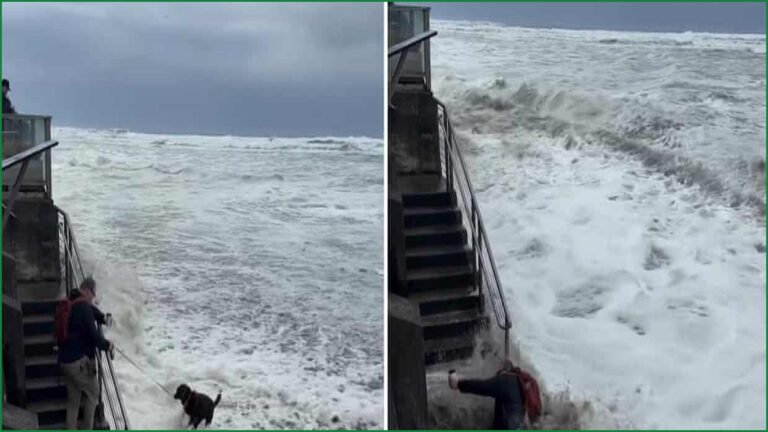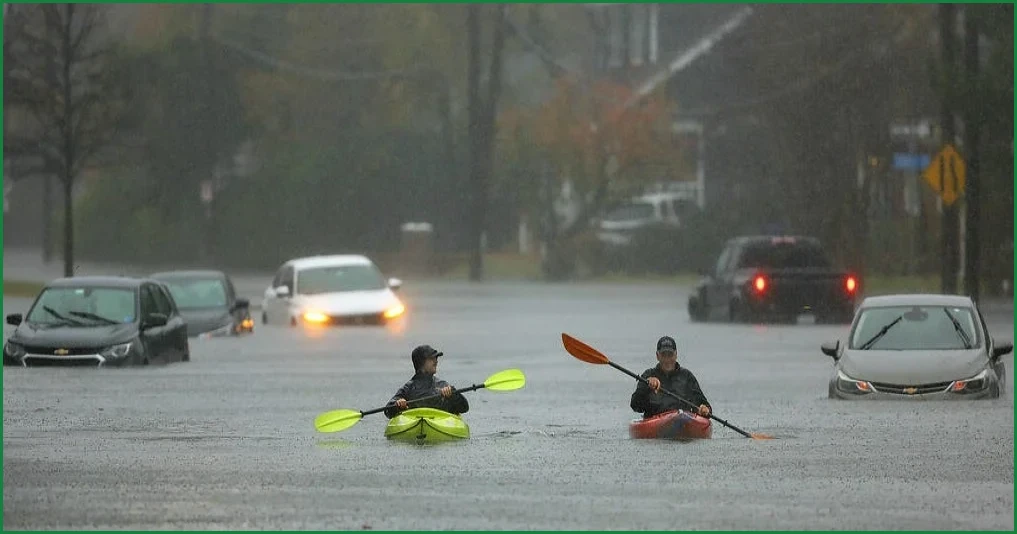
A powerful Thanksgiving Day storm battered the East Coast and Midwest with heavy rain, severe coastal flooding, and damaging winds, knocking out power to more than 900,000 utility customers and severely disrupting holiday travel. The widespread impact of the storm system also prompted the historic postponement of New York City's annual Macy's Thanksgiving Day Parade.
Data tracked by PowerOutage.us showed that over 900,000 homes and businesses were left without electricity across the Midwest and Northeast by Thursday evening. Pennsylvania was among the hardest hit, reporting more than 200,000 customers without power, while Virginia and Missouri each recorded over 100,000 outages. Air travel faced widespread delays as well, with flight-tracking service FlightAware logging more than 2,000 flight delays and over 420 cancellations for trips arriving at or departing from U.S. airports on Thursday evening.
Torrential rainfall, intense winds, and rising coastal floodwaters hammered large portions of the Eastern Seaboard. Governors in affected areas issued emergency declarations, including a statewide emergency in New Jersey declared by Gov. Mikie Sherrill on Wednesday night and local emergency declarations in parts of New York issued by Gov. Kathy Hochul. Wind advisories issued by the National Weather Service stretched from northern Georgia across most of the mid-Atlantic and into southern New England.
In New York City, Mayor Zohran Mamdani reported Thursday morning that emergency crews were forced to rescue two people from their vehicles due to rapidly rising floodwaters. Mamdani strongly advised residents against attempting to walk, bike, or drive through flooded areas during the storm. "We want to remind everyone to stay safe and there is no destination worth your safety," Mamdani stated.
New York City Emergency Management reported that the city received between 1.5 and 2 inches of rain on Thanksgiving, with some areas experiencing up to 3 inches. Strong high tides inundated low-lying coastal districts across Staten Island and Long Island. Wind gusts exceeded 30 mph in Central Park, while LaGuardia Airport recorded peak wind speeds reaching 56 mph.
Severe wind concerns and safety hazards regarding how the event's massive character balloons would handle gusts funneling between Manhattan skyscrapers forced Macy's to postpone its annual parade until Saturday. The delay created sudden logistical hurdles for participating groups and tourists. In Pearland, Texas, near Houston, the Pride of Pearland Marching Band from Pearland High School launched a community effort to raise $350,000, enabling its 500 members to cover two additional nights in New York City. Band Director Ryan Demkovich explained that the sudden shift was a massive challenge that prompted a frantic call to action to keep the students in town to complete their performance.
Visitors in Manhattan faced sudden disruptions to their holiday travel plans. Amanda Anderson, a Florida-based makeup artist brought in to style parade performers, explained that she managed to rebook her flights for an extra day after learning about the postponement while inside the flagship store. She recalled seeing several performers crying and describing a somber atmosphere throughout the store as news spread.
Heavy coastal flooding breached shorefront communities from North Carolina through New Jersey during Thursday morning's high tide. Emergency crews executed multiple water rescues to save drivers stranded in flooded vehicles, and numerous roadways were forced to close. In Avalon, New Jersey, located on the state's southern Atlantic coast, Borough Business Administrator Scott J. Wahl reported some of the worst flooding in the municipality's history, describing it as approaching benchmark levels set by Hurricane Sandy. Wahl noted that ocean debris was swept over roads next to the shore and several motorists required rescue after driving past barricades into deep water, though no injuries were reported.
In Ocean City, New Jersey, 54-year-old resident Lance Miller noted that floodwaters in his neighborhood measured about a foot deep, adding that driving through the water would destroy a vehicle. While Miller stayed indoors to eat Thanksgiving dinner with his wife and daughter, he shared that several nearby friends suffered flooding inside their homes and were forced to begin immediate cleanup efforts. Nearby in Margate City, fire officials released video footage showing water surging through streets prior to peak high tide, with floodwaters reaching home steps and local businesses placing sandbags at their entrances.
In Atlantic County, the Absecon Police Department shut down U.S. Route 30 in both directions due to severe water accumulation on the major highway into Atlantic City. Police urged drivers to remain off the roads, avoid driving through flooded streets, and never drive around official barricades. High winds and water breaches also forced closures of key coastal transport links; the nearly 18-mile Chesapeake Bay Bridge-Tunnel in Virginia was shut down for several hours Thursday morning due to wind conditions, while North Carolina Highway 12 on the Outer Banks was closed after ocean waves breached sand dunes and flooded the two-lane highway on Hatteras Island.
In West Chester, Pennsylvania, Chester County Hospital experienced a partial power outage on Thursday afternoon, though main power was successfully restored before any patients needed to be evacuated or transferred. North of Philadelphia, officials in Springfield Township temporarily advised local residents to evacuate after a fallen tree landed on a propane tank, an advisory that was lifted later in the day after crews secured the site.
Public utilities in Maryland were also severely affected by the weather system. The Washington Suburban Sanitary Commission requested that nearly 2 million customers across Montgomery and Prince George's counties in the Washington metropolitan area conserve water. The regional utility stated that intermittent storm-related power interruptions threatened operational safety at its two major water filtration plants, requiring conservation measures across all 1.9 million WSSC customers to prevent system strain.
"I wouldn't do that, I'm a car guy," said Miller. "You're gonna have a good foot of water that you'd have to drive through."