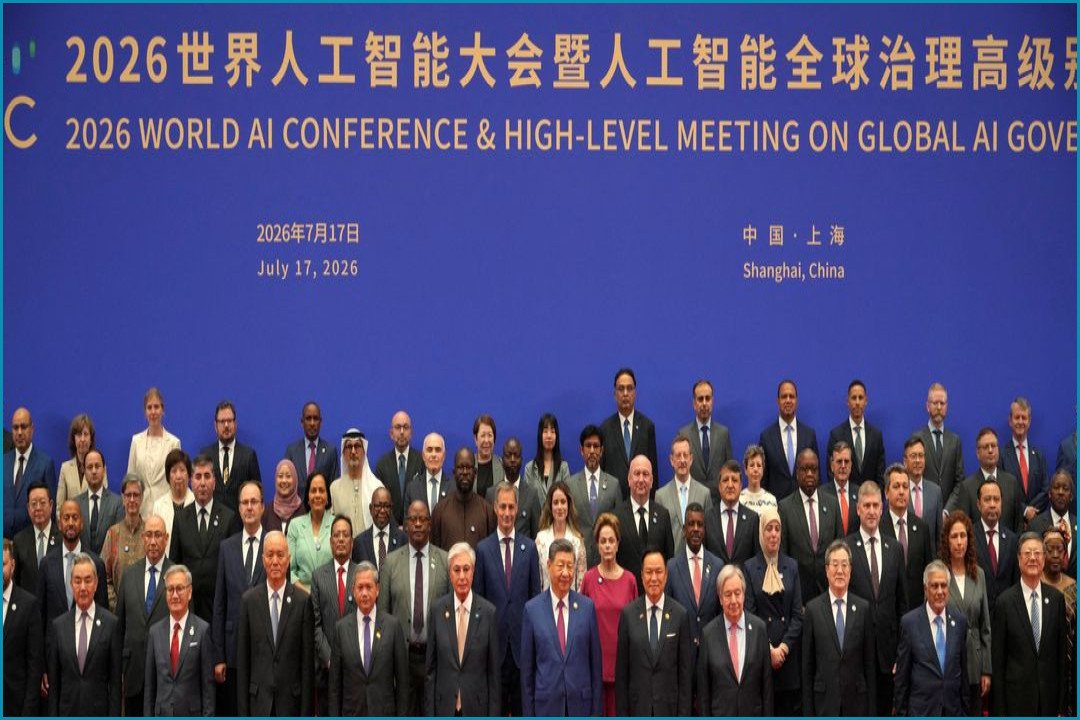
Artificial intelligence should not be dominated by a single country, China's President Xi Jinping has said, urging international cooperation on its development at a major conference in Shanghai. Speaking at the opening of the World Artificial Intelligence Conference (WAIC) on Friday, Xi stated that AI development should not be a solo performance by a single country, but rather a symphony of international cooperation. He further urged the global community to jointly oppose overstretching the national security concept in the field of AI or placing one country's security over that of others.
The four-day WAIC event draws more than 1,000 of China's tech firms together with officials, researchers, and industry figures. Approximately 3,000 products are currently on display, ranging from powerful semiconductor systems for AI computing to a smartphone that can autonomously operate apps. As the industry gathers, eyes are focused on Xi's vision for how the world should handle the potential impact of AI on cybersecurity, conflict, jobs, and the global economy. Xi emphasized the need to put in place laws and regulations, technological monitoring, early warning, and emergency response systems to ensure that AI is always under human control, calling for a people-centric approach.
Governance of the booming sector has become a key topic as concerns grow over the deployment of AI in military combat, or its use by hackers and terrorists. In a move toward international coordination, Foreign Minister Wang Yi and representatives from 29 countries, including Russia, Pakistan, and Indonesia, signed an agreement on Thursday to establish an intergovernmental AI cooperation group. The World Artificial Intelligence Cooperation Organization, which will be headquartered in Shanghai, aims to promote consultation and collaboration between members to ensure the healthy and orderly development of AI.
The summit is considered the most important annual event for understanding the direction of China's AI industry, according to Poe Zhao of the analysis publication Hello China Tech. While the United States retains a clear lead in advanced chips, frontier computing infrastructure, and the most capital-intensive model development, Zhao noted that China is its closest and most comprehensive competitor. Chinese AI models are catching up to the most powerful US offerings while attracting global users with lower costs. A growing number of companies abroad, such as Siemens, are adopting Chinese open-source AI models, attracted by their performance, lower cost, and ability to customize, in contrast to the closed systems of US giants like OpenAI and Anthropic.
Other highlights at this year's WAIC include MiniMax's M3 model, the first mass-produced phone equipped with an autonomous AI agent, and Huawei's Atlas 950 supernode, an AI architecture for learning and reasoning. Additionally, the Beijing-based startup Moonshot AI released a powerful new flagship model, Kimi K3, whose performance could reportedly rival some of the best US offerings. AI has become a strategic pillar of China's industrial policy, with daily consumption of tokens increasing a thousandfold over the past two years. The Chinese market was valued at $177 billion and is expected to grow more than 30 percent this year. Furthermore, China has more patent filings for generative AI than any other country, with the World Intellectual Property Organisation recording more than 43,000 such filings between 2024 and 2025.