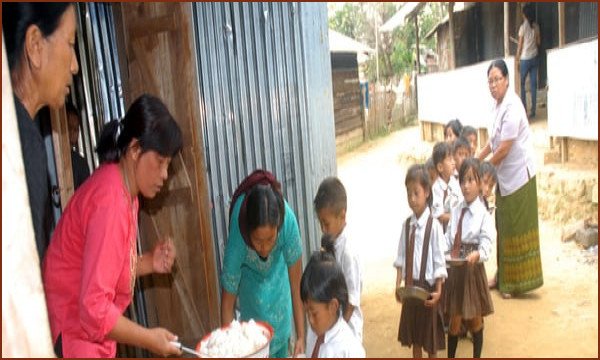
A significant controversy has emerged in West Bengal following the decision by the newly elected Bharatiya Janata Party (BJP) government to remove eggs from the state's midday meal program in Kolkata. This government-run scheme is critical for providing free lunches to students, serving as an essential tool in combating malnutrition among children in India. Given that eggs are widely recognized as an affordable and effective source of protein for growing children, the move has drawn considerable attention.
As part of its policy shift, the government proposed that the International Society for Krishna Consciousness (ISKCON), a Vaishnavite organization that advocates for a strictly vegetarian diet, take over meal preparation for these schools. While ISKCON is noted for its product quality, its catering services do not accommodate the inclusion of eggs or meat. This reflects the broader influence of sattvic dietary traditions, which are upheld by many Hindu, Jain, and Buddhist groups. These traditions emphasize avoiding meat and eggs—which are sometimes compared to consuming embryos—to promote mental clarity and peace. Dietary habits in India often correlate with specific jatis, or caste groups, with more prestigious groups traditionally favoring vegetarianism, despite the fact that 96 percent of the population in Kolkata identifies as non-vegetarian.
The debate extends beyond simple religious preference. While other Indian states like Karnataka and Bihar successfully offer both egg and eggless meal options, and West Bengal is currently considering a model similar to Odisha where schools might procure eggs via additional funding, the core of the issue lies in the tension between traditional social units and the modern public sphere. For many supporters of the egg ban, the primary concern is not just about individual choice, but about preventing students from drifting away from their family's cultural and dietary norms. The public sphere—including schools, malls, and restaurants—is increasingly viewed as a space where such traditional customs are challenged by the mixing of diverse communities.
This friction mirrors other societal debates in India, such as the recent discourse surrounding endogamy and marriage, which was triggered by a high-profile criminal case in Maharashtra. These controversies highlight the ongoing struggle to define a modern polity within a society comprised of thousands of distinct communities. As India continues to integrate into a globalized market economy, the premise that individuals should have the freedom to make personal choices in the public sphere—whether regarding their diet or their marriage—frequently clashes with the traditional values that many seek to preserve. Ultimately, the egg row serves as a microcosm of the larger challenge India faces in balancing the demands of diverse, traditional social structures with the inevitable realities of a modern, democratic society.
You have reached the limit of 2 free articles this month.
For traditional communities seeking to preserve their own distinct customs, schools, colleges, malls, restaurants, bars, cafés, and even offices and factories — the public sphere — are a potential threat, because these places enable different jatis and communities to interact and mix. Issues such as the egg controversy arise in India because of the tension between the demands and assumptions of traditional social units and the life that entails and the reality of the development of a public sphere, and all the mixing that entails, in contemporary India.