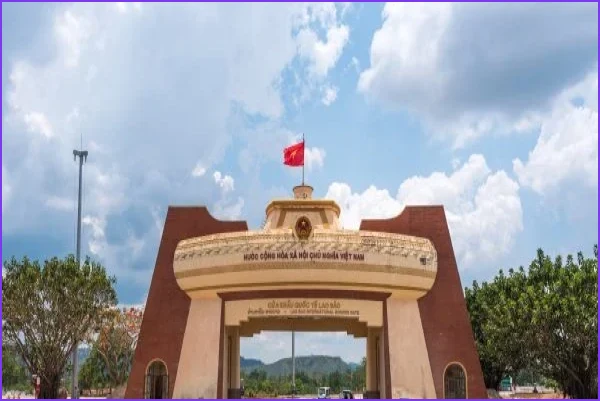
Landlocked Laos is increasingly looking toward Vietnam as a vital counterweight to the economic influence of its massive neighbor, China, in a bid to avoid being paralyzed by mounting debt. Recent data shows that Vietnamese investment in Laos has seen a dramatic rise, nearly quadrupling in the first half of 2026.
According to Vietnam's Ministry of Foreign Affairs, investment in the first quarter reached $582 million, a 4.2-fold increase compared to the same period last year. Cumulative Vietnamese investment has now reached $6.6 billion across 289 projects. Lao officials, speaking at the VIETLAO Expo in Vientiane this July, reported a similar 4.2-fold jump in the first half of the year, with funds primarily directed toward mining, energy, electricity, and agriculture. An earlier count from March indicated that Laos remains Vietnam’s top outbound investment destination among 85 countries.
Trade between the two nations is also expanding. VietnamNet reported a trade turnover of $1.07 billion in the first five months of 2026, with governments aiming for $4 billion by the end of the year and a long-term goal of $10 billion by 2030. Despite the official rhetoric of “great friendship” and “special solidarity” that has characterized the relationship since the mid-1970s, the recent surge in capital is widely viewed as a strategic move by Vientiane to diversify its economic partnerships.
Laos is currently facing a significant debt crisis. The Bertelsmann Transformation Index’s 2026 report estimates the country's public debt at $16.4 billion, or 108 percent of its GDP. With annual debt service projected to exceed $700 million by 2028, experts suggest that Laos will likely require unprecedented debt relief from China, its largest bilateral lender. Research from 9DASHLINE estimates that Laos’s debt exposure to Beijing is approximately $12.2 billion, or about 65 percent of its GDP.
While China has provided partial debt deferrals, the new leadership in Vientiane—installed following the 12th Party Congress in January—has formalized “self-reliance” and partner diversification as official policy. Although Laos cannot realistically disengage from China due to large-scale infrastructure projects like the Laos-China Railway and China Southern Power Grid’s involvement in the national grid, it is actively seeking to avoid becoming a single-supplier economy.
Analysts note that Vietnamese investment functions differently than Chinese capital. Rather than competing for the same multi-billion-dollar infrastructure assets, Vietnamese firms are filling gaps in sectors such as high-value agriculture, hydropower, and mining. At the recent VIETLAO Expo, which featured over 250 booths and 140 companies, Lao officials explicitly encouraged further Vietnamese investment in organic agriculture and deep processing to move beyond simple raw resource extraction.
As Laos prepares for debt restructuring talks later this year, the ability to successfully balance Chinese debt obligations with increased Vietnamese investment may determine whether the country can effectively diversify its economic future and reduce its dependency on a single power.