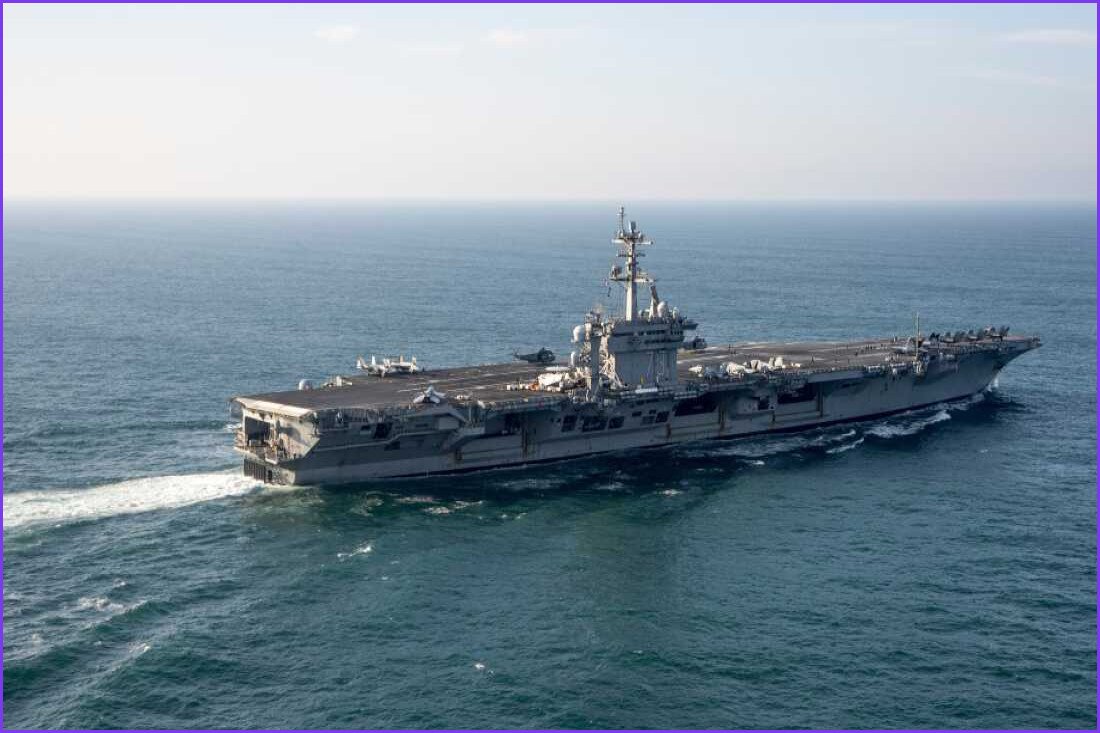
The Pacific-based aircraft carrier USS George Washington has begun its transit toward the Middle East, a strategic shift occurring as reports emerge regarding significant mental health and supply challenges aboard the USS Abraham Lincoln. The Lincoln has been central to U.S. military operations against Iran, having completed a record-setting, uninterrupted deployment of more than 260 days at sea. The move, first reported by The Wall Street Journal, will see the Washington replace the Lincoln as one of two aircraft carriers currently stationed in the Middle East, leaving the Pacific region without a U.S. carrier presence for an unknown period. The Trump administration has characterized China as a "settled force" that requires deterrence rather than the status of a top global adversary, a shift from the previous administration's policy.
A Navy official, speaking on the condition of anonymity, confirmed that the Washington was in the Strait of Malacca, positioning the vessel to enter the Indian Ocean. The carrier, accompanied by a cruiser and a destroyer, departed Da Nang, Vietnam, last week. This deployment comes as the Navy continues to enforce a blockade on Iranian ports within the Strait of Hormuz. Defense Secretary Pete Hegseth stated on Thursday that the U.S. is capable of maintaining this blockade "indefinitely," while also pushing back against criticism regarding the conditions on the Lincoln, which he described as "completely misrepresented."
The Lincoln originally deployed from San Diego on November 21 and reached the Middle East in January, ahead of the February 28 launch of the war against Iran. The Navy acknowledged that the conflict created a "highly contested environment" that disrupted traditional supply hubs. In a statement, the Navy admitted that leadership had to prioritize mission-critical supplies, specifically food, followed by hygiene items, and finally mail. While the Navy now asserts that sailors have access to clean water and healthy meal options, the situation has drawn sharp criticism from Democratic lawmakers.
Connecticut Sen. Richard Blumenthal, a member of the Senate Armed Services Committee, has formally requested information from Navy leadership regarding the impact of the prolonged deployment. Arizona Sen. Ruben Gallego, a Marine Corps veteran, stated on social media that he intends to lead a bipartisan delegation to the ship for an official oversight visit, describing the treatment of the crew as "not just disgusting; it's dangerous." During a recent visit to Panama, Secretary Hegseth expressed his desire to see the Lincoln's crew rotated home as quickly as possible, emphasizing his gratitude for the sailors operating in austere conditions with limited port calls.
Tensions regarding the ship's status were evident during a recent town hall meeting held by acting Navy Secretary Hung Cao for the families of troops aboard the Lincoln. Commanders of the Navy's air and surface forces promised to prioritize relief for the carrier. Although the Navy previously labeled reports of food shortages as "false" back in April, concerns have since shifted to the mental health of the crew. The Navy stated it has "not observed an increase in suicidal ideations or attempts aboard the ship," though it declined to provide specific data, citing patient privacy and operational security. A Navy official confirmed that a sailor went overboard in early August but was quickly recovered and transferred off the ship for medical care; the official did not clarify if the incident was a suicide attempt.
U.S. Central Command defended the morale and status of the crew, noting on social media that the Abraham Lincoln Carrier Strike Group remains "resilient and resolved" after 260 days at sea, 10,000 aircraft flights, and the expenditure of 1.5 million pounds of ordnance. The current strain on naval assets follows other extended deployments, such as the USS Gerald R. Ford, which returned in mid-May after an 11-month mission—the longest since the Vietnam War. That deployment included a laundry room fire that displaced hundreds of sailors. Similar concerns regarding the demands of battle and the overextension of crews have been noted in previous operations, including those involving the USS Harry S. Truman during its 2024 and 2025 deployments against Houthi rebels in Yemen.
"We make sure that every ship, every crew, every captain has everything we can provide them at every single moment. Some deployments are longer than others, and I have more respect and gratitude for those sailors than anybody. What they do in those high seas in those austere conditions with less port calls — it's incredible."
During its deployment, the Ford experienced a fire in a laundry space that forced the carrier to turn around and return to the Mediterranean Sea for repairs and left hundreds of sailors without places to sleep.